“The two ladies had supper, discussing, as they ate, various aspects of life as lived in the village of St. Mary Mead. Miss Marple commented on the general distrust of the new organist, related the recent scandal about the chemist’s wife, and touched on the hostility between the schoolmistress and the village institute. They then discussed Miss Marple’s and Mrs. McGillicuddy’s gardens.”
— Agatha Christie, 4:50 from Paddington (Miss Marple, #8)
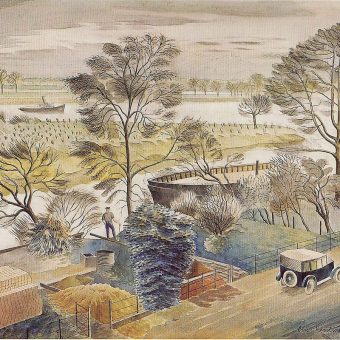
Life in an English Village, published by King Penguin Books in 1949, was illustrated with 16 watercolour plates by Edward Bawden (10 March 1903 – 21 November 1989). The book was number 51 in a series that began in 1939 and ran to issue 76, published 20 years later.
In an article about the Penguin Modern Painters, Allan Lane, who together with his brothers Richard and John Lane founded Penguin Books in 1935, explained the series:
“The aim of the King Penguin is different. These have not been planned to coincide with the public’s growing appreciation of art, but rather to appeal to the general liking for illustrated keepsakes of special projects. For this reason they are specialised … often dealing with by no means broad subjects, such as the History of British Military Uniforms, The Stone Carvings at Southwell Cathedral, Poisonous Fungi and Romney Marsh. The original idea for King Penguins came from the small Insel-Verlag books which were published in Germany before the war. Why, we felt, should there not be a similar series of books in this country? The experiment, started a few weeks after war broke out, turned out to be successful. One of the most distinctive features of this series is their decorative covers.”
The series was first edited by Elizabeth Senior (29 June 1910 – 11 May 1941), who was Assistant Keeper, Prints and Drawings at the British Museum. An historian with a background in art, she became the editor of King Penguins at the age of 29. She was killed by a bomb during the Blitz in May 1941, while still just 30 years old.
She was succeeded by Nikolaus Pevsner (30 January 1902 – 18 August 1983), the German-born Jewish writer best known for his monumental 46-volume series of county-by-county guides, The Buildings of England (1951–1974). He remained with the series till its conclusion in 1959.


English artist Edward Bawden lived in Great Bardfield near Braintree, and in Saffron Walden, and was one of 30 people appointed by the War Artists’ Advisory Committee during World War Two.
Bawden had a long career that saw him excel as a graphic designer, illustrator, printmaker, watercolourist and portraitist. He was at the Royal College of Art school with Barbara Hepworth and Henry Moore, and studied under Paul Nash. Bawden’s friendship with Eric Ravilious is well documented. Nash who tutored both Bawden and Ravilious, described the pair as “an extraordinary outburst of talent”.
Like Ravilious, Bawden was selected as an official war artist during the War, which allowed him to travel widely in East Africa. His portraits of Italian and Ethiopian military leaders and personnel were amongst his first attempts at portraiture, and deal sensitively and boldly with their subject matter.
Modest to the last, he claimed not to be an artist, but only to make “dirty marks on paper”.
Would you like to support Flashbak?
Please consider making a donation to our site. We don't want to rely on ads to bring you the best of visual culture. You can also support us by signing up to our Mailing List. And you can also follow us on Facebook, Instagram and Twitter. For great art and culture delivered to your door, visit our shop.