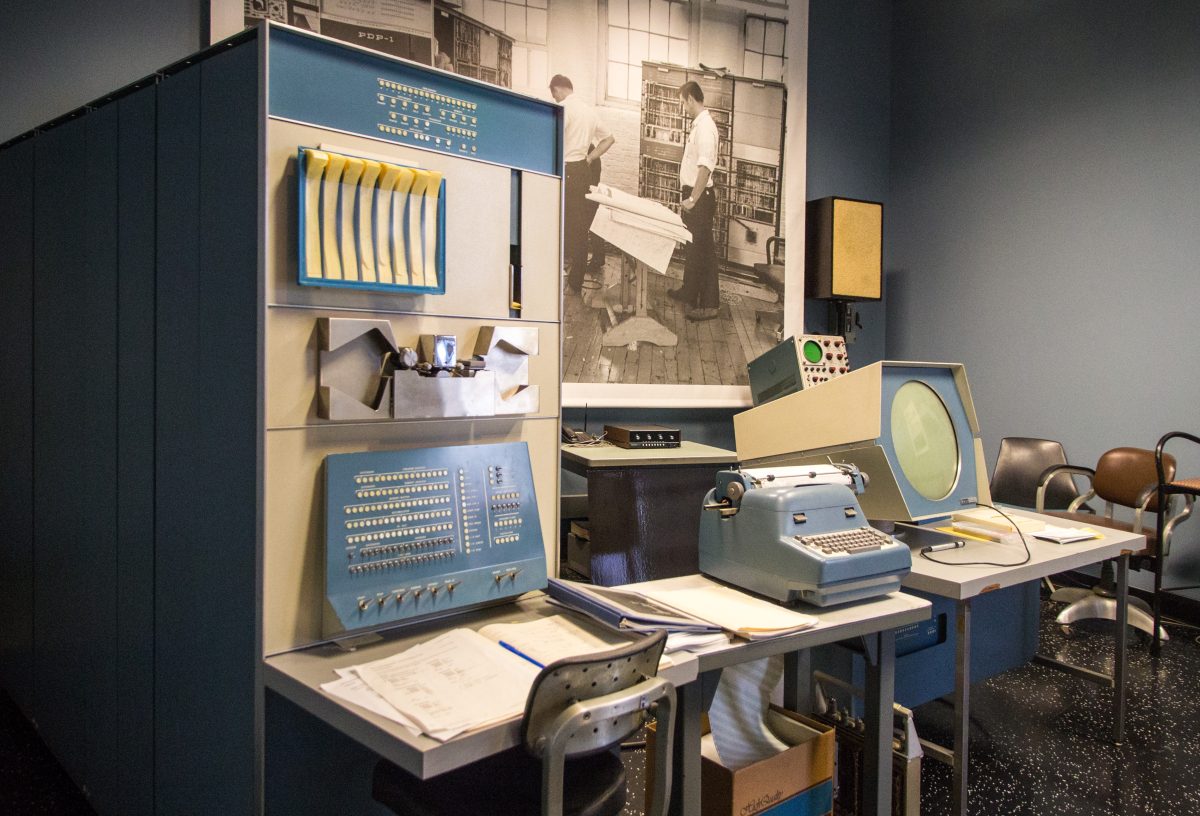
The PDP-1 at the Computer History Museum, Mountain View, California
In the early 1970s, before the first floodtide of digital consumer technology hit the market, sci-fi maven and futurist J.G. Ballard remarked that “even if we can barely tell the difference between a sparking plug and a dipstick, the car is probably the last machine whose basic technology and function we can all understand.”
Ballard’s statement may or may not hold true for you, depending on your level of aptitude with machines. The hackers and gamers whose views have come to dominate contemporary culture heartily disagreed, treating computers as only slightly more sophisticated platforms for modding and customization than small Japanese import cars, for example.
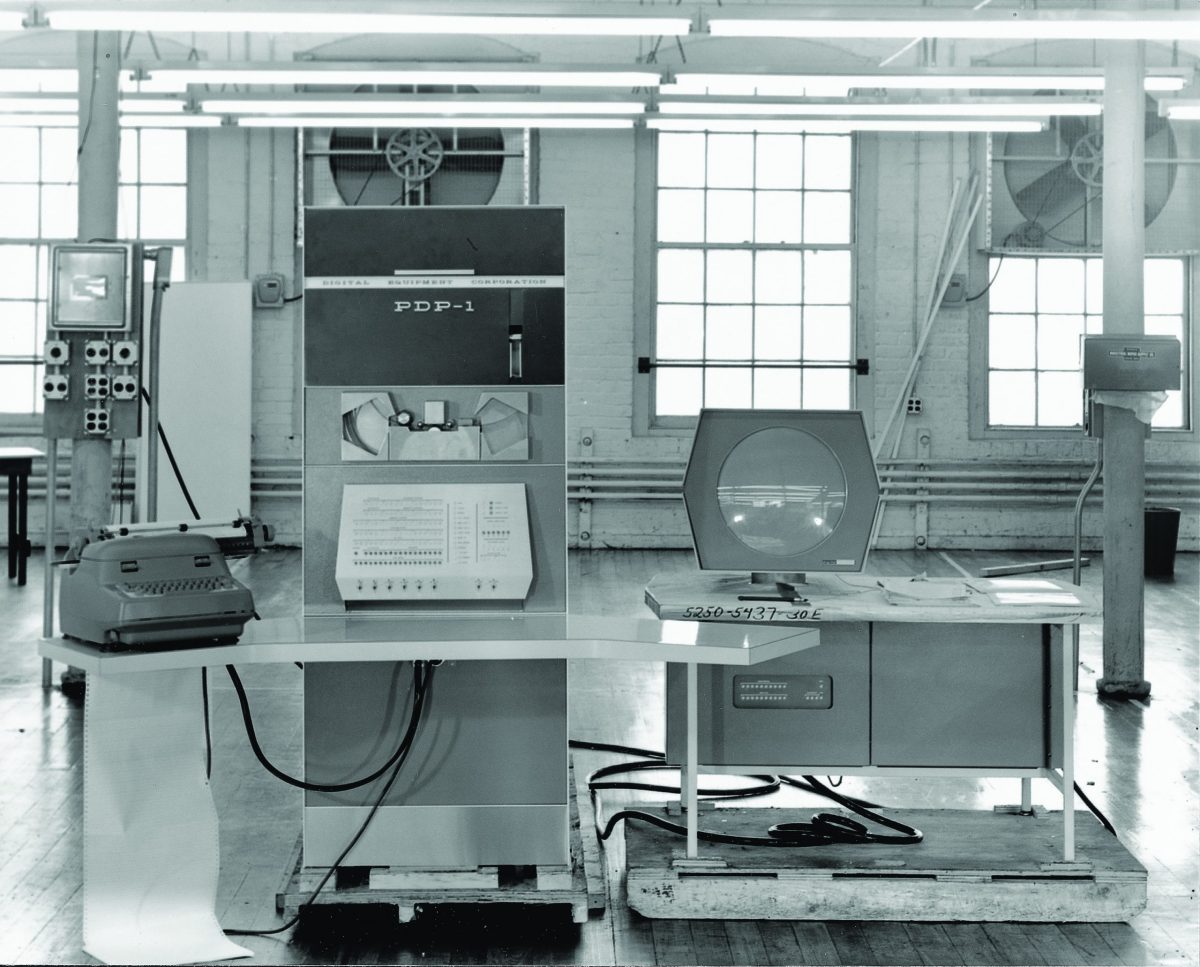
In 1960, one machine hit the market with technology so ridiculously simple it can be summed up as “blinking lights and strips of paper tape.” And yet, the PDP-1, manufactured by Ken Olsen’s Digital Equipment Corporation (DEC), can also credibly be called the first console gaming machine; the originator of modern debugging programs; the first personal computer on the market with a high-definition display; and a very early pioneer of computer art and music.
These are big claims for the PDP-1, a machine sold only 53 units, compared to IBM’s tens of thousands. If you’re waiting for, “but wait, there’s more…,” there is: the PDP-1, developed by research scientists and primarily purchased and used by research scientists, also orginated hacker culture, formulated the first principles upon which would be built today’s fortunes and empires. But the culture of the time showed few aspirations toward unenlightened techo-despotism and world domination.
At the close of the 1950s, techno-optimism reigned, and the worlds of high finance and computing operated far more independently. When engineers at DEC wanted to build their computer, venture capitalists at the firm said, “‘Don’t do computers; it’s not a good idea.’ So when they built the computer, they called it not a computer, but a PDP – a Programmed Data Processor.”
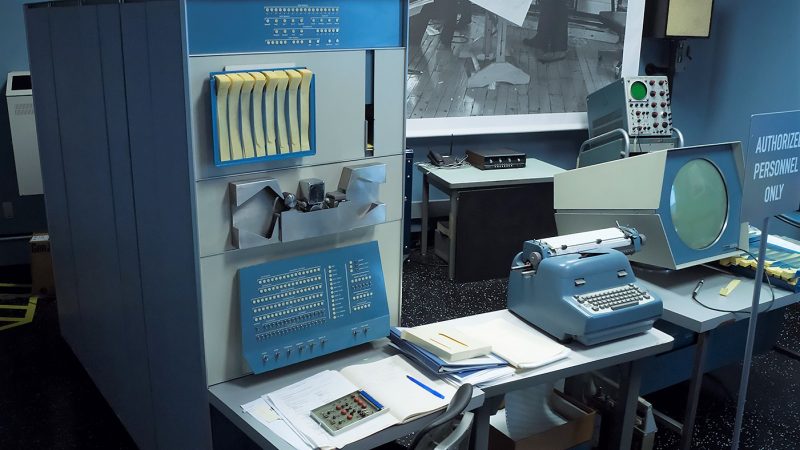
Computer scientist Lyle Bickley chuckles as he gives this short history at the Computer History Museum. Bickley knows the machine inside and out, having worked on the years-long restoration of an original PDP-1, now housed at the CHM in Mountain View, California. Behind its robin’s-egg blue and white exterior, the PDP-1 housed 4K words of 18-bit memory, upgradable with paged memory to 64K.
The machine included three peripherals: a typewriter for keyboard input and printed output, a paper tape reader to feed data into the machine, and a paper tape punch to store data it produced. Finally, a 1024 x 1024 circular cathode-ray tube display, modified from a radar unit served as another point of interactivity, along with an innovative light pen, and it was this interactivity that set DEC apart from their competitors, they believed.
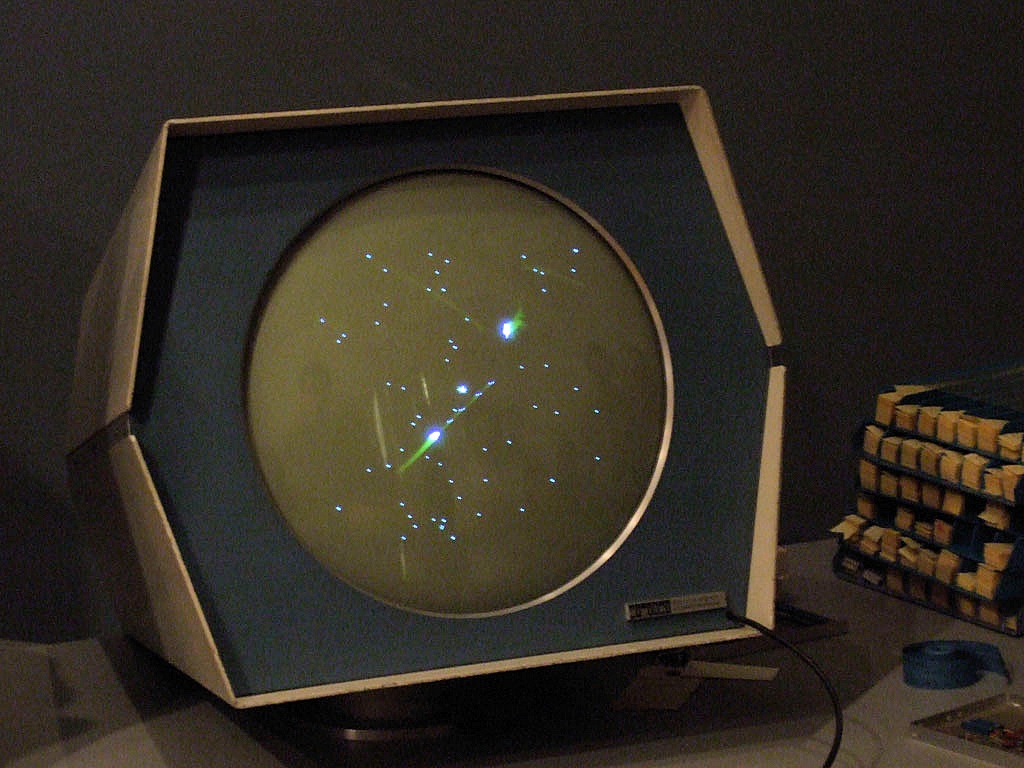

Spacewar!
Produced in “relatively small quantities (about 50),” notes CHM, the PDP-1’s focus on both user interfacing and affordability foreshadowed “an entirely new class of computer: the ‘minicomputer.’” While not mini by our standards, we should keep in mind that at the time computers could take up entire office buildings, with costs to match (somewhat like data centers of today…)
As the world’s first commercial interactive computer, the PDP-1 was also used for process control, scientific research and graphics applications as well as to pioneer timesharing systems. The PDP-1 also made it possible for smaller businesses and laboratories to have access to much more computing power than ever before.
Later iterations of the PDP did not stay quite as “mini” (check out the size of the PDP-5), but the PDP-1 remained a reliable engine of innovation throughout the 1960s. Peter Samson fell in love with the machine as a teenager before joining DEC in 1964 to work on it himself, becoming a computer gaming legend.
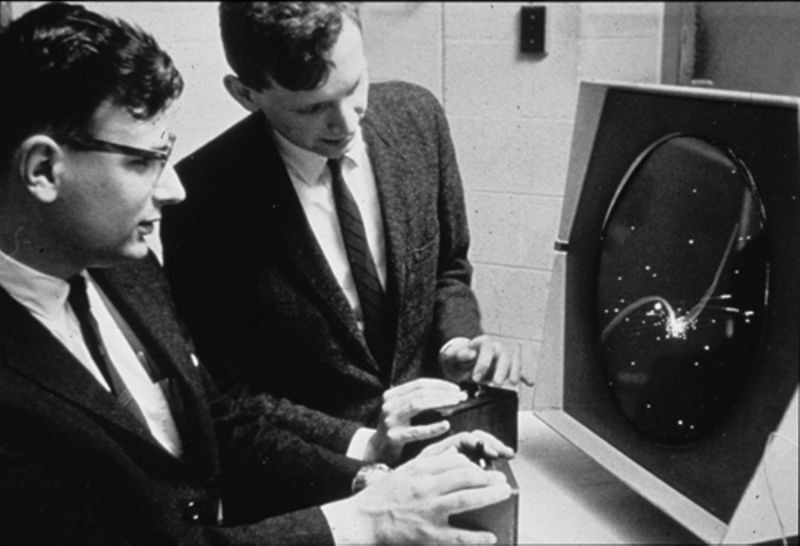
Peter Samson and the first controllers and console game, 1964
Samson helped invent the game Spacewar! for the PDP-1, and can thus rightfully claim to have invented the first console video game. “Is it a stretch to call a $100,000 computer from 1959 a games console?” asks Obsolescence Guaranteed. “No.”
[The PDP-1] is where the computer video game was invented: Spacewar! And it is where games controllers were first introduced. Games are still being written for the machine – hackers still exist.
Peter Samson is still around as well, (see him in action here, demonstrating one of the other incredibly prescient uses of the PDP-1, generating polyphonic digital music, in this case a version of Boards of Canada’s electronic track “Olson,” as programmed by Joe Lynch. The setup may appear comically old-timey, but the results are hypnotic, both aurally and visually, as the PDP-1 uses programmed light banks, and blinks in time to music.)
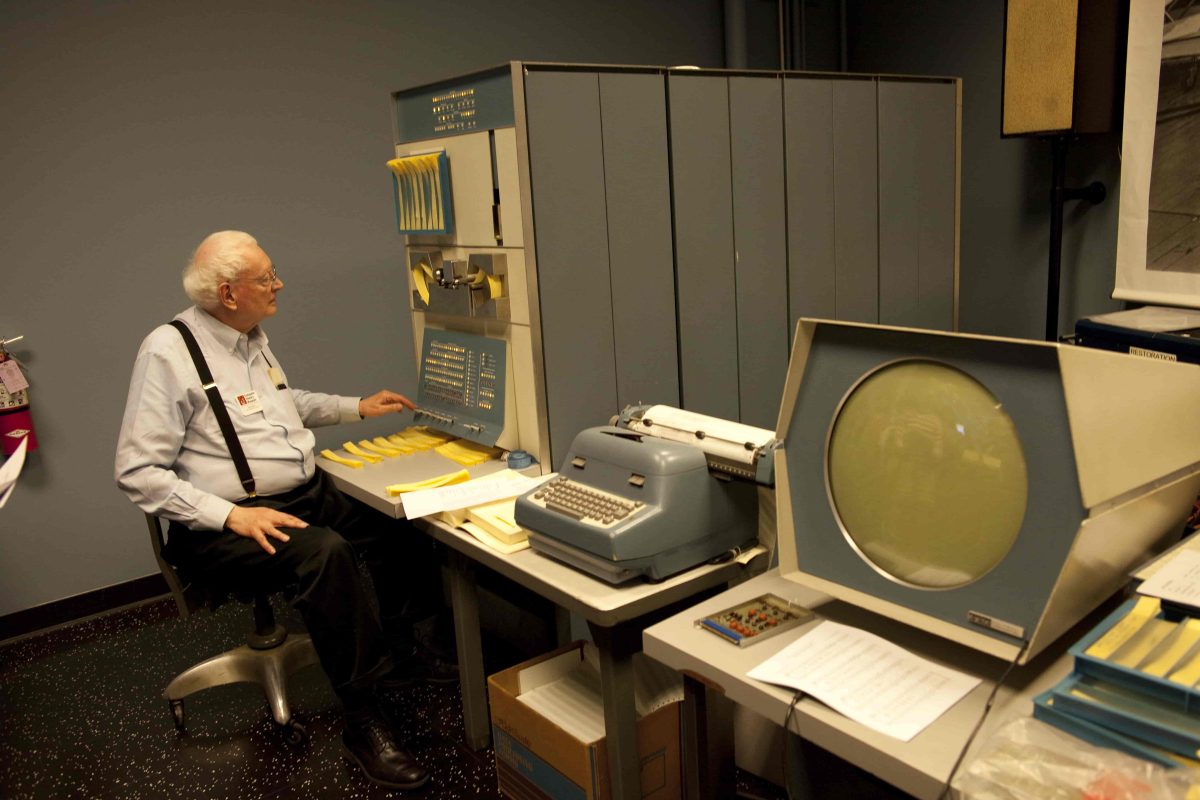

Spacewar! creator Peter Samson and the PDP-1
Known as “blinking lights machines,” says Binkley, machines like the PDP-1 were notable in that “almost every flip-flop in the machine is wired to a light,” allowing operators to “enter programs through the front panel [and] see what’s going on.” Before operating systems with graphical user interfaces, computers were literally hand-operated, each operation step-by-step by the user. The PDP-1 were also hand-wired, each logic board joined carefully by human hands.
Significantly the PDP-1’s light banks are complemented, almost as an afterthought, by a 19-inch circular 1024 by 1024 display, “that’s just crazy,” Binkley says. While graphics capacities were extremely limited at the time, one still-anonymous MIT student wrote several programs like “Snowflake,” a piece of 1959 computer art and one among several that predate Warhol’s Amiga art by over two decades.
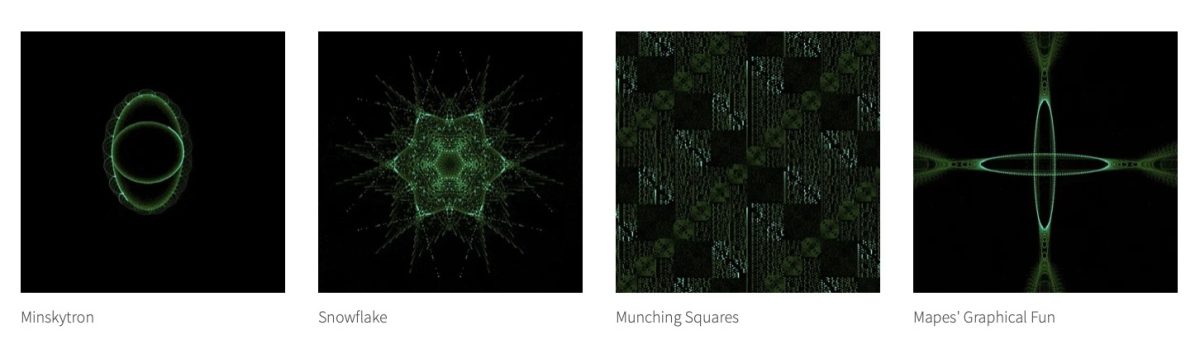
Understandably, fascination with the PDP-1 continues, with digital emulators and physical recreations popping up all over the internet. But the cult of the Programmed Data Processor remains laughably niche next to the church of the computer, even if “chances are pretty good,” as Dan Maloney writes at Hackaday, that you’d find the PDP-1 “at the root” of all true hacker culture.
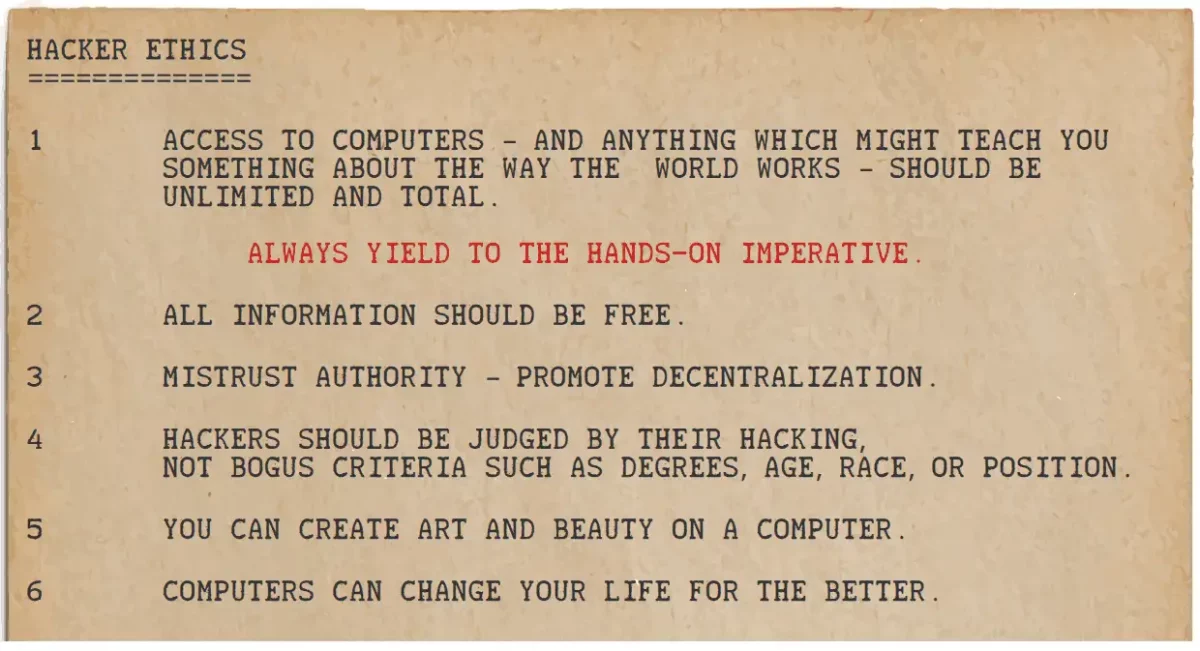
1962 Hacker Ethics, devised by PDP-1 engineers at MIT
Would you like to support Flashbak?
Please consider making a donation to our site. We don't want to rely on ads to bring you the best of visual culture. You can also support us by signing up to our Mailing List. And you can also follow us on Facebook, Instagram and Twitter. For great art and culture delivered to your door, visit our shop.