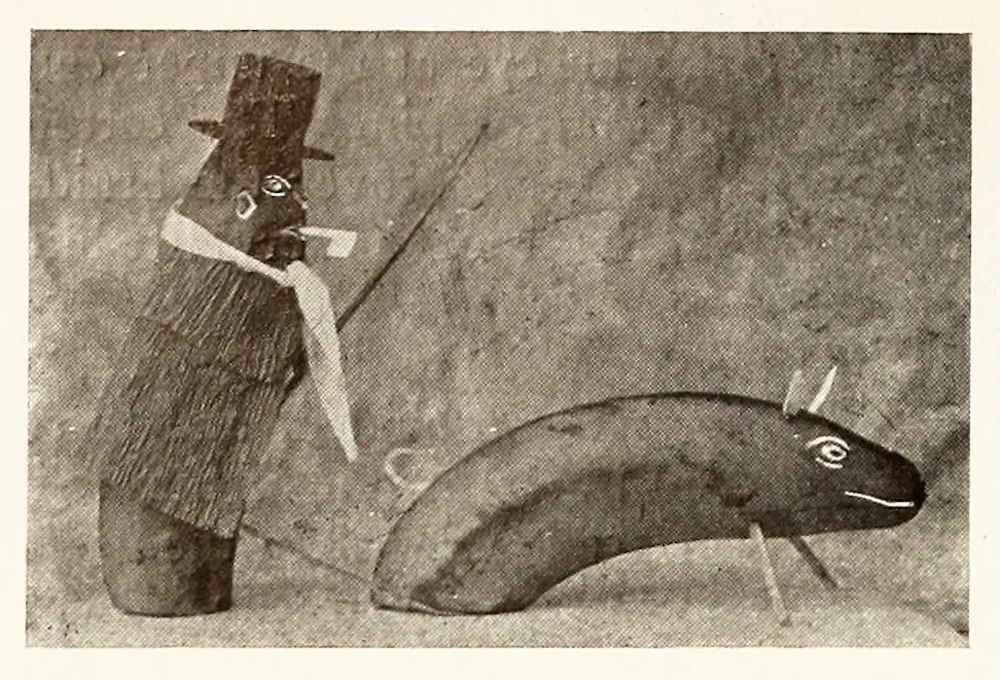
You can recreate Fig. 2 ‘The old Irishman taking his pig to market’ from a article by Percy Collins on quaint dishes for American Homes and Gardens (February 1911) “by the simple expedient of adding broken matches for legs, paper tails and ears, and eyes painted with Chinese white upon the yellow rinds.” Also: bananas.
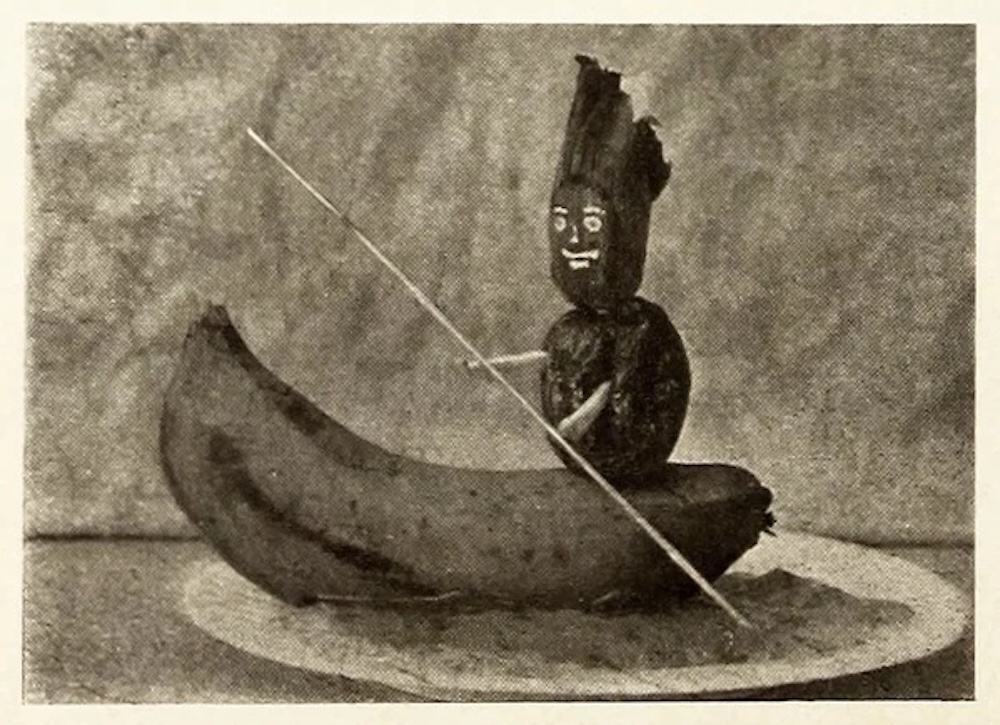
“The Red Indian,” the body… is a good sized Turkey fig. His head is a filbert nut with the outer husk intact; his arms are pieces of almond; while the river upon which his canoe or banana sails is rendered by means of some pale colored jelly.
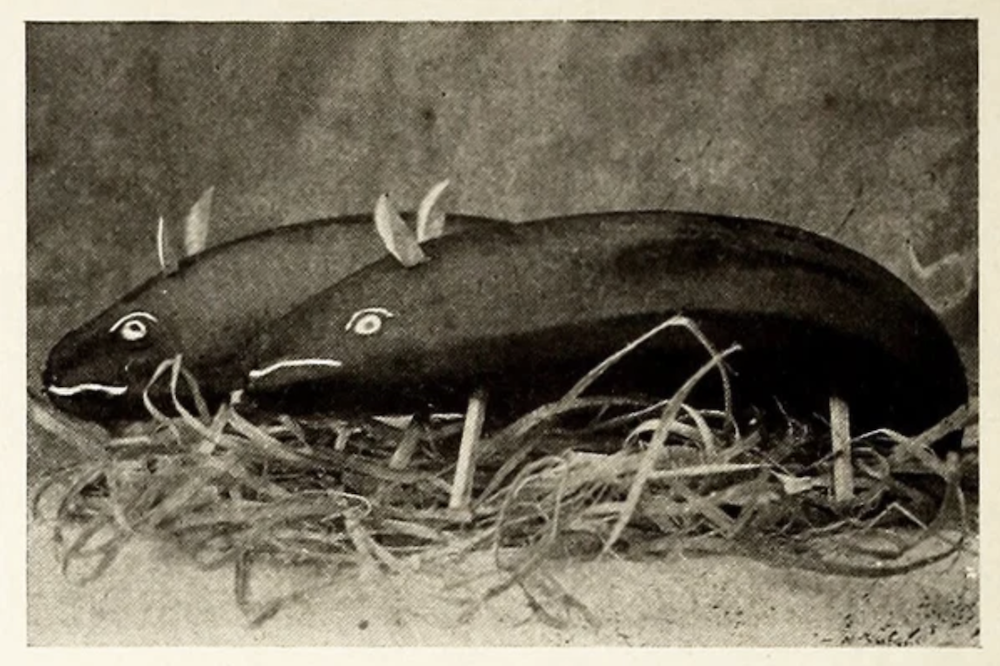
“Banana pigs. The legs are are matches, while the eyes are indicated in icing sugar.”
Let the reader prepare a few such “banana animals” and arrange them upon plates with a little colored paper shaving, and she will be surprised at the wild delight which her handiwork will call forth.
Bananas adapt themselves favorably to this kind of treatment, as several of the accompanying photographs bear witness. The old Irishman taking his pig to market “to pay the rent” is always a great favorite. The manner of rendering the pig has already been described. His master is simply a banana with a small portion sliced off one end so that it will stand erect. A little piece of colored tissue paper makes an admirable cloak, to which may be added a scrap of ribbon to play the part of scarf. The old gentleman’s hat requires a word of special counsel. It is formed from a small cork, gummed upon a circle of cardboard for the brim, the whole being duly blackened.
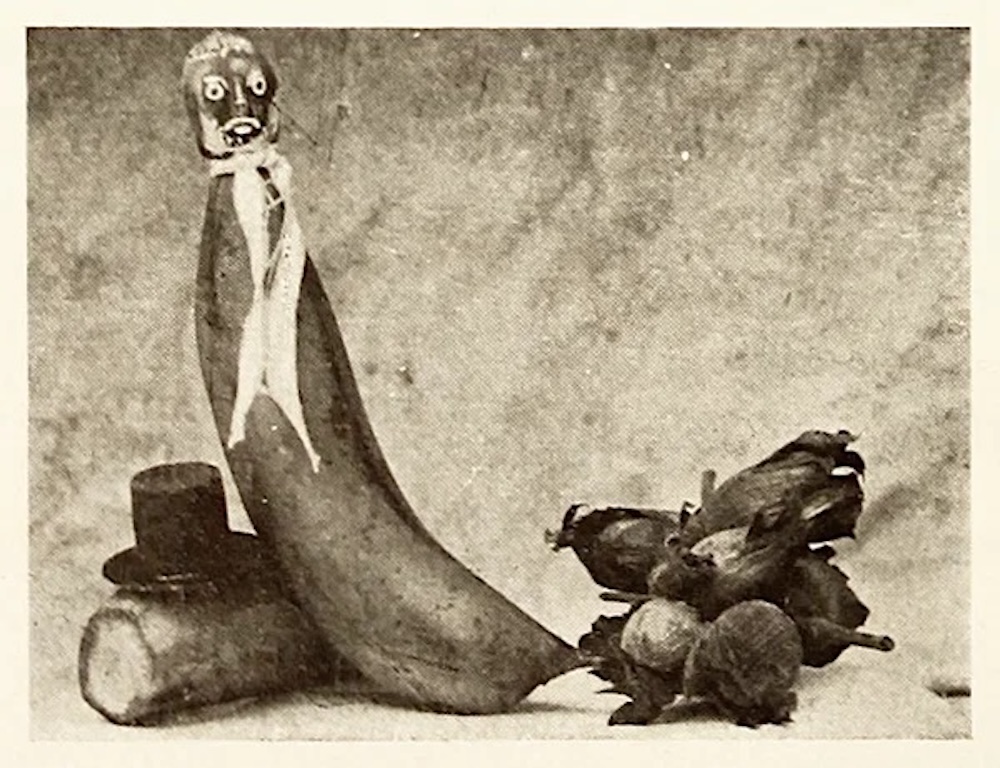

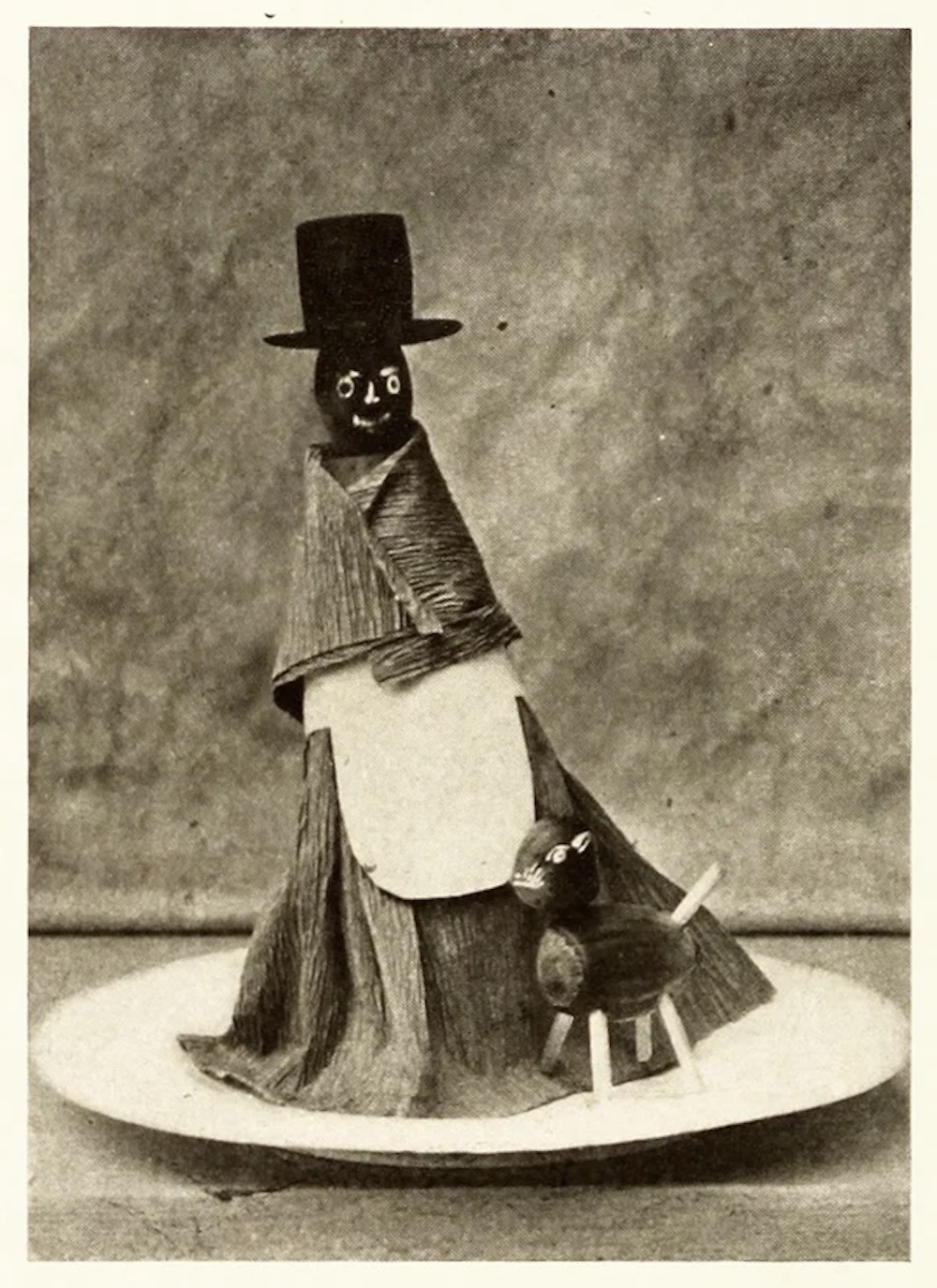
A top-hat is invaluable in the preparation of the Welsh woman and her cat (above), which together make an attractive dish. The lady’s body is simply a banana appropriately garbed in colored tissue paper. Her head is a filbert nut, the crown of which is flattened by means of a penknife in order to support the hat. The cat is also formed of two filbert nuts joined together and supported by pieces of matches. Holes are carefully bored through the shells of the nuts in order that the matches may be accommodated, and when a touch or two of the paint brush has supplied eyes and mouth, a very weird creature results.
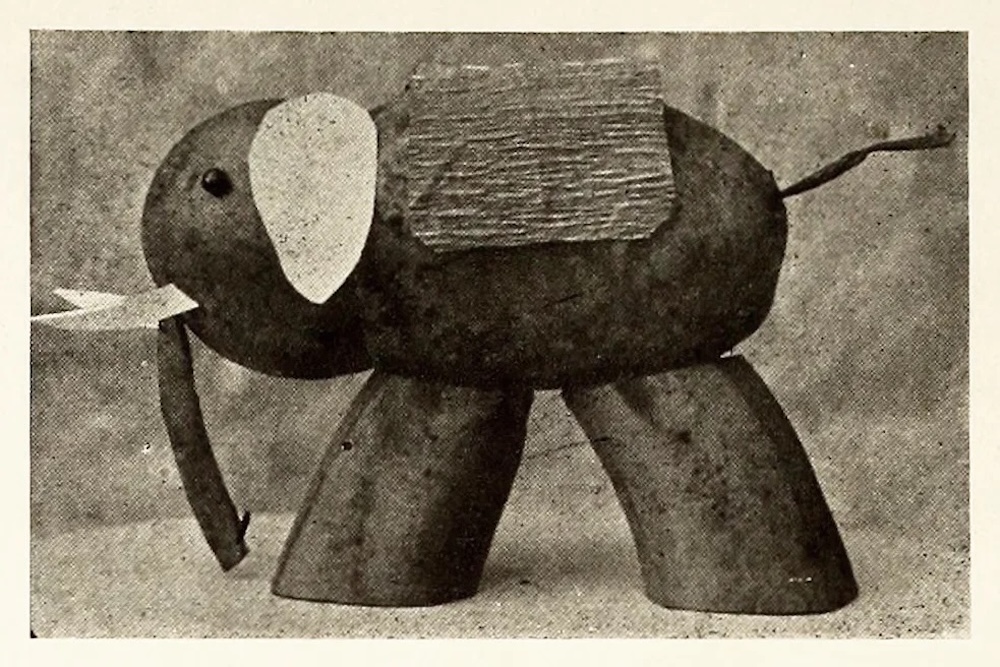

The Elephant is a little more complicated, and calls for a word of special description. His body is a pear, and is joined to the head (a small apple) by means of a little wooden skewer. He is supported upon two pieces of banana, which act as legs; while his trunk is a piece of orange peel. His tail is a straw; his eyes are of glass, purchased at two cents a pair from a neighboring bird-stuffer’s establishment (ordinary glass-headed pins serve the purpose equally well); while his ears and his trappings are of colored paper.
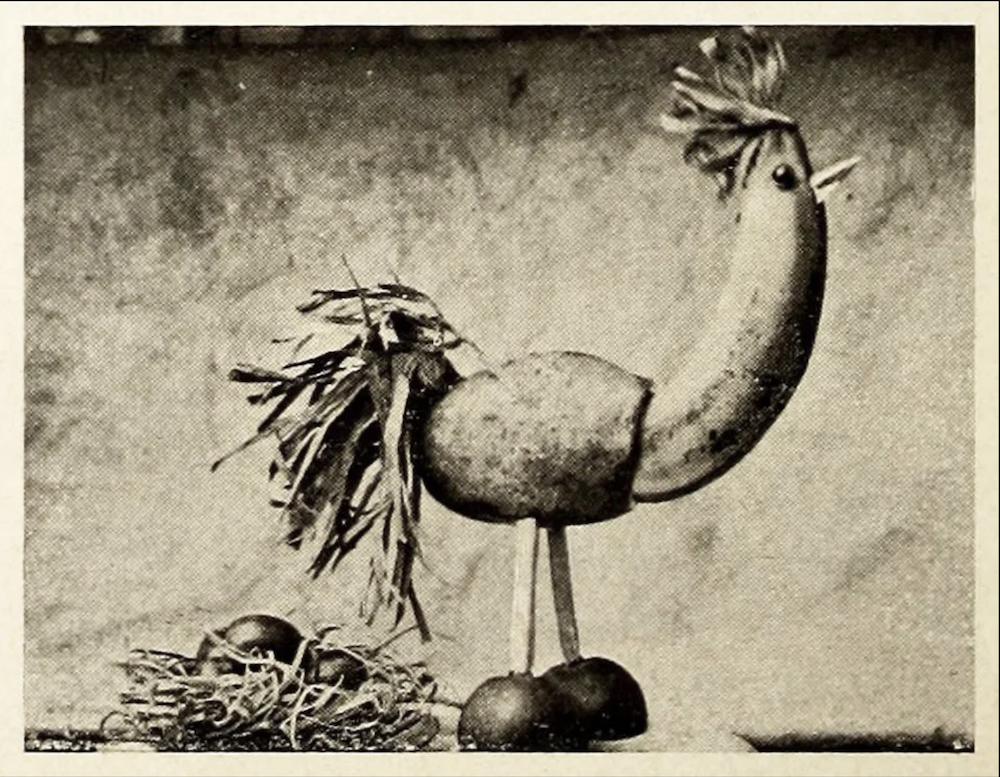
The strange “booby bird” was prepared in a similar manner. The body is a pear, to which, by means of a skewer, is fixed a banana to do duty for the head and the neck. The beak is a piece of bleached almond. The legs are skewers fixed into the upper halves of two small pears. The tail and top-knot are made from colored tissue paper, some of which also does duty for the nest, in which a few grapes (“eggs”) repose.
It is obvious that the few brief descriptions which have been given by no means exhaust the list of possible dishes.
Via: Public Domain Review
Would you like to support Flashbak?
Please consider making a donation to our site. We don't want to rely on ads to bring you the best of visual culture. You can also support us by signing up to our Mailing List. And you can also follow us on Facebook, Instagram and Twitter. For great art and culture delivered to your door, visit our shop.