“I am a traveller and a seeker of true knowledge.”
– Clement Lindley Wragge in conversation with The Promised Messiah, England c. 1917
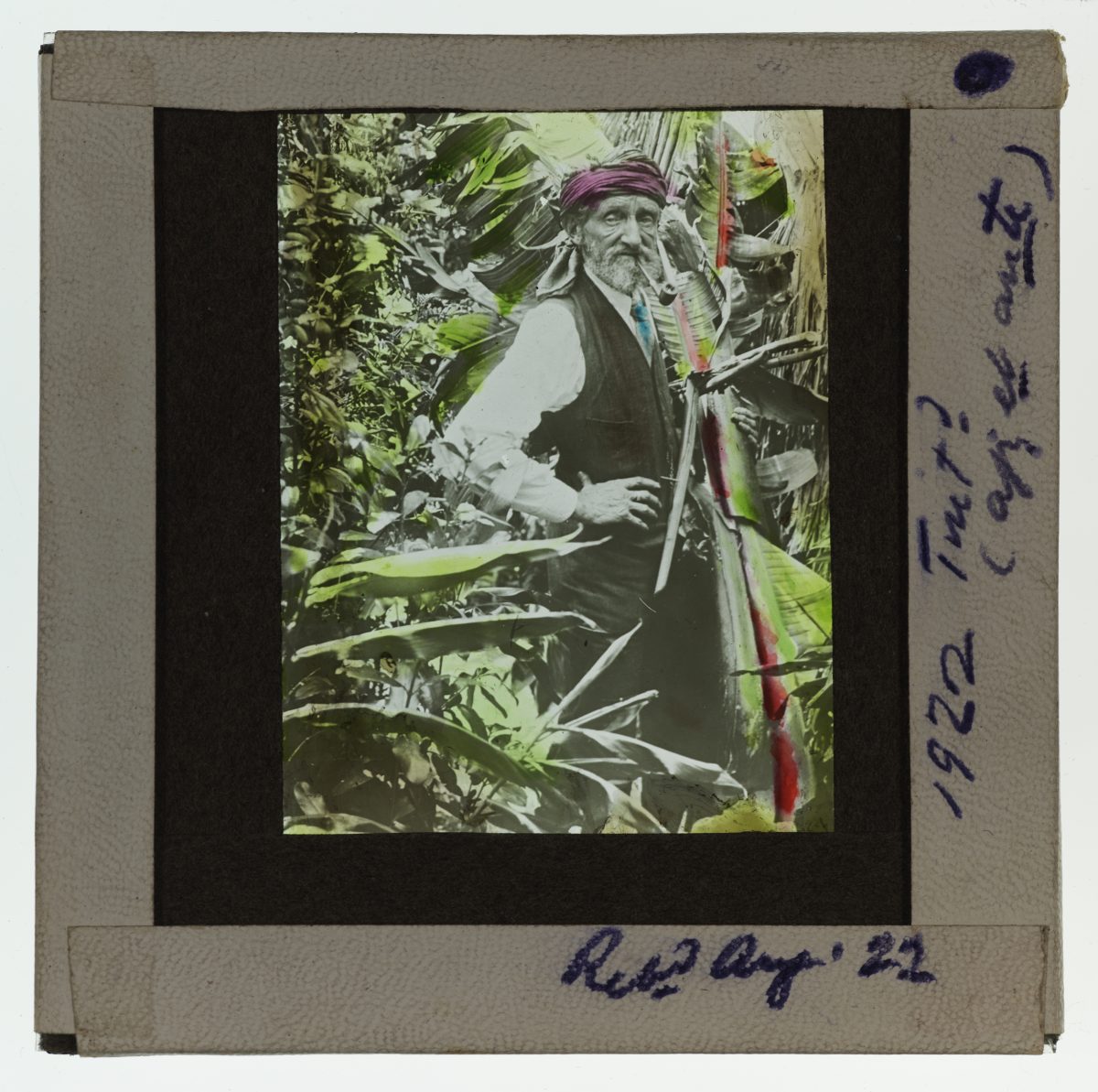
Clement L. Wragge at Waiata Tropical Gardens, 5 April 1905.
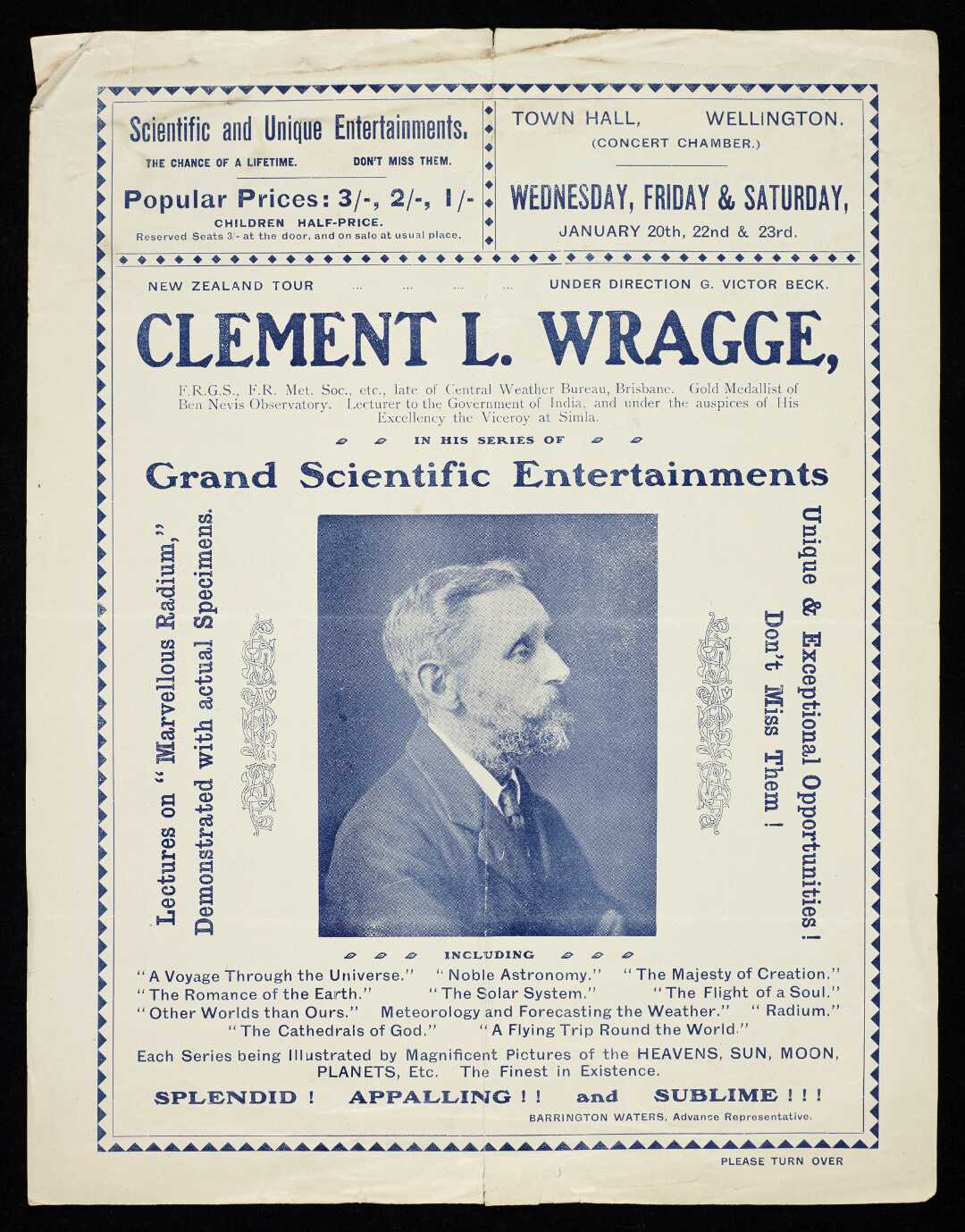
British-born Clement Lindley Wragge (18 September 1852 – 10 December 1922), also known as ‘Old Wragge’ and ‘Inclement Wragge’, was a meteorologist and Theosophist who gave popular magic lantern lectures from 1900 to 1922 in Australia and New Zealand, including: A Voyage through the Universe (1902), The Majesty of Creation (1906), The Grandeur of the Universe (1912), and The Endless Universe and Eternal Life (1918–22).
He started the practice of naming cyclones and created several of his own museums, the last of which in Birkenhead, New Zealand, included a tropical garden called Waiata (see photo above).
His collection of lantern slides takes the viewer on a journey ranging from astronomy and weather to notions of immortality through a sense of divine matter and his belief that radium contained “the radio-active spark of God”.
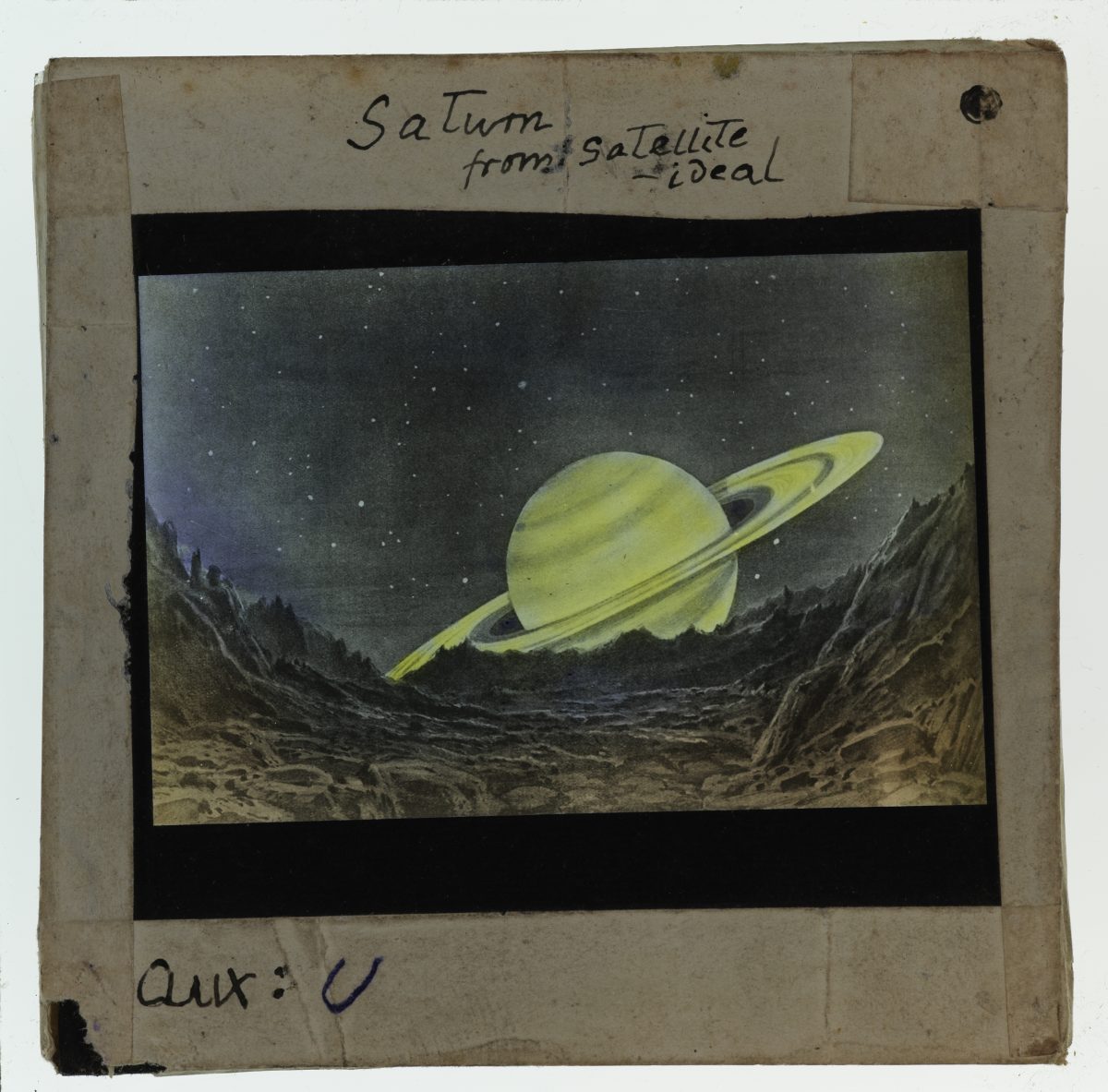
This lantern slide of Saturn relates to a photograph taken by Clement Lindley Wragge (b.1852, d.1922), date unknown.
Clement Lindley Wragge biography
Traveller, spiritualist, weather watcher and ethnographer Clement Lindley Wragge was born in Stourbridge, England. His mother died from complications of childbirth and not long after his father, a lawyer, was fatally injured when he fell from a horse. His grandmother introduced him to cosmology and meteorology. He studied law at London’s Lincoln’s Inn and used an inheritance to travel to North Africa and the Levant.
In 1874, he toured Egypt and Jerusalem, where a meeting with a group of Mormons encouraged him to visit Utah, which he did in 1875, after visits to India, Australia and San Francisco. In Utah he met the Mormon prophet and governor Brigham Young, before heading home.
The Weather Prophet
In 1881, Wragge worked with the Scottish Meteorological Society to establish a weather station on the country’s highest peak, Ben Nevis, 1,345m (4,400ft) above sea level. He scaled the mountain every day for four months – through blizzards, gales, and heavy storms – to record measurements at the summit. The work earned him the nickname The Weather Prophet and the Society’s gold medal in 1882.
Two years later, Wragge and his wife, the scientist Leonora Edith Florence d’Eresby Thornton, set sale fo a new life in Oceania. In Australia and New Zealand, Wragge devoted himself to the study of rain and wind.
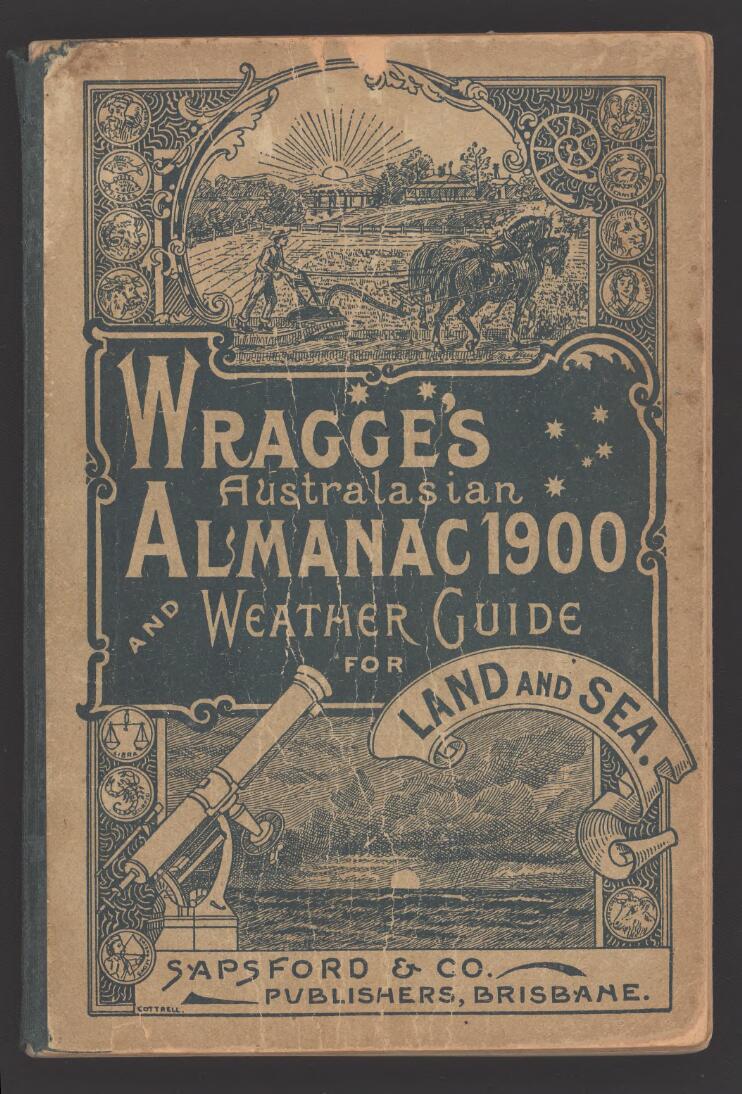
He founded the Royal Meteorological Society of Australasia, crested a number of weather stations and published Wragge’s Australasian Almanac and Weather Guide for Land and Sea (1898 to 1903). He became government meteorologist for Queensland in 1887.

The Mystic Wragge
In 1908, during a tour of India, he met Hazrat Mirza Ghulam Ahmad (1835–1908), the so-called Promised Messiah, who founded the Ahmadiyya messianic movement in Islam. On May 12, 1908, Wragge held an audience with the Promised Messiah in Lahore, stating: “I am a man of science and seek facts only.”
During a 1908 lecture, Wragge defined scientific observation as a form of prayer:
“Instead of going to church, I prefer to go out into the mighty universe and ask God for wisdom. Can we not pray in the open, in the forests, and by the rivers! (showing a picture of the Manawatu River.) Why can’t I pray in the Manawatu River?”
His lectures were peppered with poems and statement of believe, some of which we include below from his collection of lantern slides.
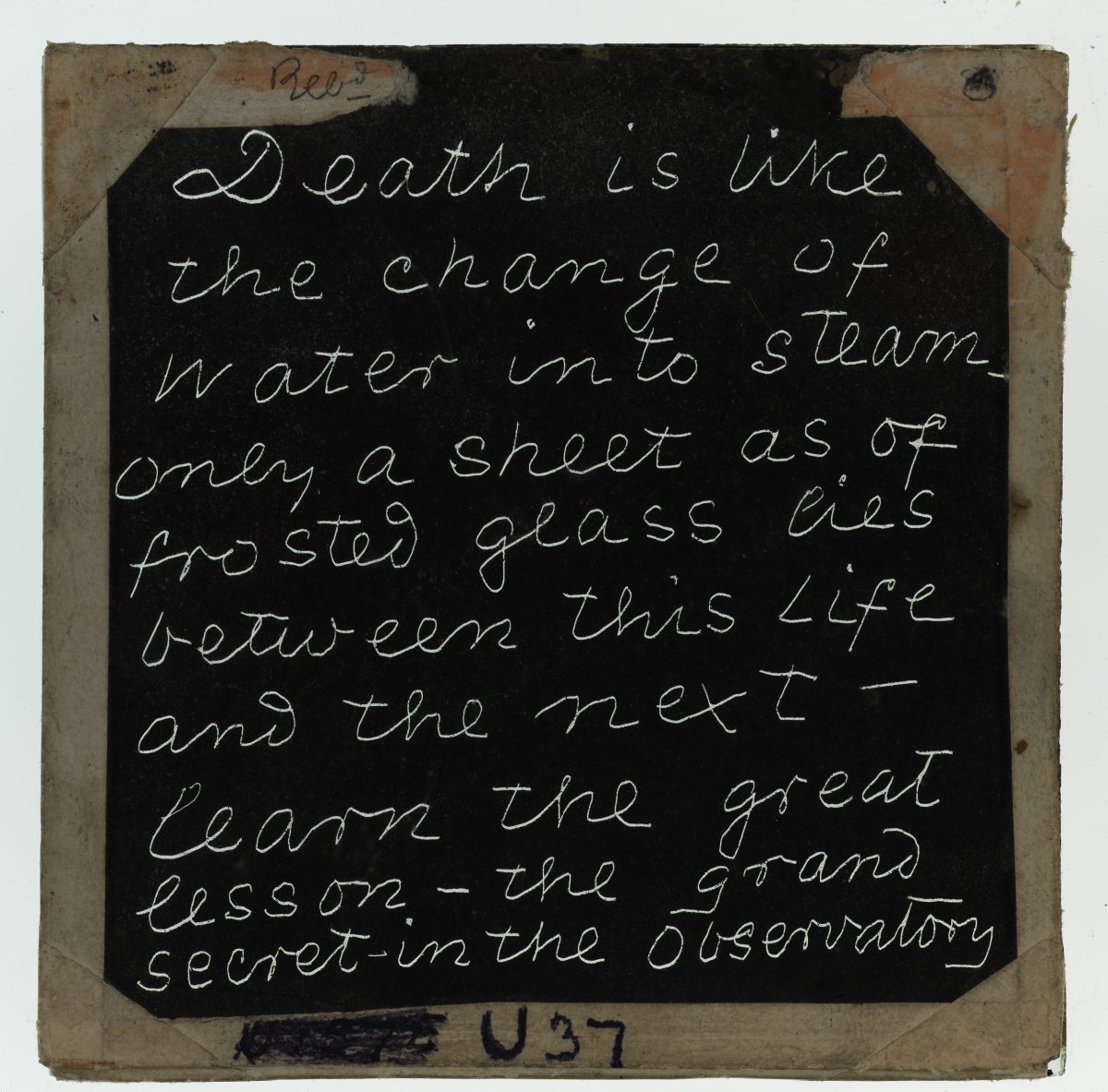
This lantern slide relates to a photograph taken by Clement Lindley Wragge (b.1852, d.1922), likely dating between 1890-1922.
“Death is like the change of water into steam, only a sheet as of frosted glass lies between this life and the next- learn the great lesson-the grand secret- in the observatory”
– Clement Lindley Wragge collection
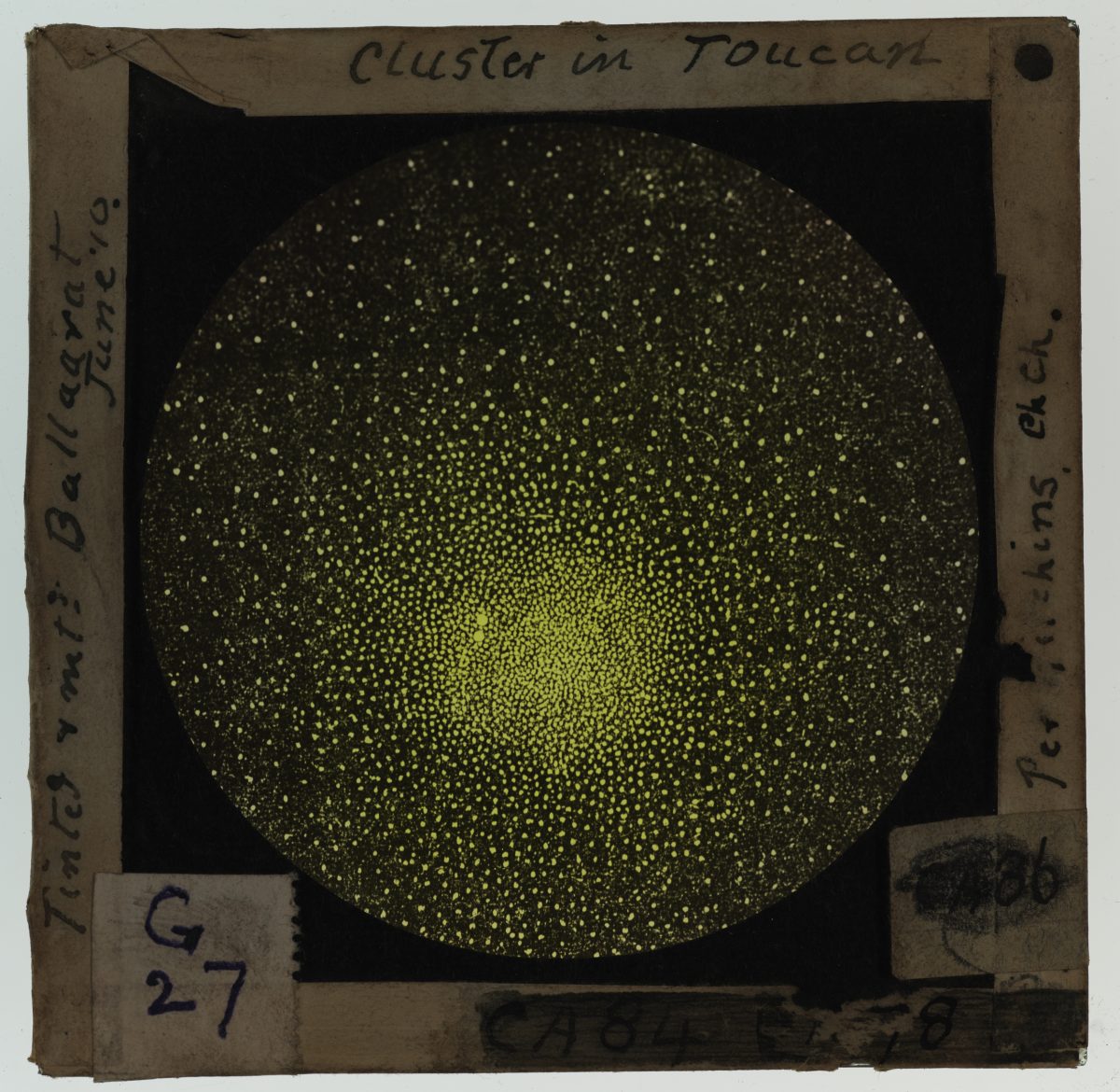

Cluster in Toucan. This lantern slide relates to a photograph taken by Clement Lindley Wragge (b.1852, d.1922), dated 24 March 1905. The slide is a yellow tinted plate, depicting a cluster of stars in space.
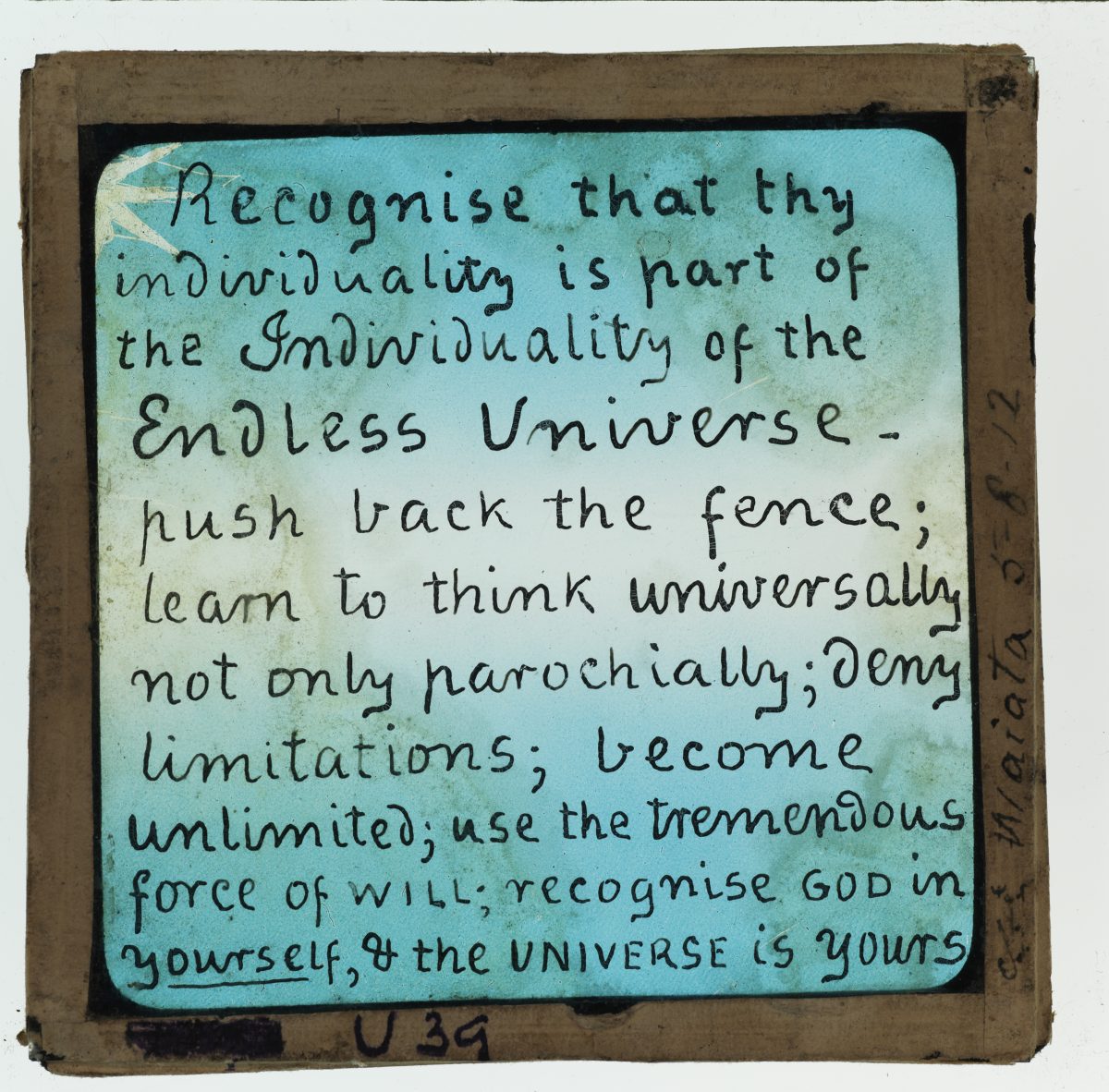
This lantern slide relates to a photograph taken by Clement Lindley Wragge (b.1852, d.1922), dated 5 August 1912.
“Inscription Details: Handwritten on plate, ‘Recognise that thy individuality is part of the Individuality of the Endless Universe push back the fence; learn to think universally not only parochially; deny limitations; become unlimited; use the tremedous force of WILL; recognise GOD in (underlined) yourself, and the UNIVERSE is yours”
– Clement Lindley Wragge
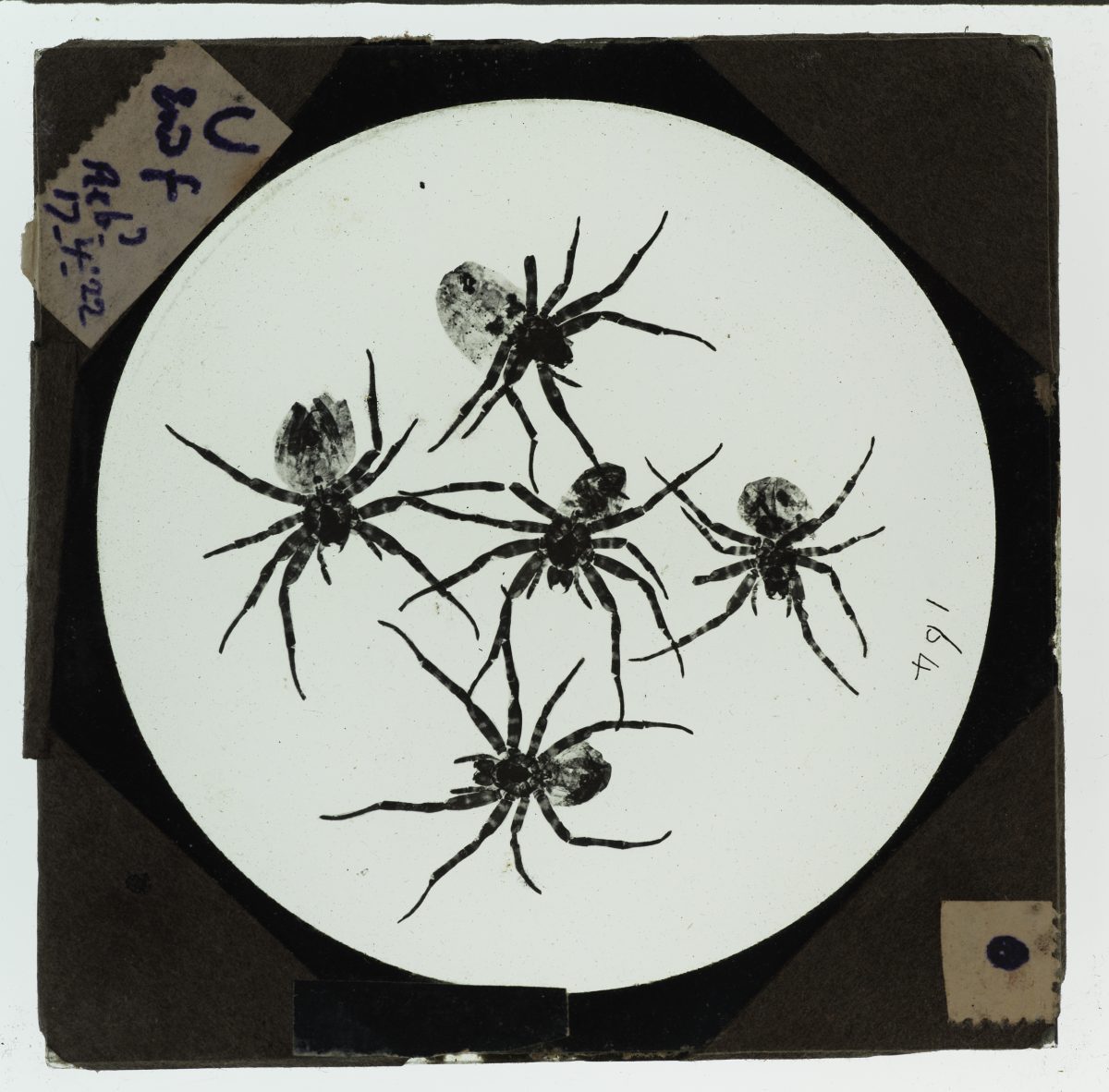
This lantern slide relates to a photograph taken by Clement Lindley Wragge (b.1852, d.1922), date unknown.
The slide is a photo of 5 spiders. One in centre, four surrounding.
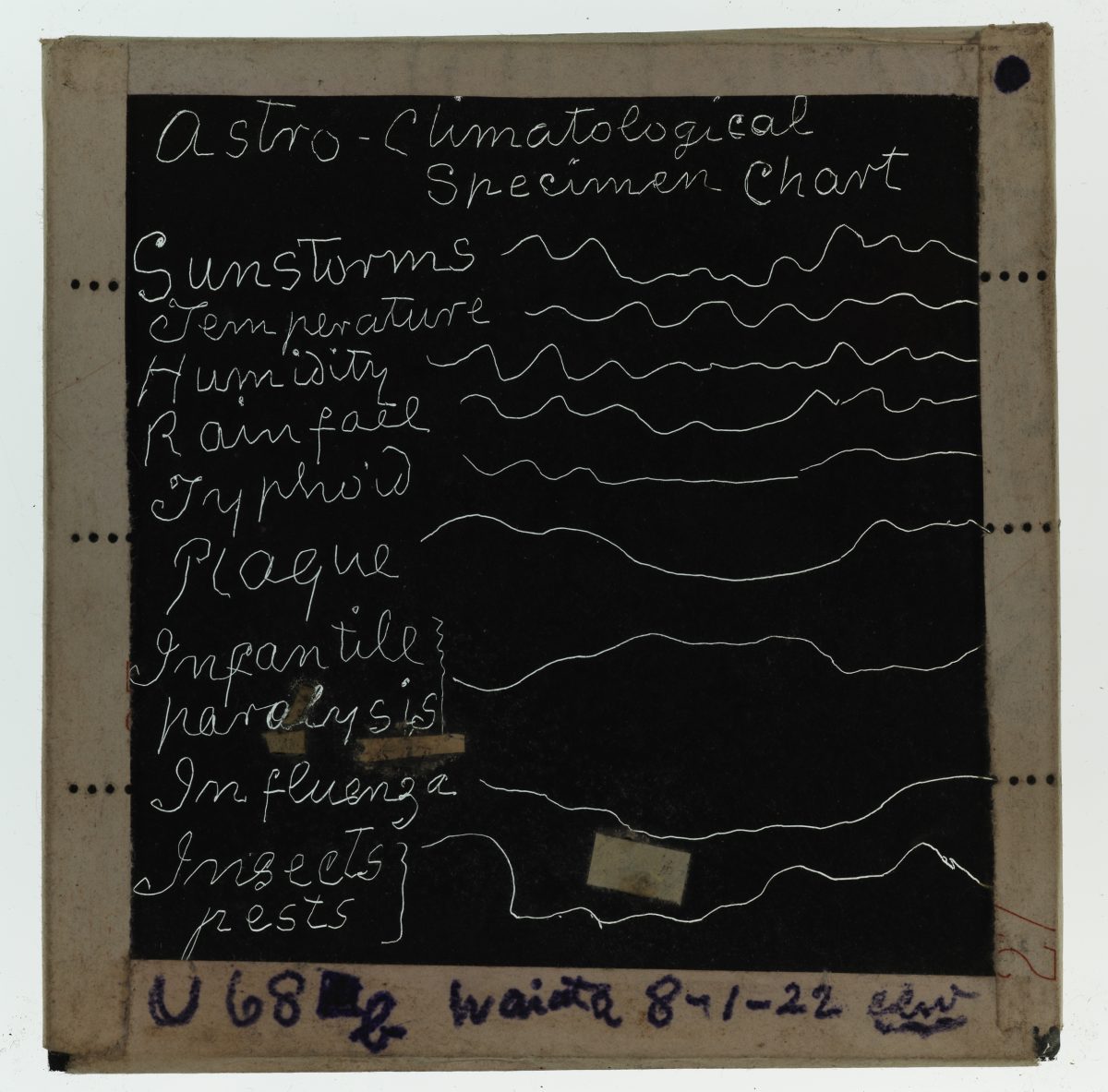
Astro-Climatological Specimen Chart
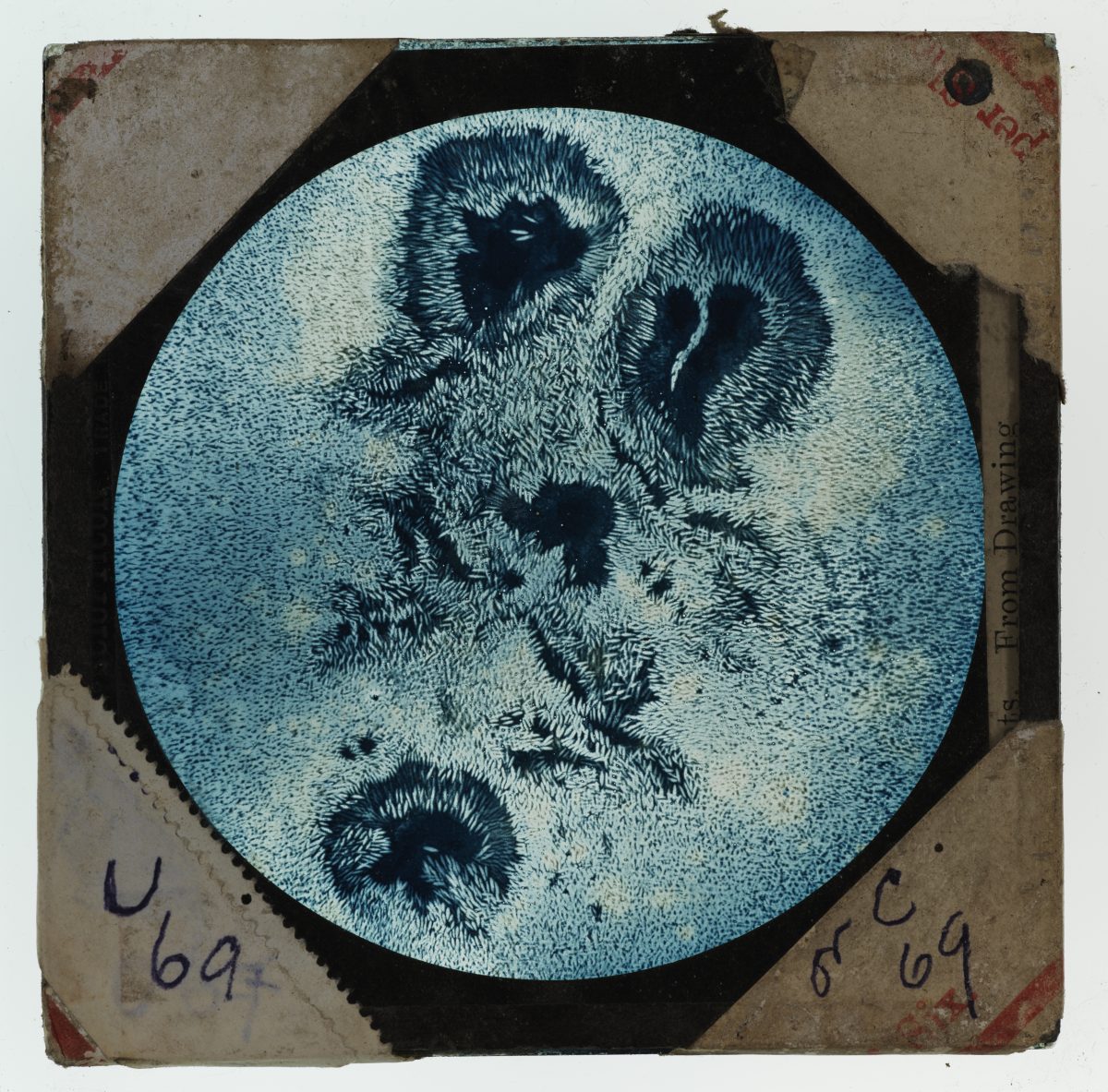
This lantern slide relates to a photograph taken by Clement Lindley Wragge (b.1852, d.1922), date unknown.
The slide shows the circular image of 3-4 dark masses on a textured blue/green surface.
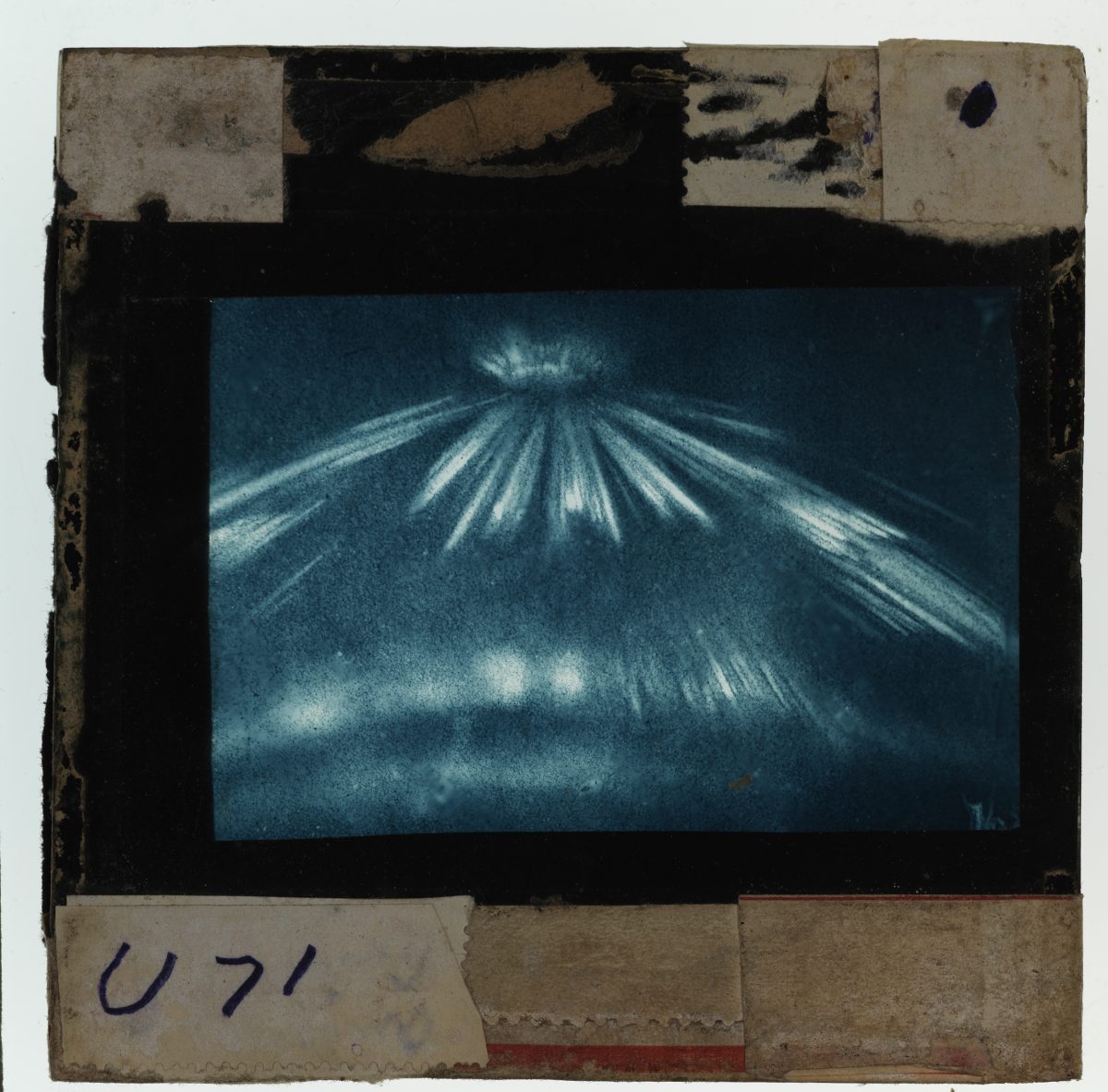
This lantern slide relates to a photograph taken by Clement Lindley Wragge (b.1852, d.1922), likely dating between 1890-1922.
The slide shows blue tinted image depicting rays of light radiating down from a small, oval shaped light source in the top centre of the plate.
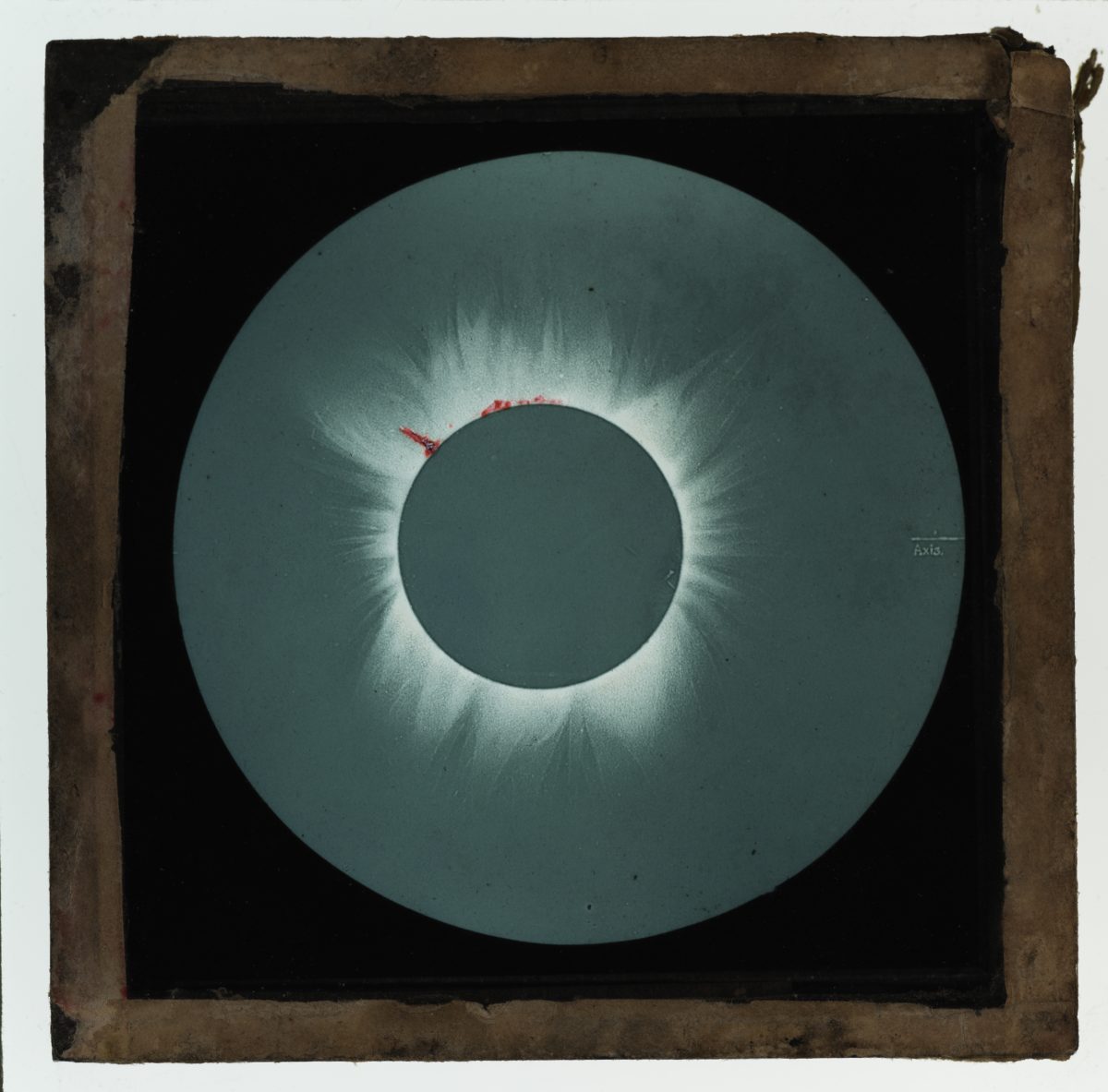
This lantern slide relates to a photograph taken by Clement Lindley Wragge (b.1852, d.1922), dated 8 March 1909.
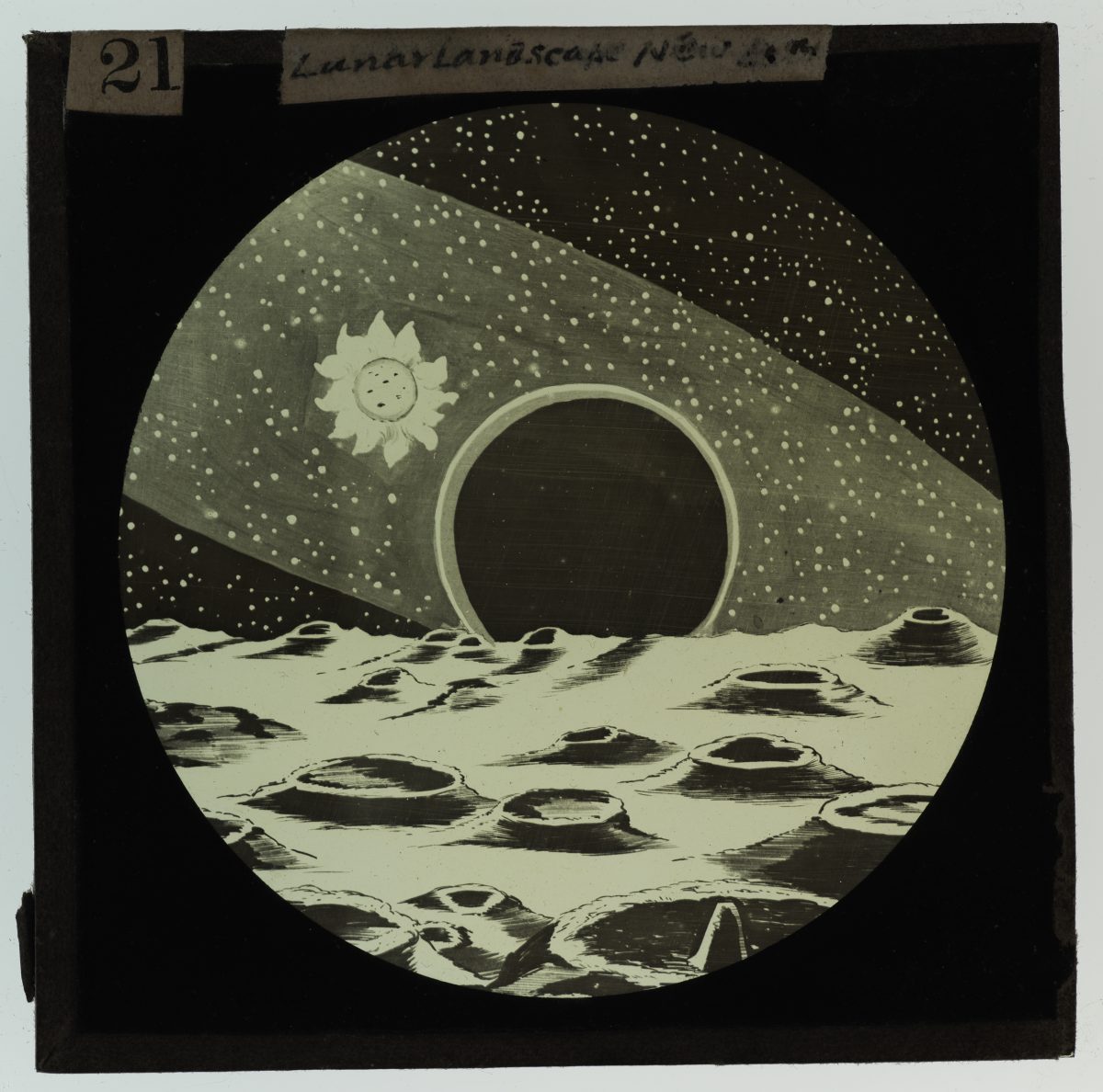
The slide shows a circular image of the moon covering the sun. A dark circle is in the center of the plate with light radiating from behind it. Some red colouring can be seen behind the upper right section of the moon.
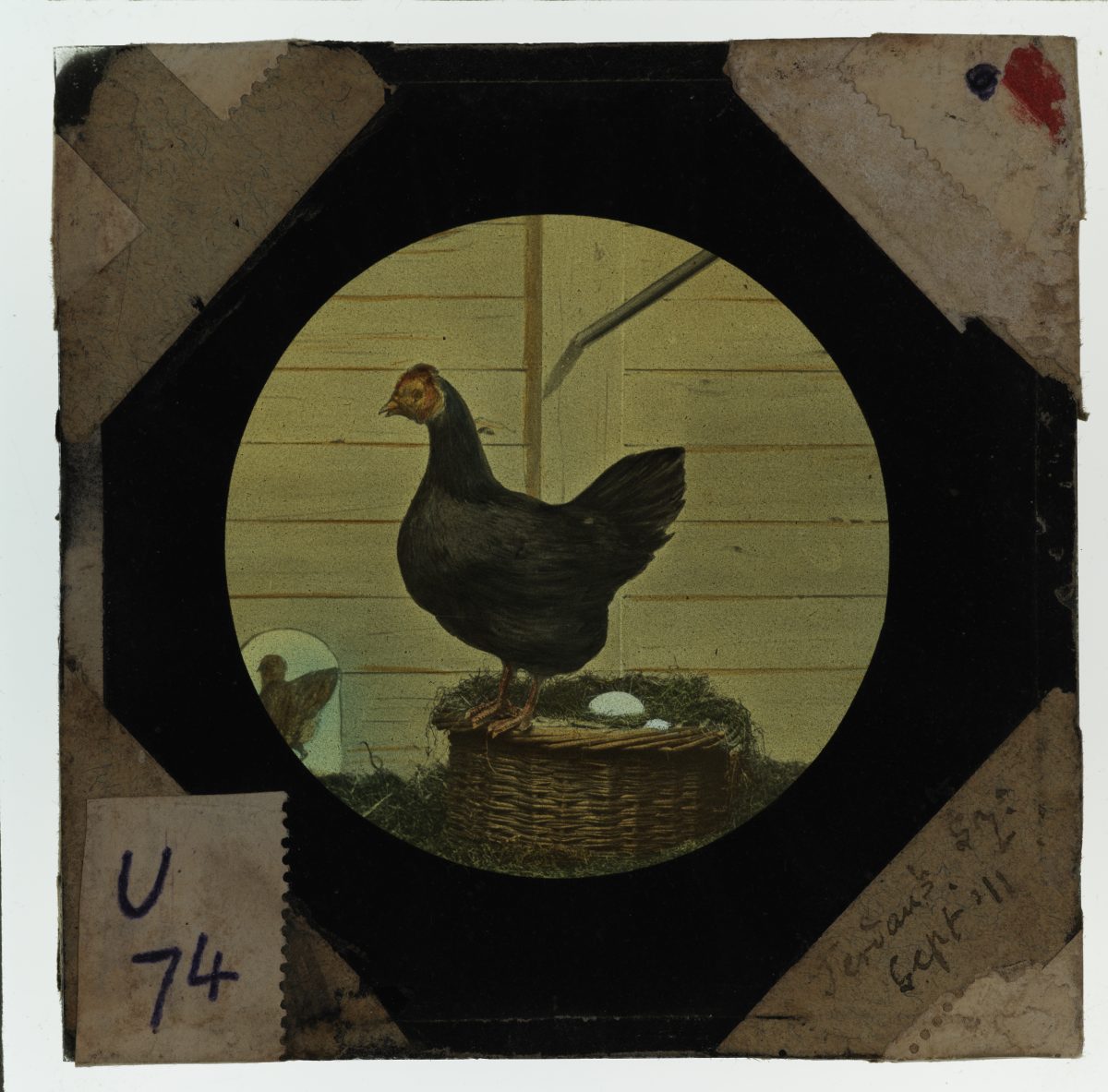
This lantern slide relates to a photograph taken by Clement Lindley Wragge (b.1852, d.1922), dated 25 March 1905.
The slide shows the coloured image of a black hen inside a hen house standing on top of a basket filled with hay and two eggs. In the lower left corner, another hen is exiting the hen house through an arch.
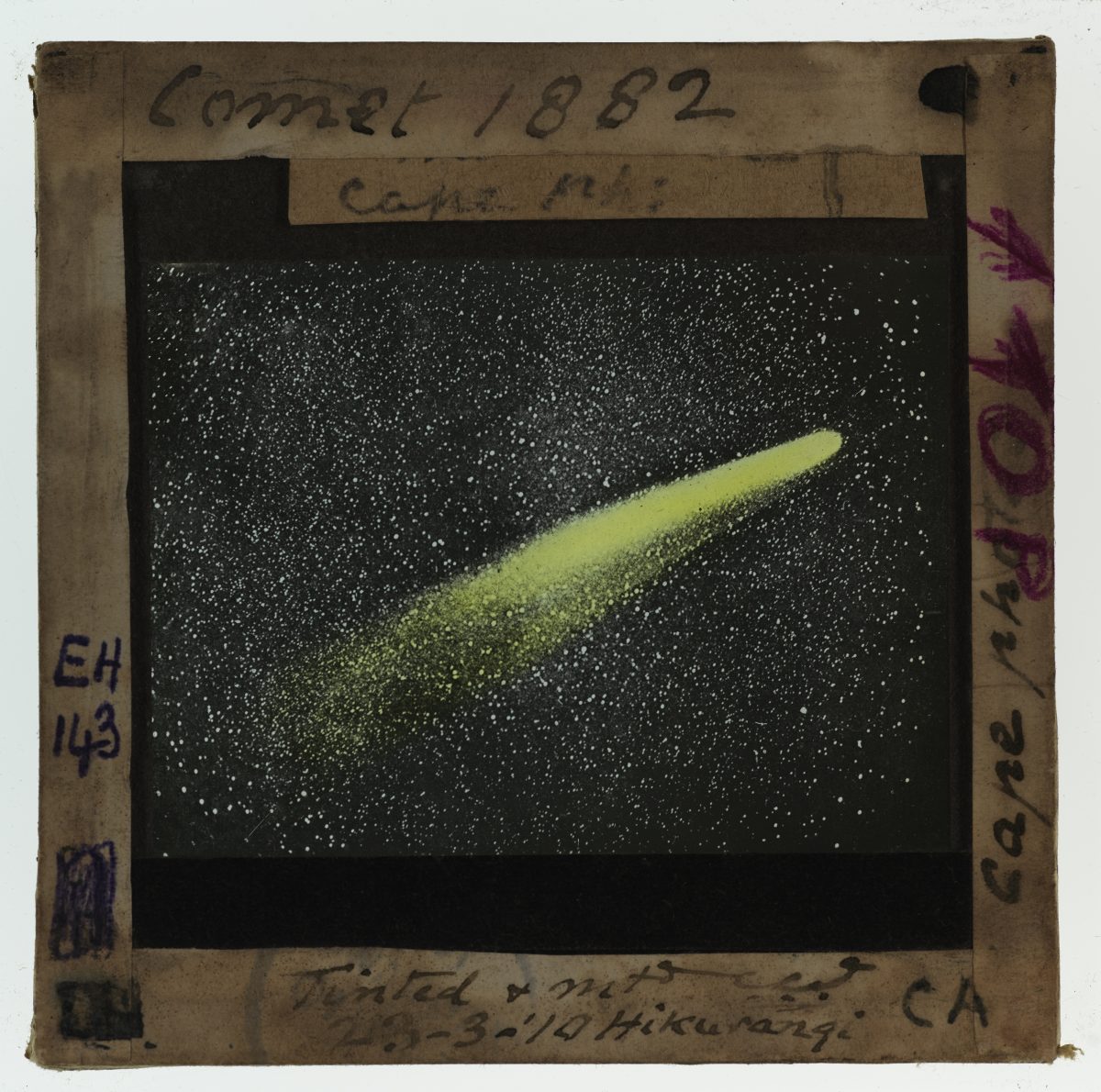
This lantern slide relates to a photograph taken by Clement Lindley Wragge (b.1852, d.1922), dated 24 February 1905.
The slide shows an image of a comet flying through outerspace, surrounded by stars. Printed on green glass.
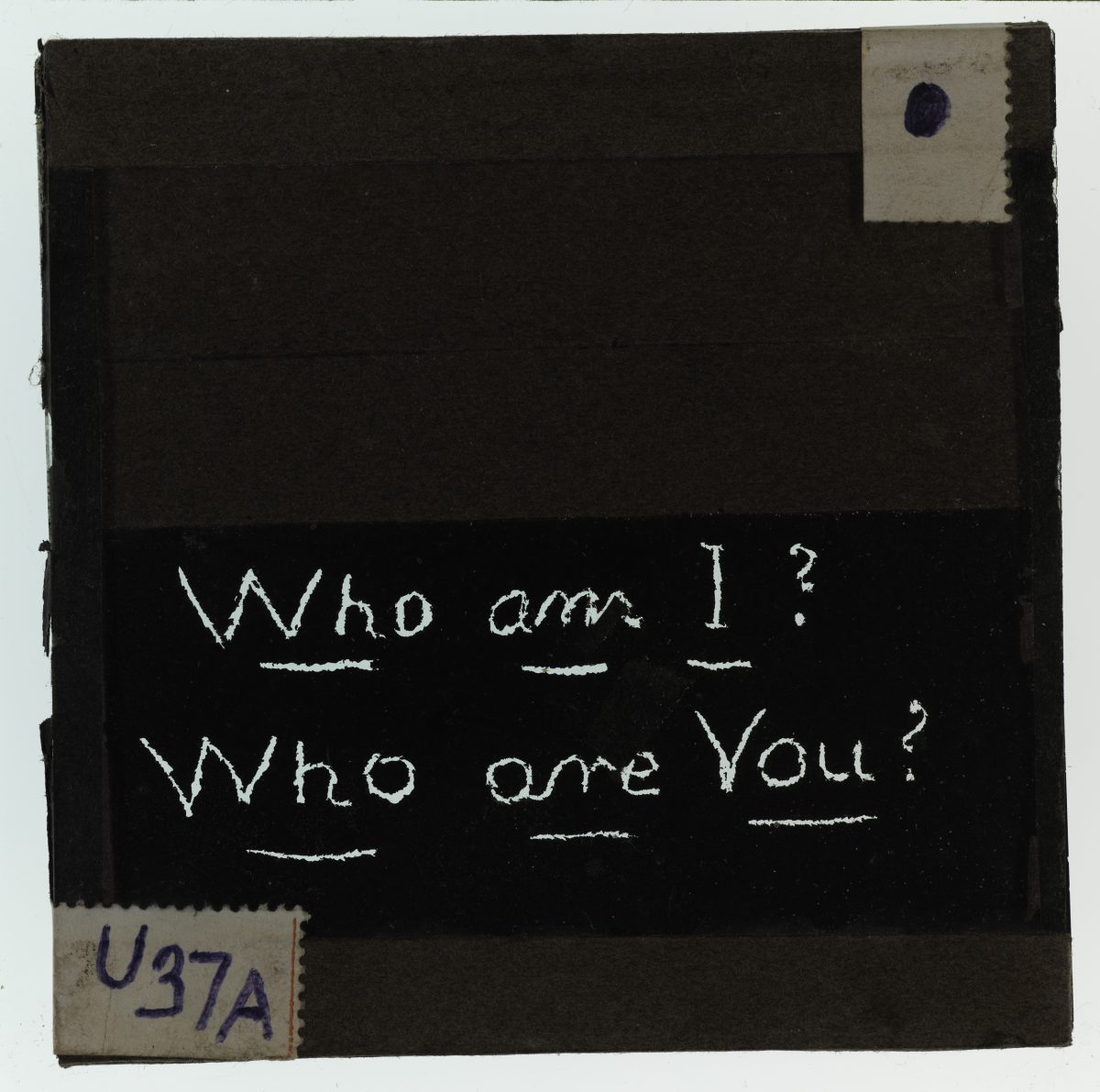
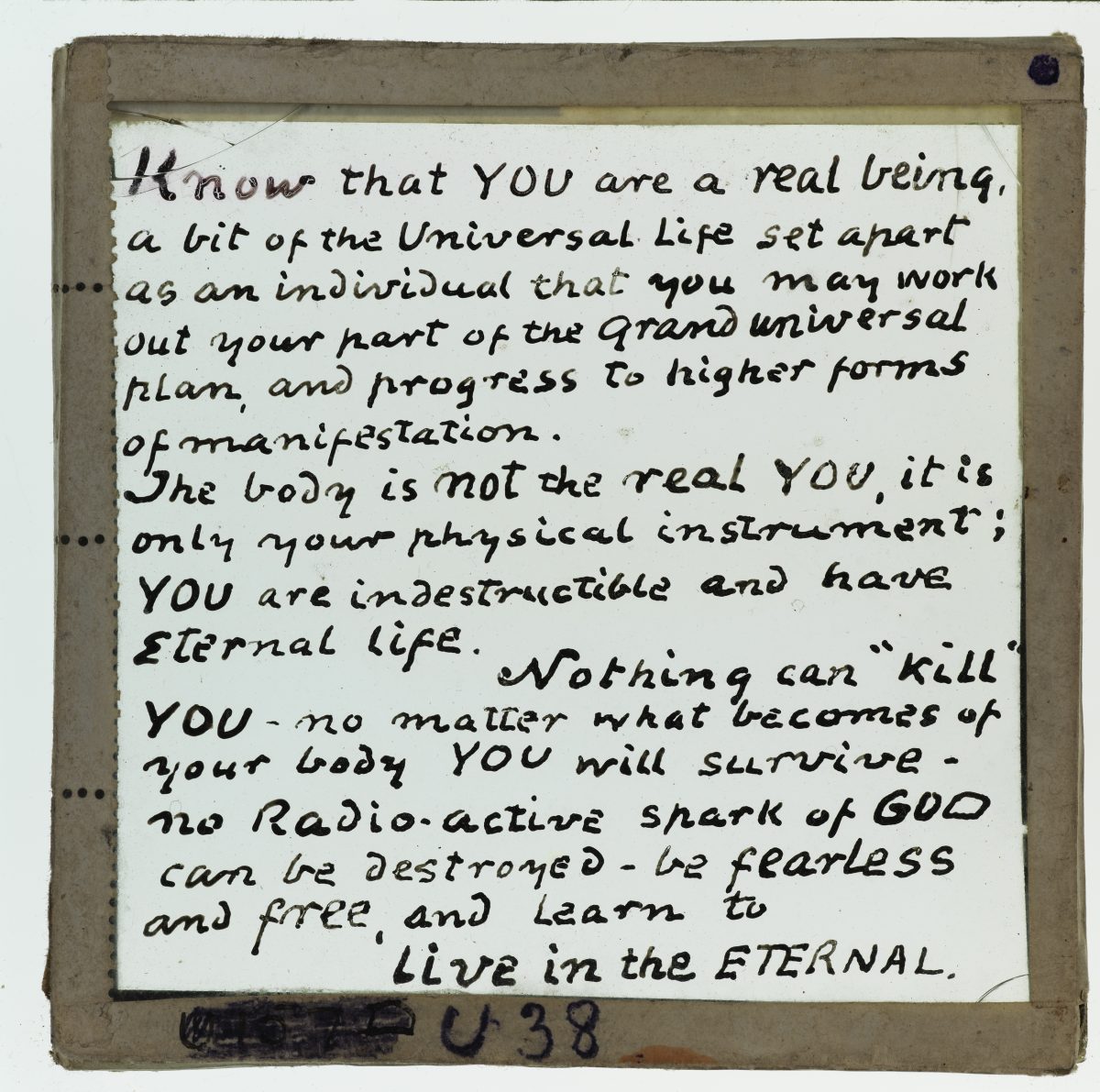
This lantern slide relates to a photograph taken by Clement Lindley Wragge (b.1852, d.1922).
“Know that YOU are a real being, a bit of the Universal Life set apart as an individual that you may work out your part of the Grand Universal plan, and progress to higher forms of manifestation. The body is not the real YOU, it is only your physical instrument; YOU are indestructable and have Eternal Life. Nothing can “kill” YOU – no matter what becomes of your body YOU will survive – no Radio-active spark of GOD can be destroyed – be fearless and free, and learn to live in the ETERNAL.”
– Clement Lindley Wragge
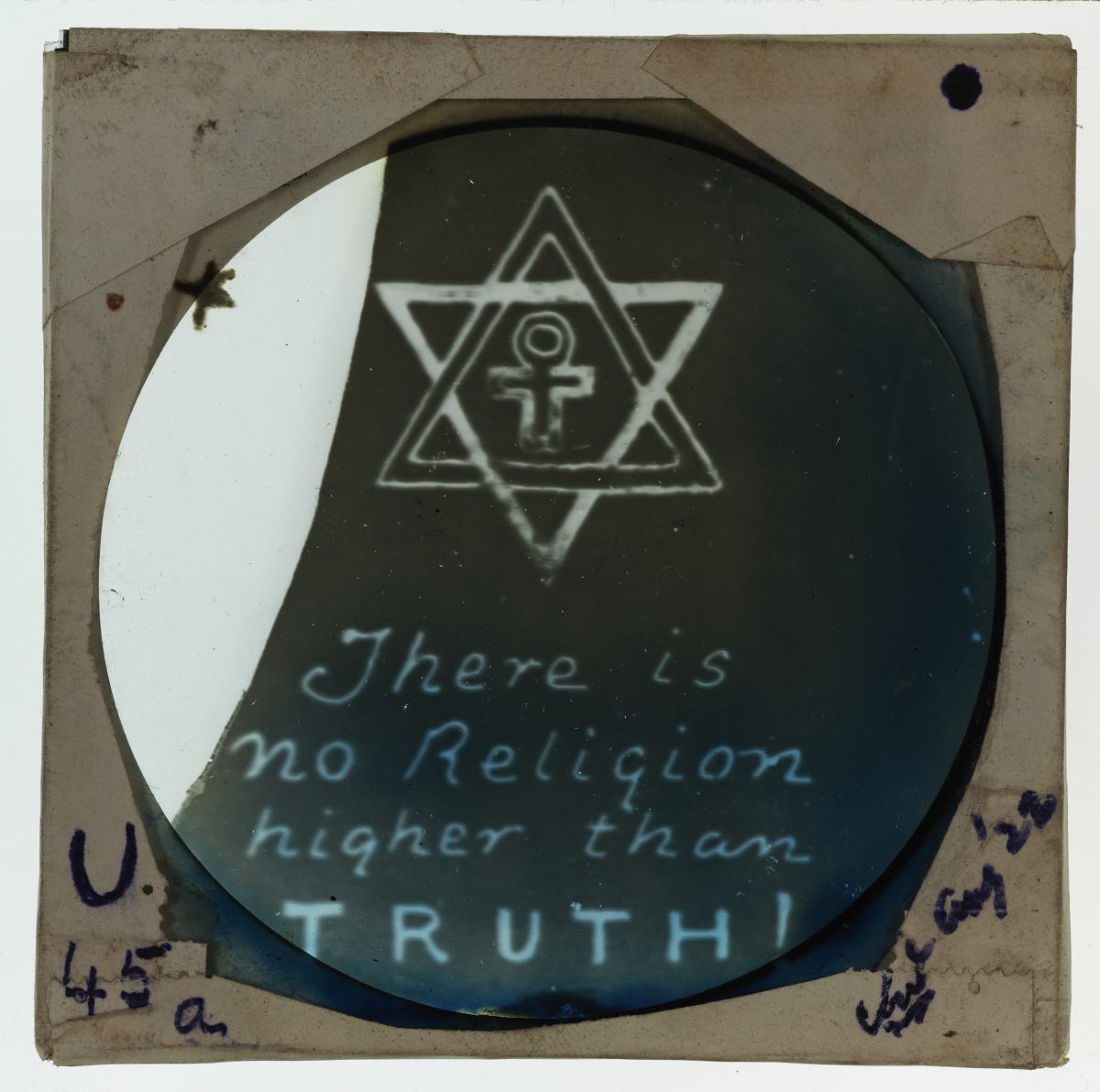
This lantern slide relates to a photograph taken by Clement Lindley Wragge (b.1852, d.1922), date unknown.
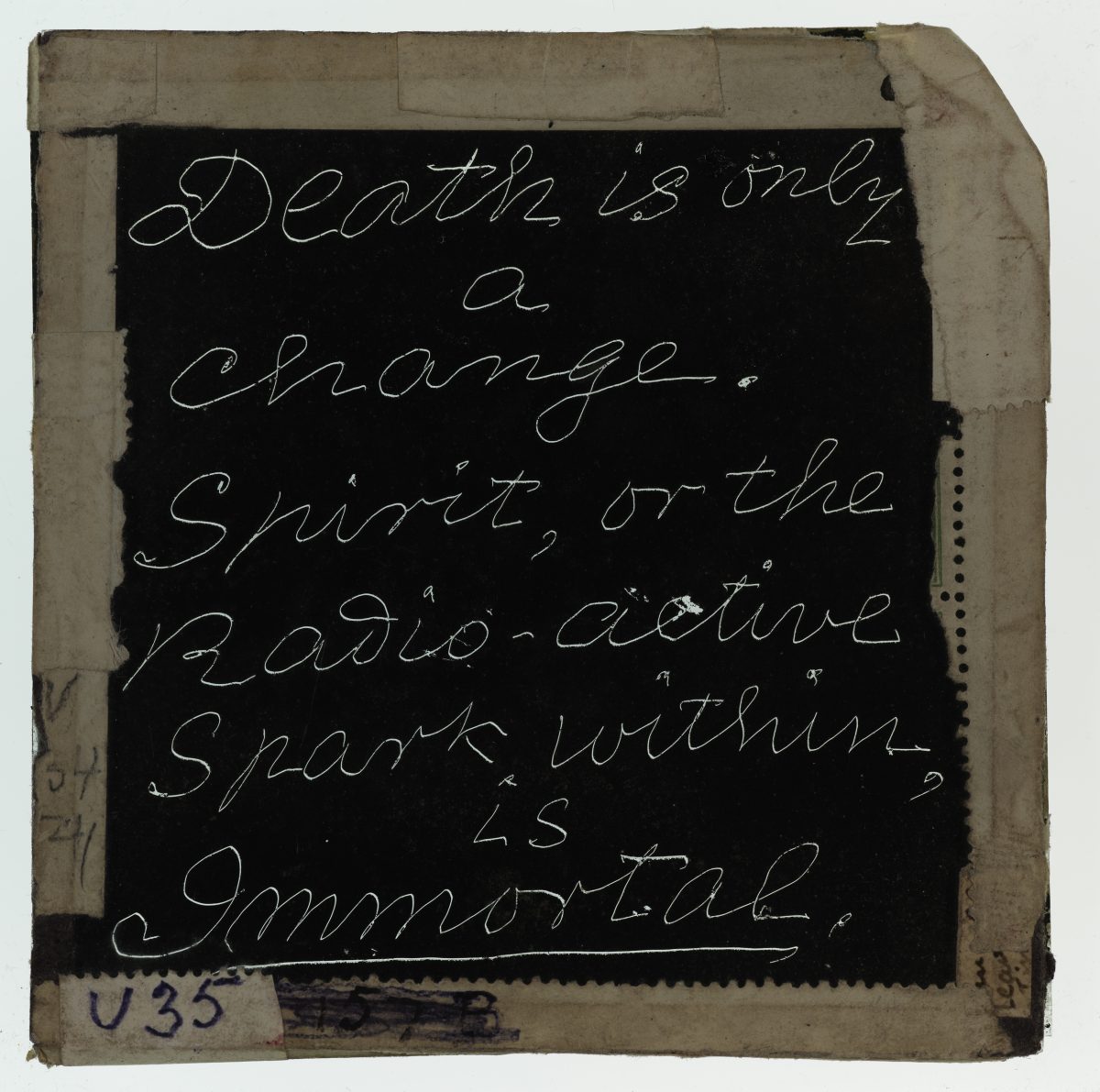
“Death is only a change. Spirit, or the Radio-active Spark within, is Immortal.”
– Clement Lindley Wragge
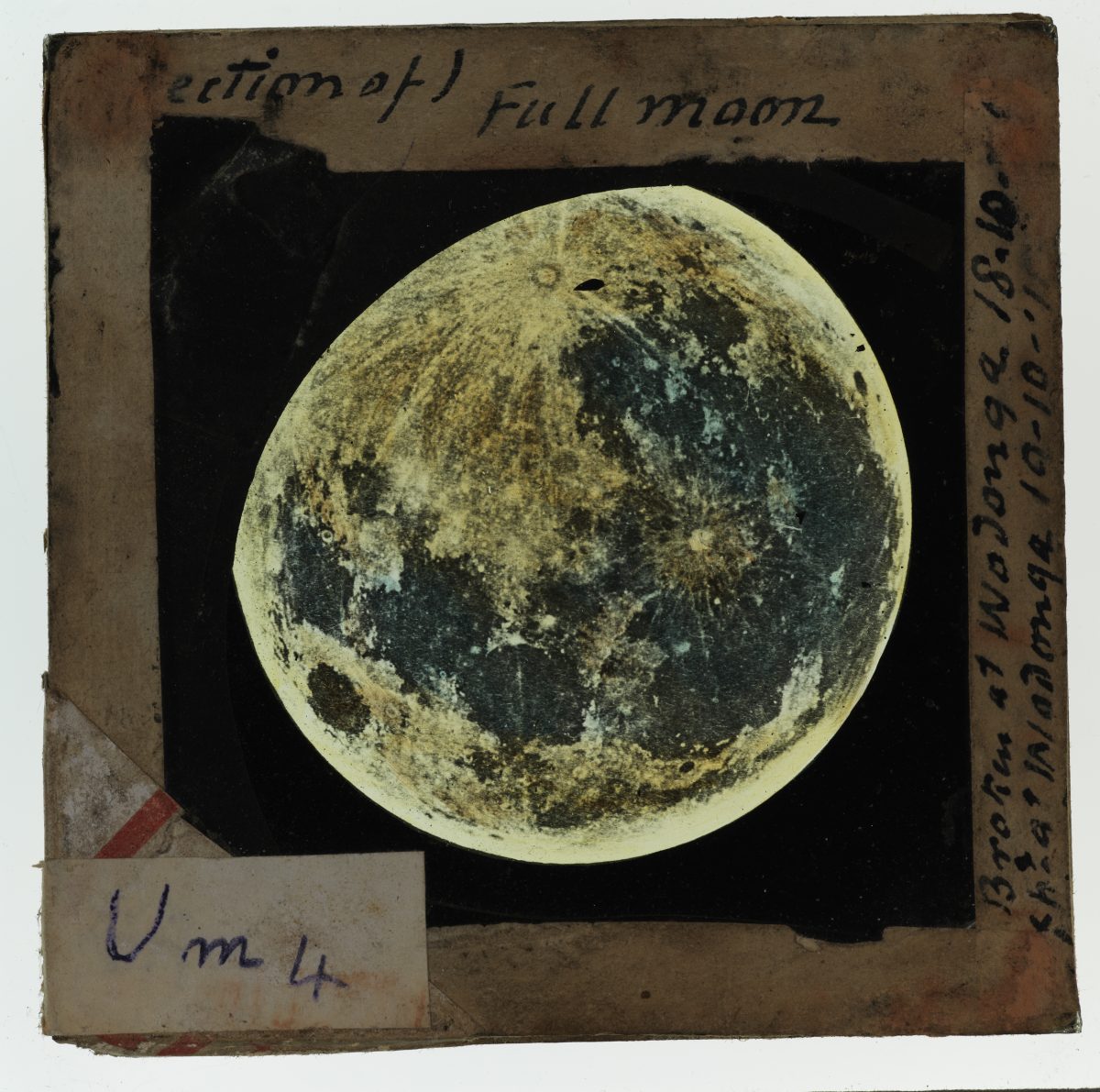
This lantern slide relates to a photograph taken by Clement Lindley Wragge (b.1852, d.1922), circa 1911.
The slide shows a photograph of a moon, partially obscured by black paper, with craters and maria visible.
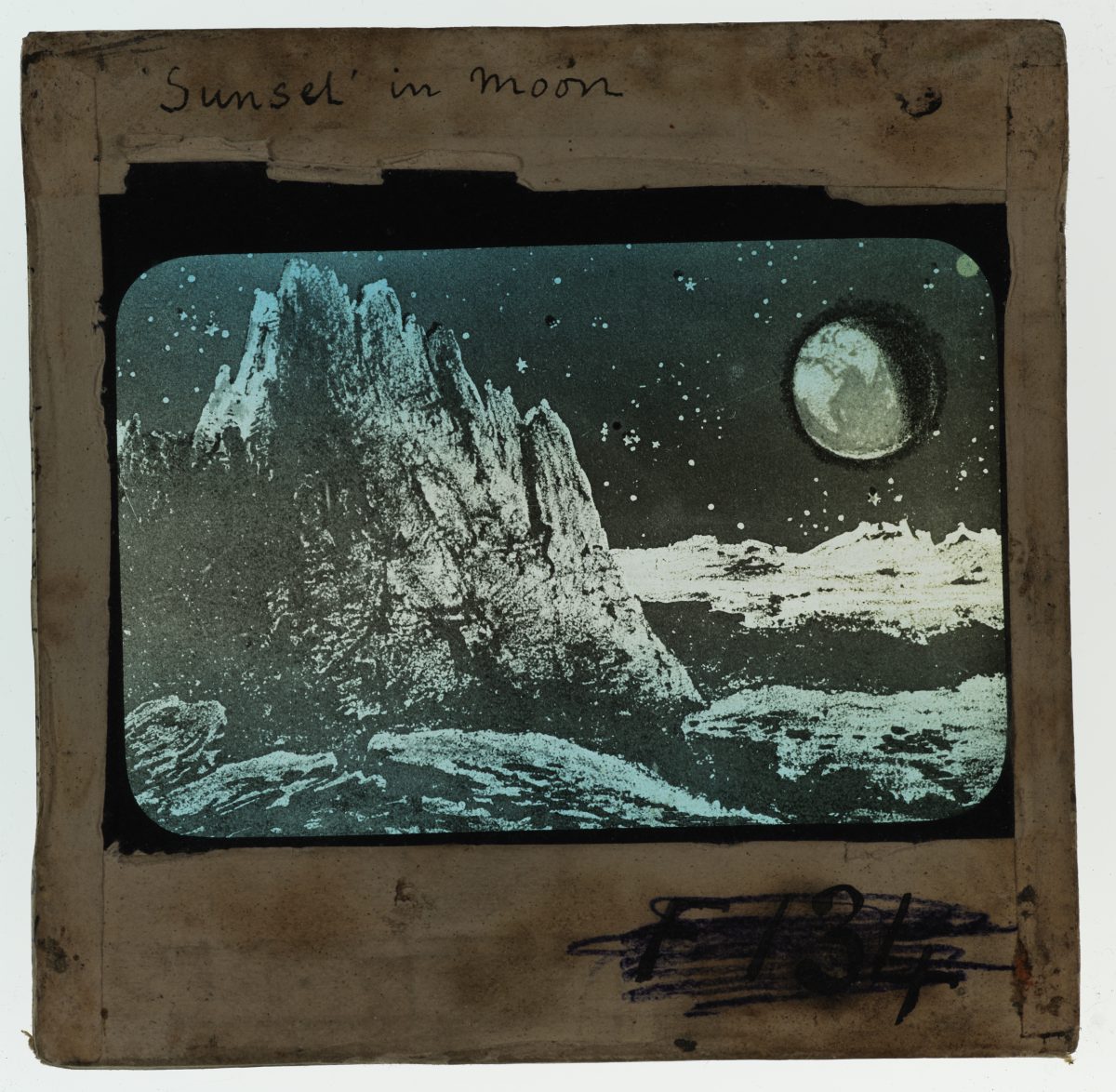
This lantern slide relates to a photograph taken by Clement Lindley Wragge (b.1852, d.1922),
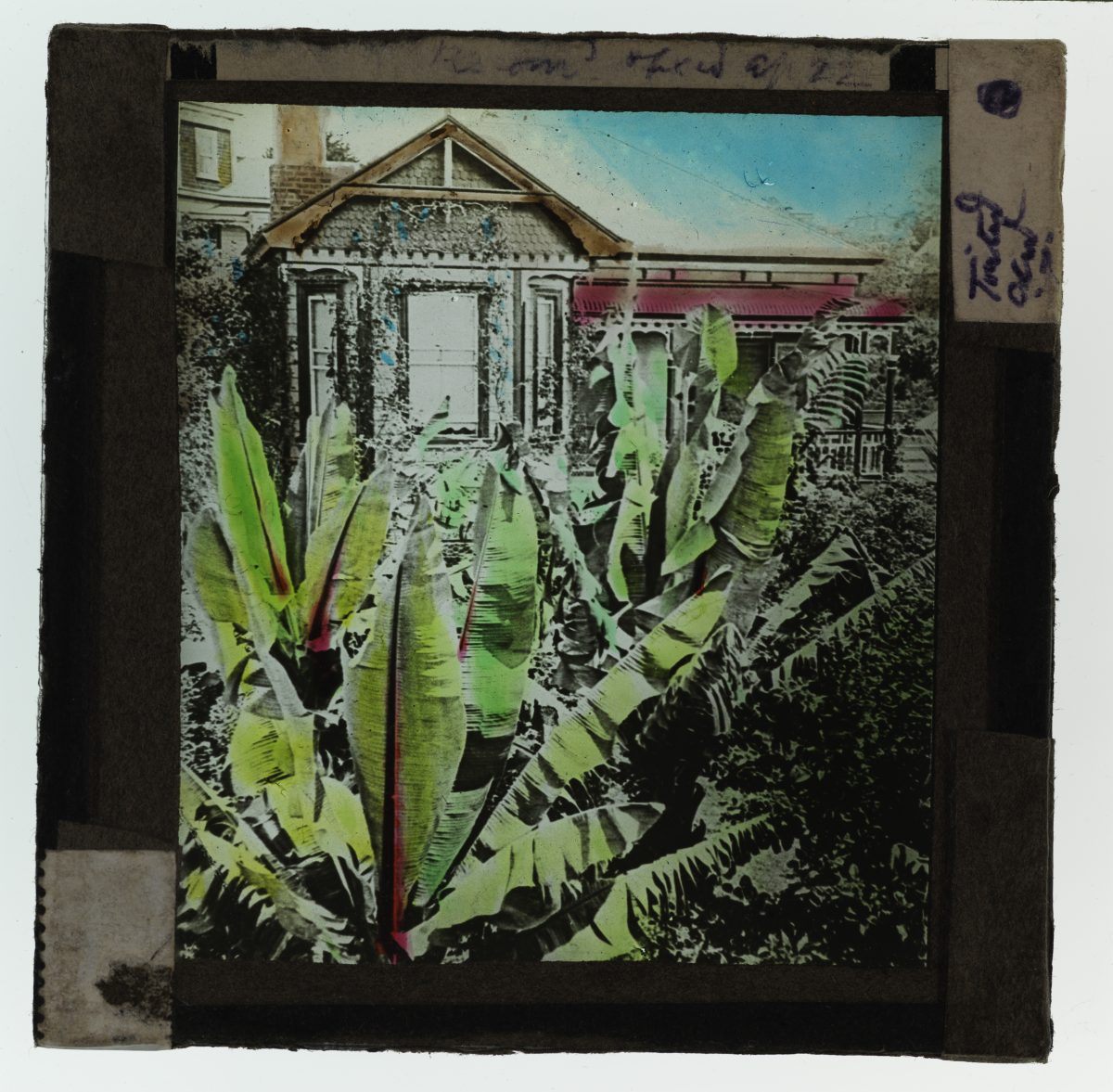
Clement Wragge’s House, Waiata Tropical Gardens at 8 Awanui Street, Birkenhead.
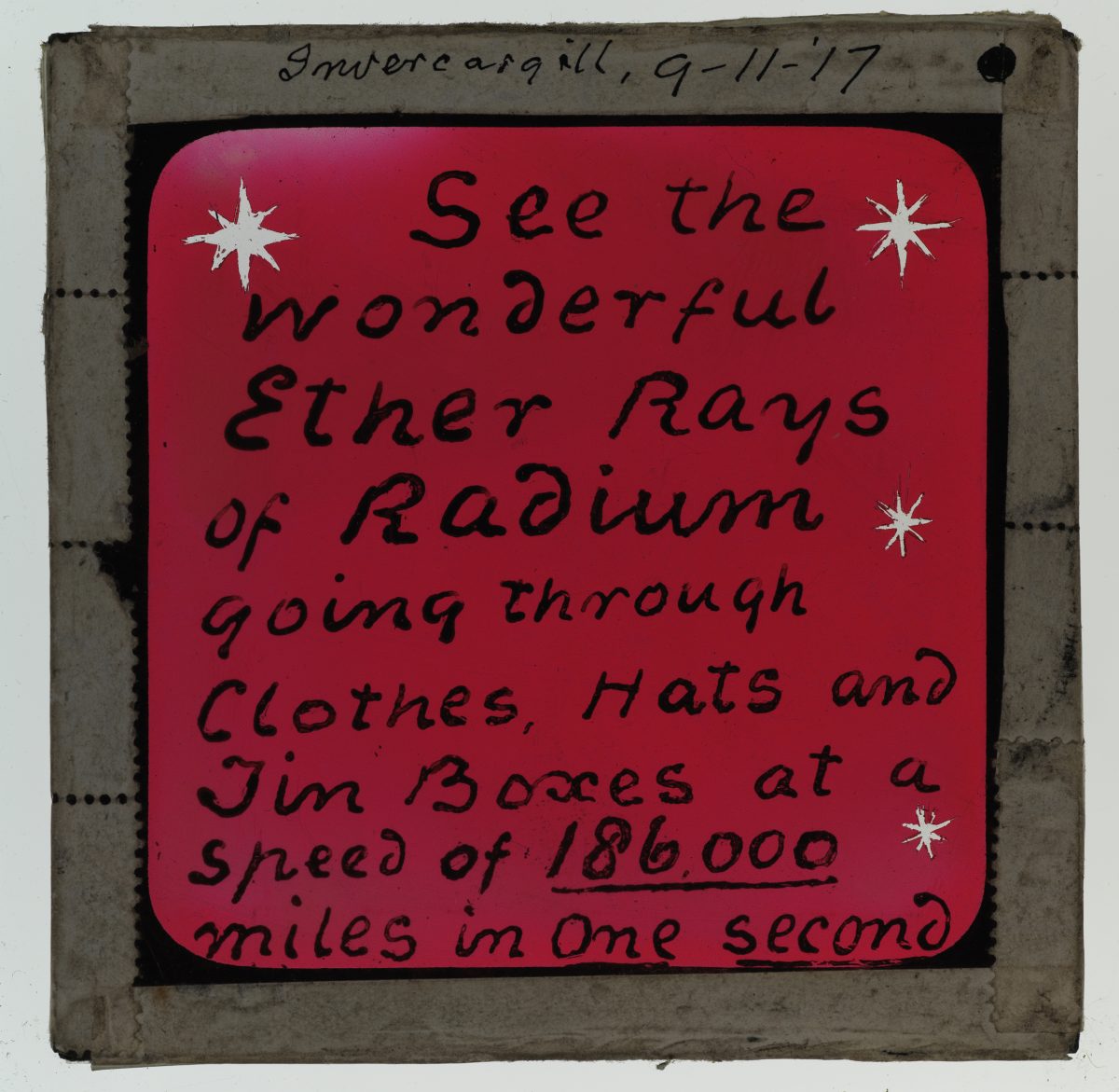
See the Wonderful Rays of Radium, Invercargill 9th November, 1917″
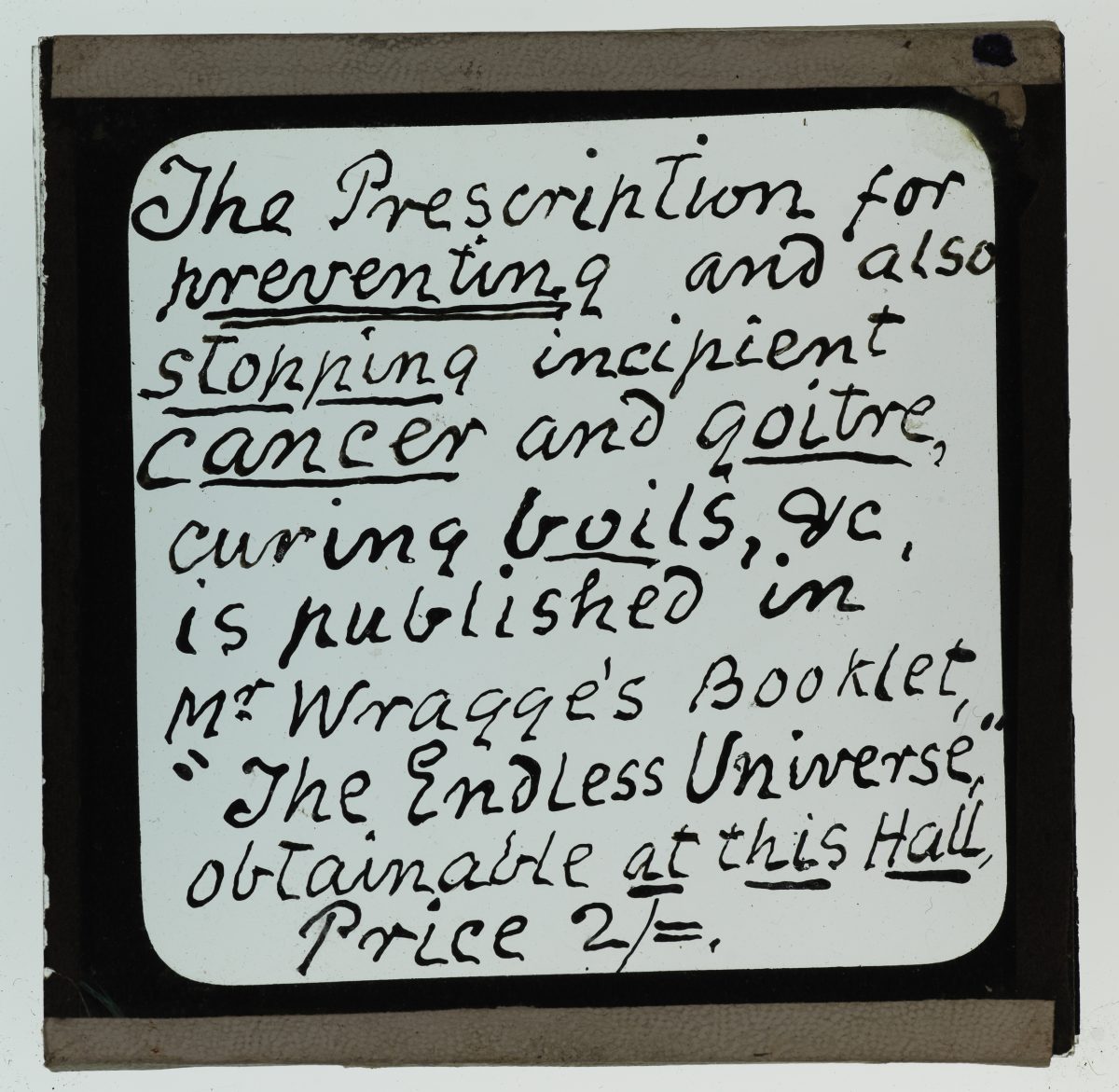
Advertisement for ‘The Endless Universe’
‘The Prescription for preventing and also stopping incipient cancer and goitre, curing boils &c, is published in Mr. Wragge’s Booklet, “The Endless Universe” obtainable at this Hall, Price 2/=.’
– Clement Lindley Wragge
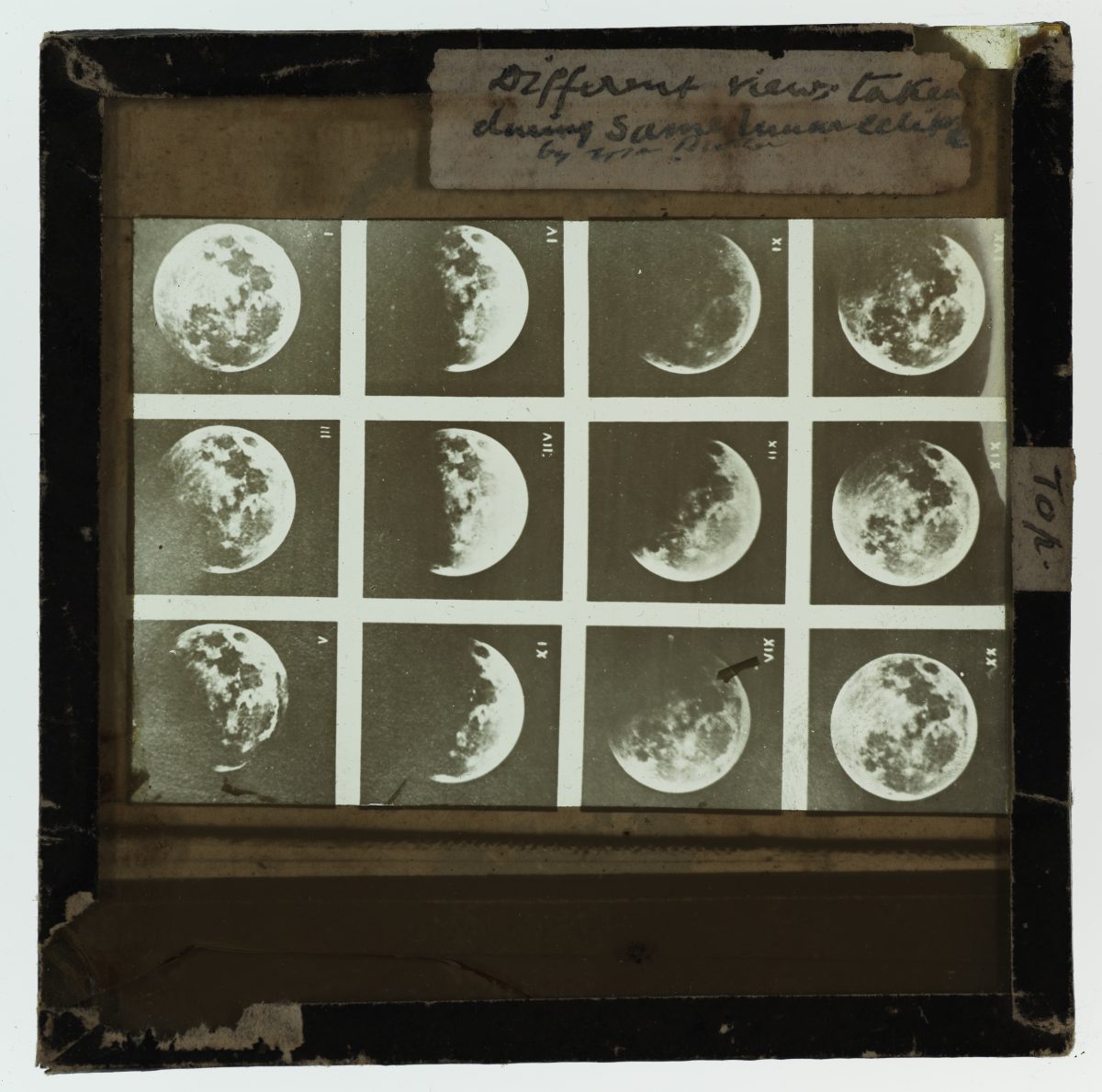
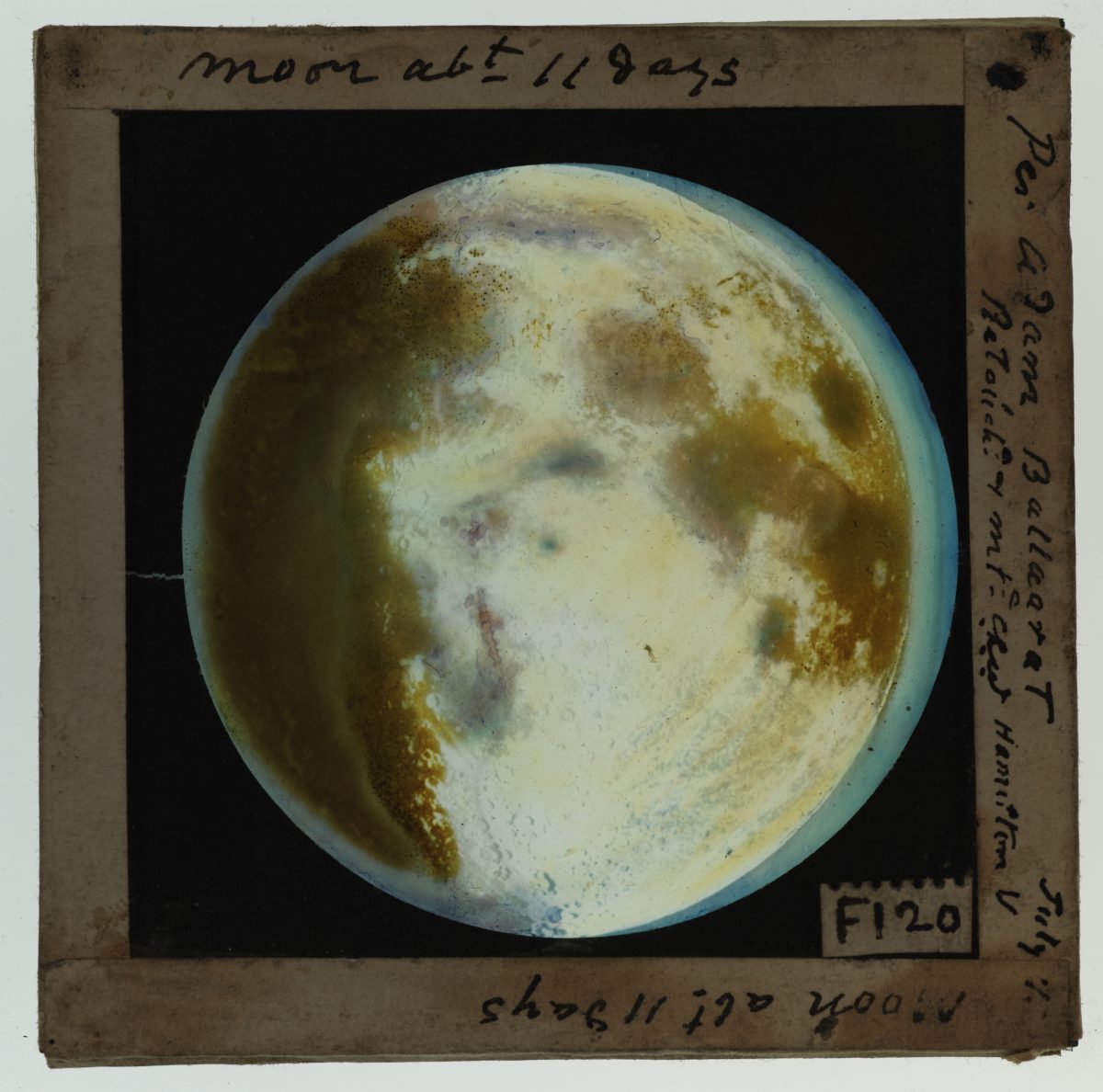
‘Moon by small ‘opera’ glass ‘.
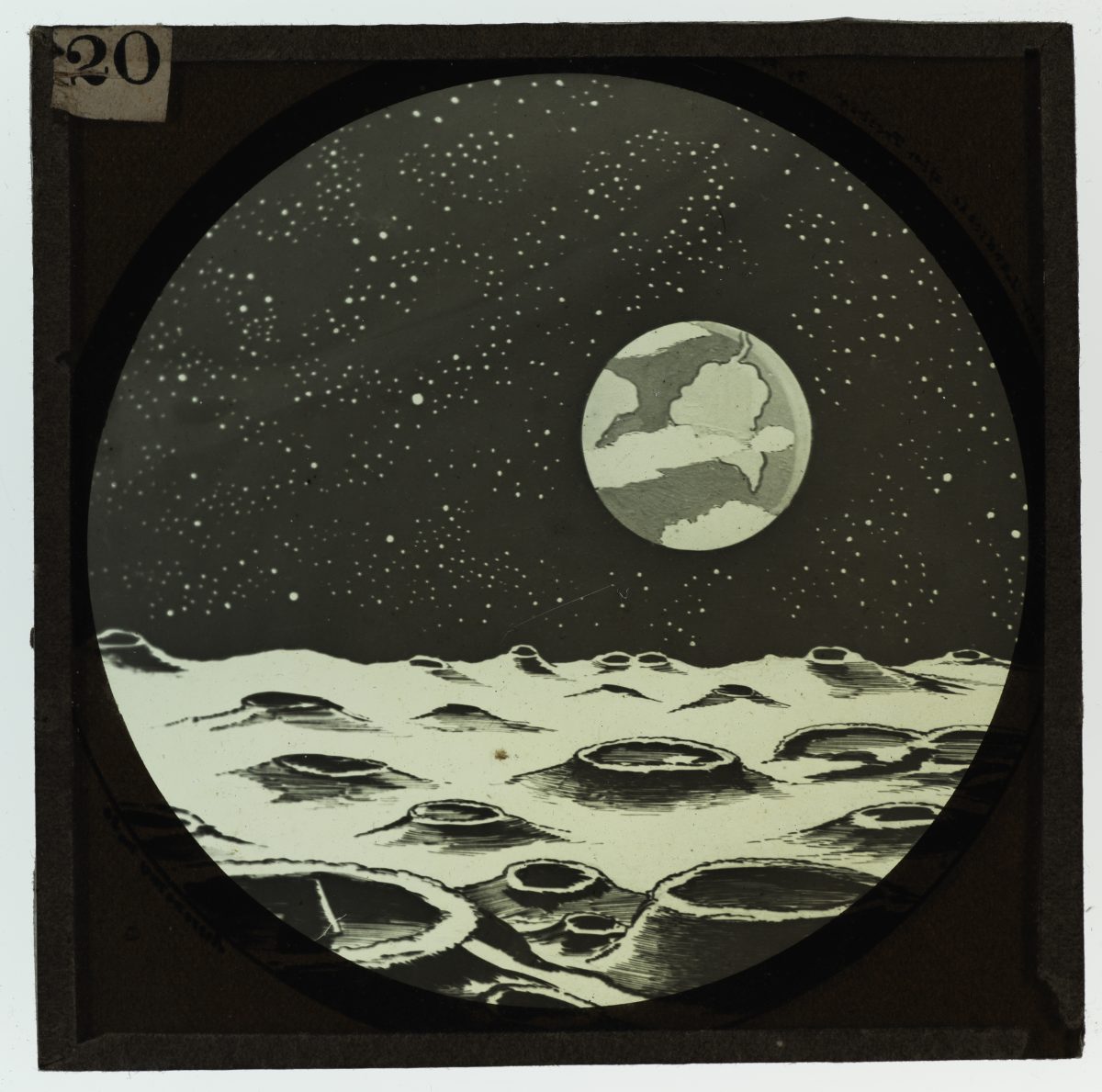
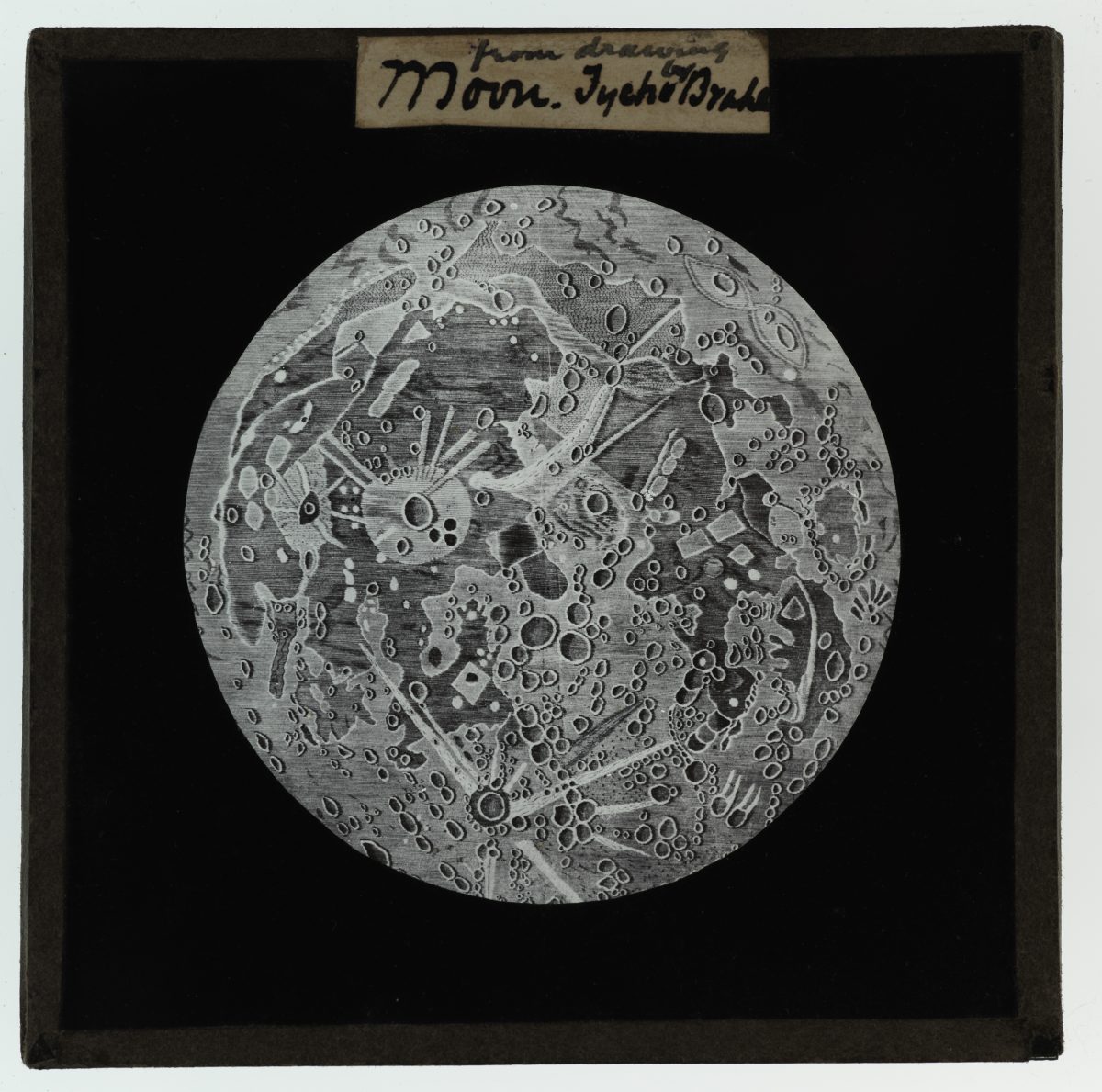
Via: National Library of New Zealand, Auckland War Memorial Museum
Would you like to support Flashbak?
Please consider making a donation to our site. We don't want to rely on ads to bring you the best of visual culture. You can also support us by signing up to our Mailing List. And you can also follow us on Facebook, Instagram and Twitter. For great art and culture delivered to your door, visit our shop.