“In my photomontages I spoke to the single soldier who at that moment held the magazine in his hands. I related to him and put myself in his place. I was his interested interlocutor.”
– Aleksandr Zhitomirsky
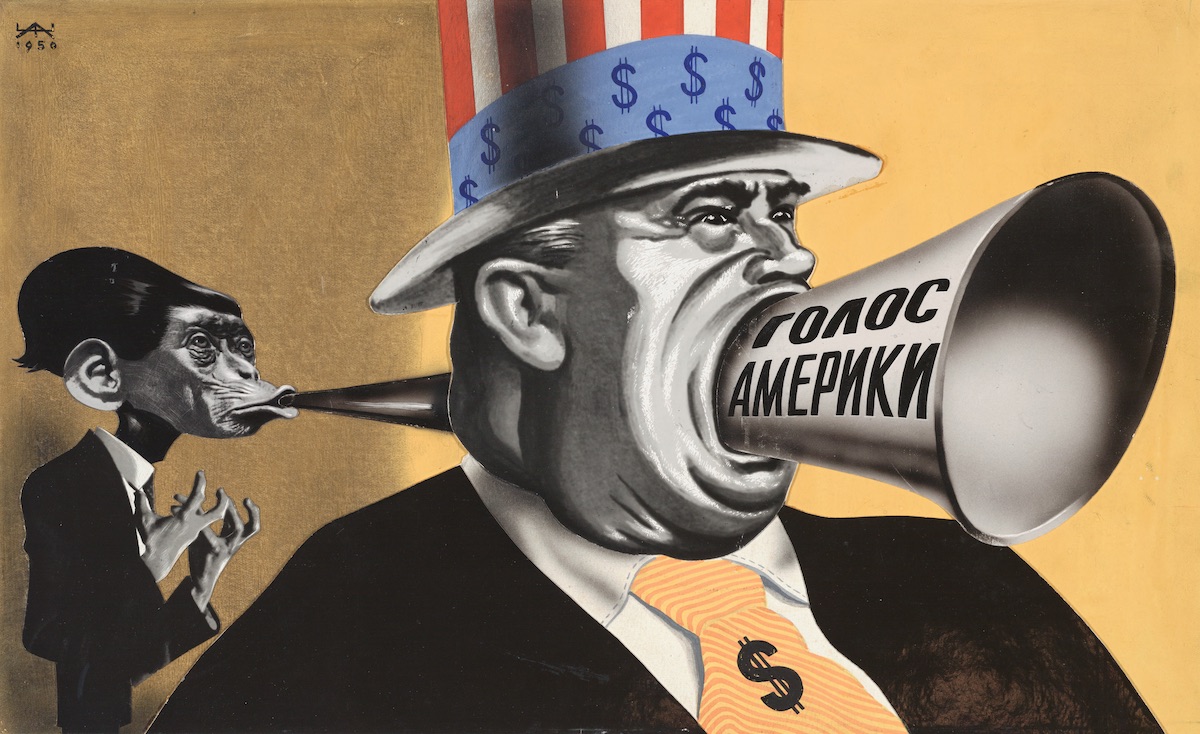
Nazi Minister of Propaganda Joseph Goebbels speaks through the Voice of America in 1950 by Alexandr Zhitomirsky
Soviet graphic art was made in the service of political belief and subject to state regulation. Through posters, caricatures and cartoons, the communist Soviet Union hammered citizens at home and abroad with its message.
Aleksandr Zhitomirsky (1907–1993) was a leading and prolific artist working under the auspices of the Soviet propaganda ministry. Inspired by German artist John Heartfield, his photomontages and leaflets were airdropped on German troops during World War II. He later worked for Pravda and other Soviet publications during the Cold War.
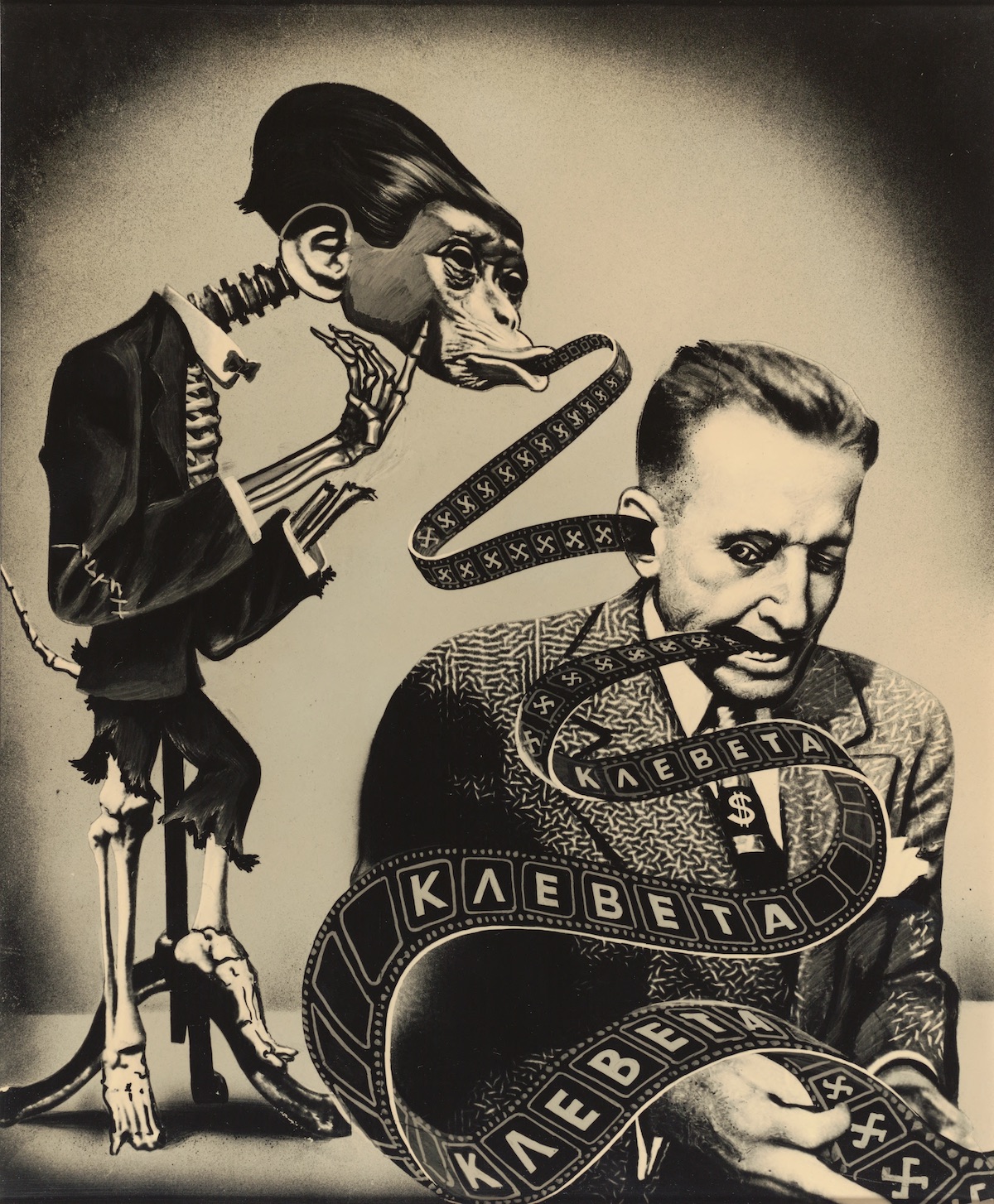
Goebbels speaks through American capitalism.
Zhitomirsky was born in 1907 in Rostov-on-Don and moved to Moscow in 1925. He began work as a publisher for the Artists’ Association of Revolutionary Russia (a major Soviet art group that championed realistic, documentary depictions of everyday working-class life) and as editor for journals such as We’re Building, Socialist Industry and Illustrated Newspaper.
During WWII, Zhitomirsky produced some of his best known political photomontage.
He worked on The Photo Newspaper for the Red Army, which told stories of Russian heroes, and Front Illustrierte. Published in many languages — German, Italian, Finnish, Romanian and Hungarian — these four-page leaflets were intended to demoralise enemy soldiers. Urging surrender and promising leniency, millions of pages of Front Illustrierte were dropped from Soviet planes over Nazi-occupied territory. The Third Reich forbade German soldiers to collect the leaflets and added Zhitomirsky to its “most wanted” enemy list.
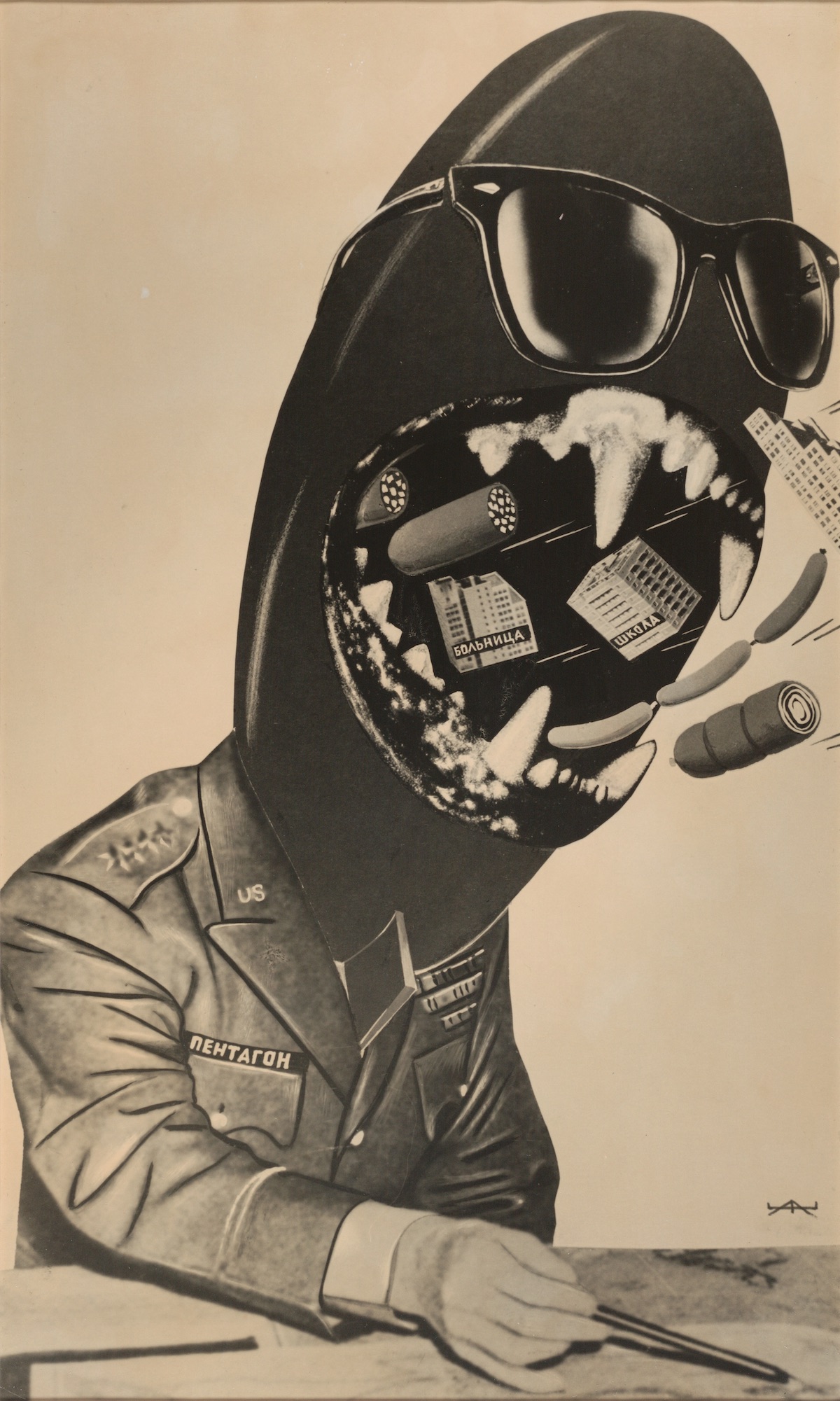
The Pentagon is seen eating up a number of objects, including a school and a hospital, 1950
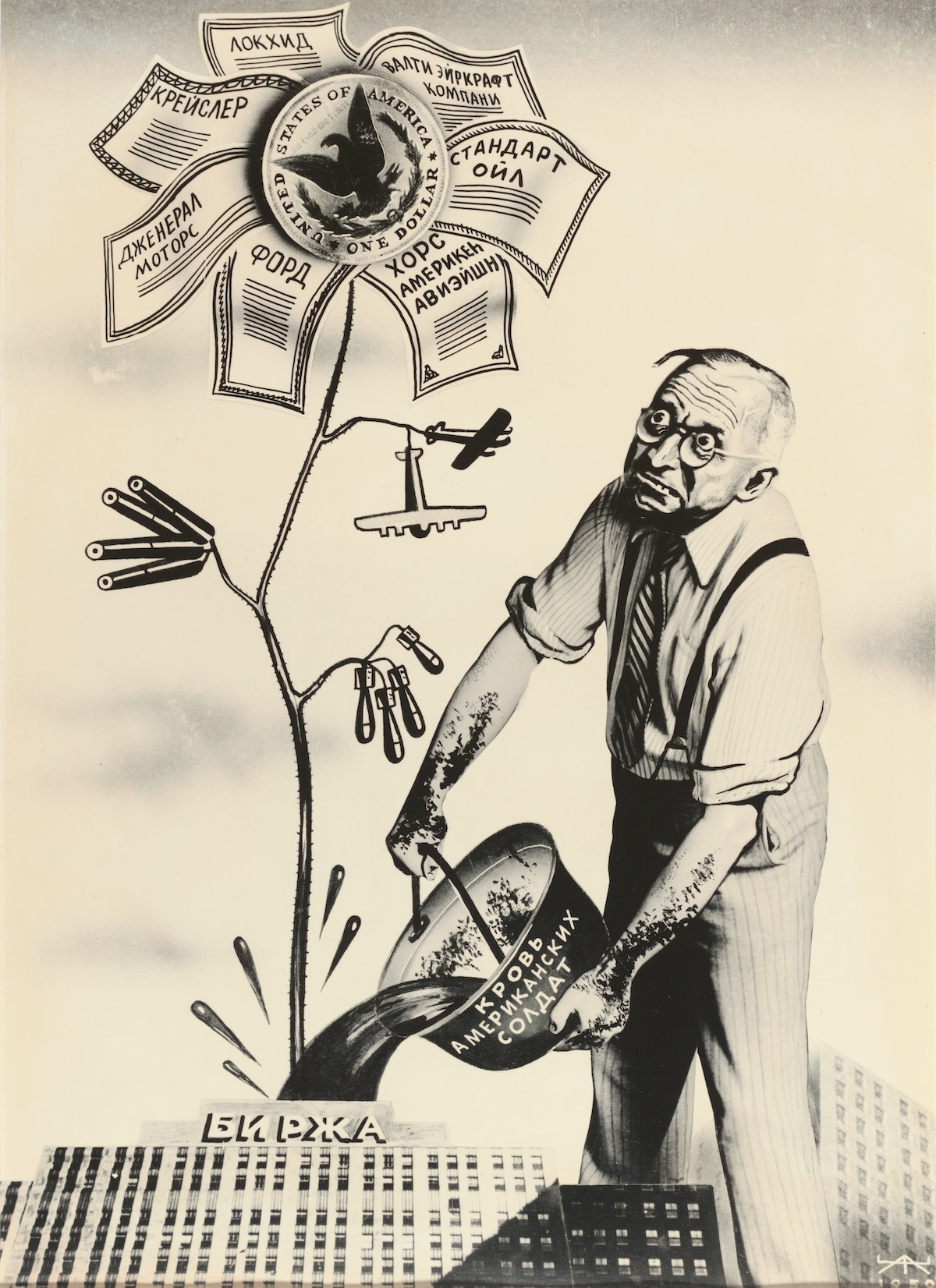

The Stock Exchange watered with the blood of US soldiers – On the petals of the flower are the names of various American corporations by Aleksandr Zhitomirsky, 1950
Soviet Realism, Anti-Semitism and Persecuting Zhitomirsky
After the war, Zhitomirsky became a target of State-approved anti-Semitism. People close to Zhitomirsky were arrested and some executed on account of being Jewish.
Joseph Stalin’s rise to power marked a turning point. Following the establishment of Israel in 1948, Stalin increasingly viewed Jewish cultural and political affiliations as threats, labelling Jews with terms like “rootless cosmopolitanism”. He condemned “Zionism” as disloyalty, referring to the Jewish people having existed without a land to call their own for nearly two millennia (the Romans destroyed the Temple of Jerusalem in the year 70) and having lived among the various Gentile nations as they waited a time to return to their ancient land.
This led to harsh restrictions on Jewish intellectuals, artists, and organisations, particularly during the Zhdanov Doctrine – Zhdanovshchina, a policy instituted in 1946 by Andrei Zhdanov, the Soviet Union’s “propagandist-in-chief”. The doctrine enforced strict adherence to Communist ideals in the arts. Photomontage as an art form increasingly came under fire in 1951-1952 as a deviation from “socialist realism”, the official artistic form in the Soviet Union.
The doctrine was formally proclaimed by Maxim Gorky at the Soviet Writers Congress of 1934, although not well defined. In practice, it meant using realist styles to create highly optimistic depictions of Soviet life. Any pessimistic or critical element was banned.
As the Russian-Jewish revolutionary Leon Trotsky (26 October 1879 – 21 August 1940) noted;
The name itself has evidently been invented by some high functionary in the department of the arts. This “realism” consists in the imitation of provincial daguerreotypes of the third quarter of the last century; the “socialist” character apparently consists in representing, in the manner of pretentious photography, events which never took place.
It was not until the late 1950s, after the death of Stalin and during the Cold War’s “thaw” period under new Soviet leader Nikita Khrushchev, that Zhitomirsky was able to more freely take up photomontage work again.
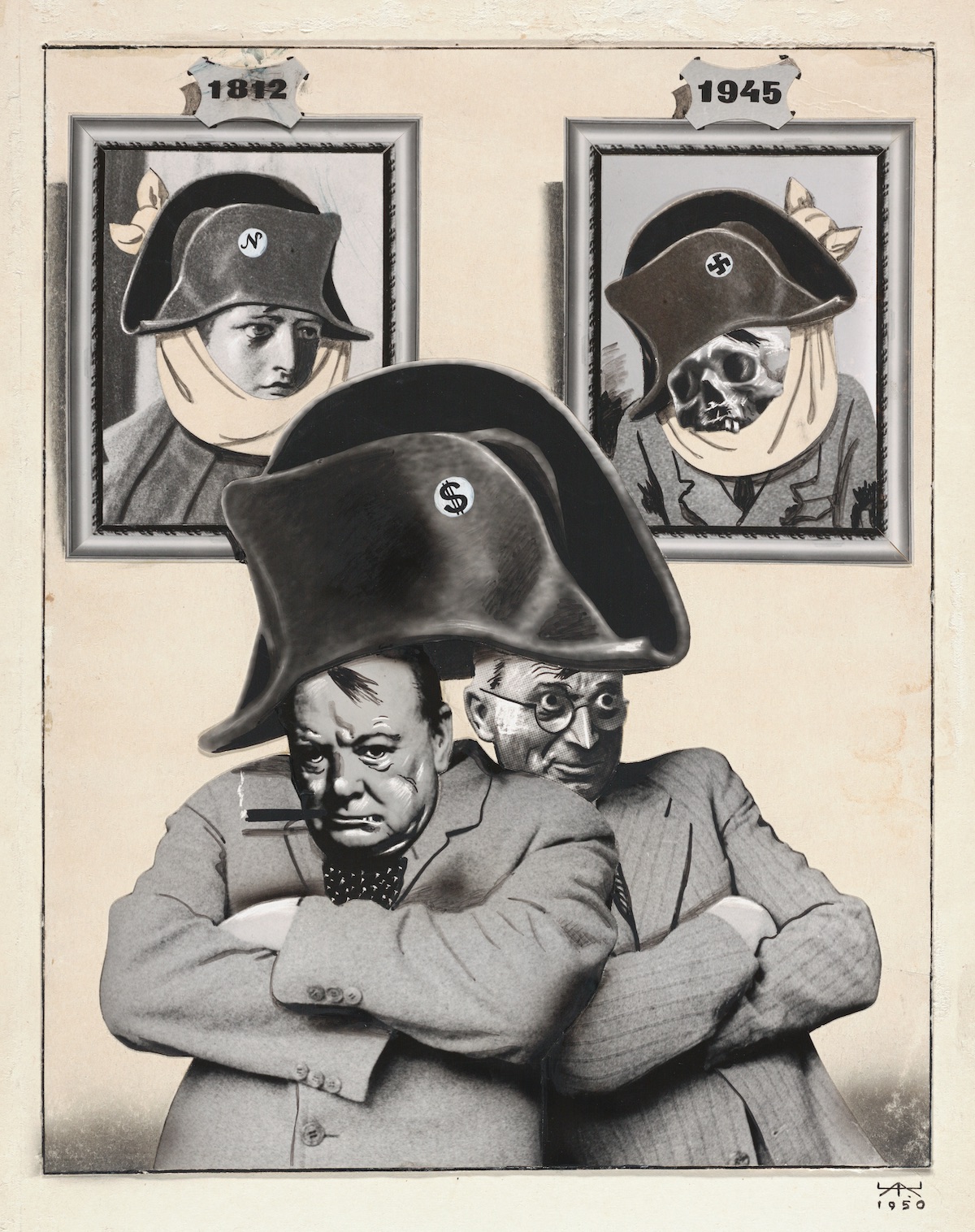
Harry Truman and Winston Churchill pose under a giant Napoleon-style hat, 1950
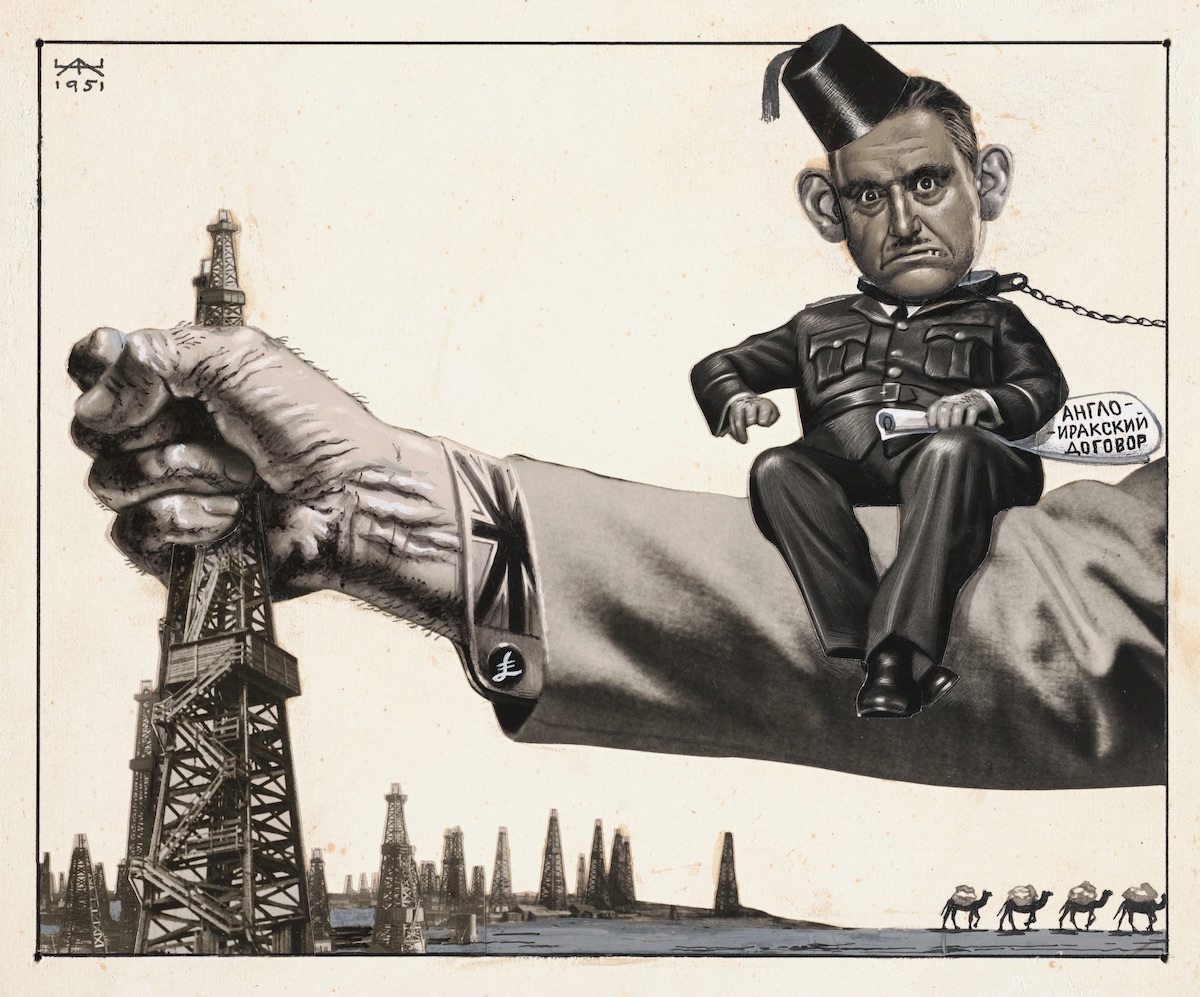

Anglo-Iraqi Pact, 1951
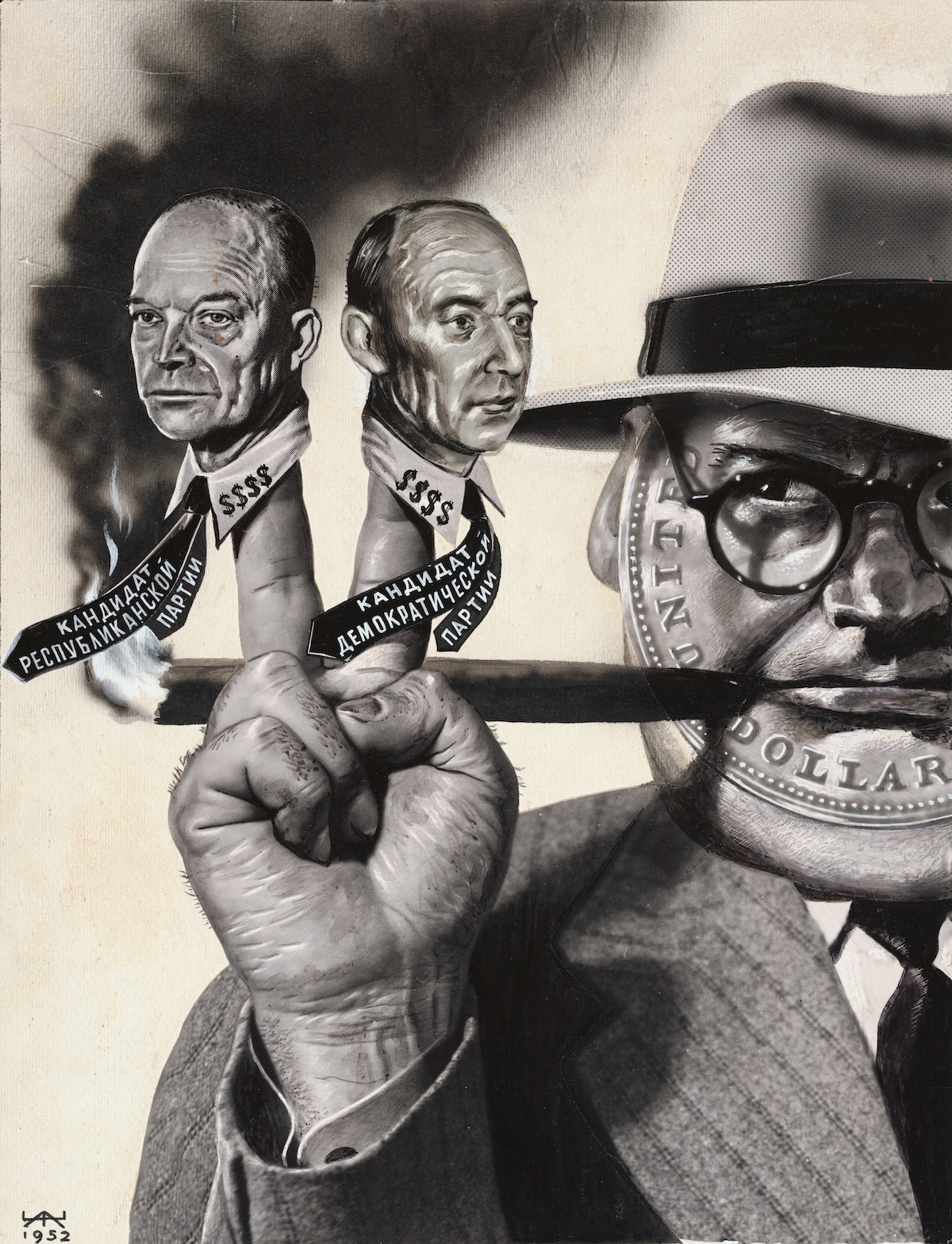
Candidate of the Democratic Party, Candidate of the Republican Party, 1952
Advice for the Artist by Aleksandr Zhitomirsky
In 1983, Zhitomirsky published his only book, The Art of Political Photomontage: Advice for the Artist.
In it he asks:
“What gives the power of dynamite to the photo-poster pamphlet? Foremost, its motto is humanism. And, of course, the ability to see in subjects something new that others do not see but that they by all means should see.”
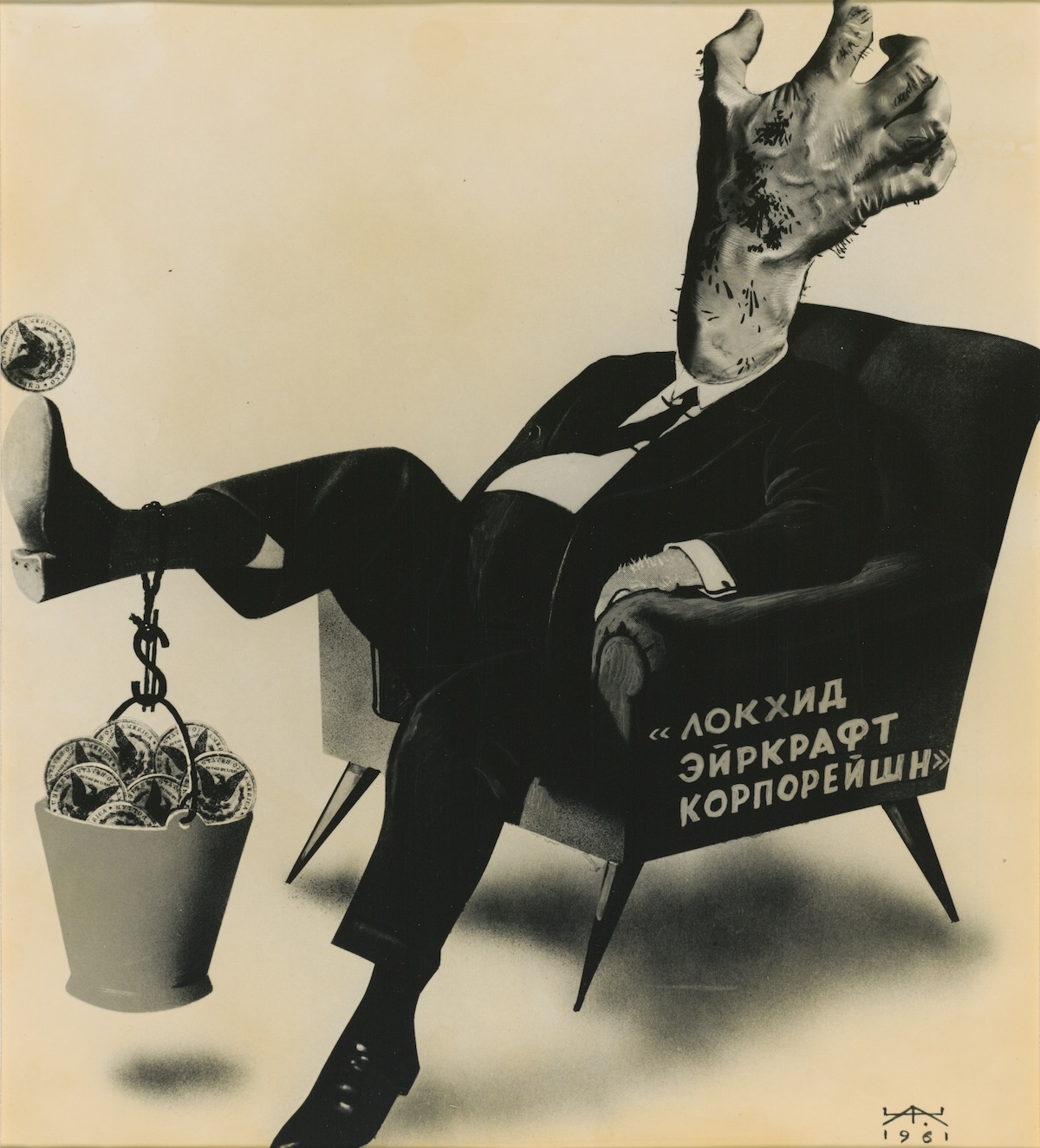
Lockheed Aircraft Corporation is pictured as a businessman with a grasping hand instead of a head and a foot holding up a bucket full of money – 1961
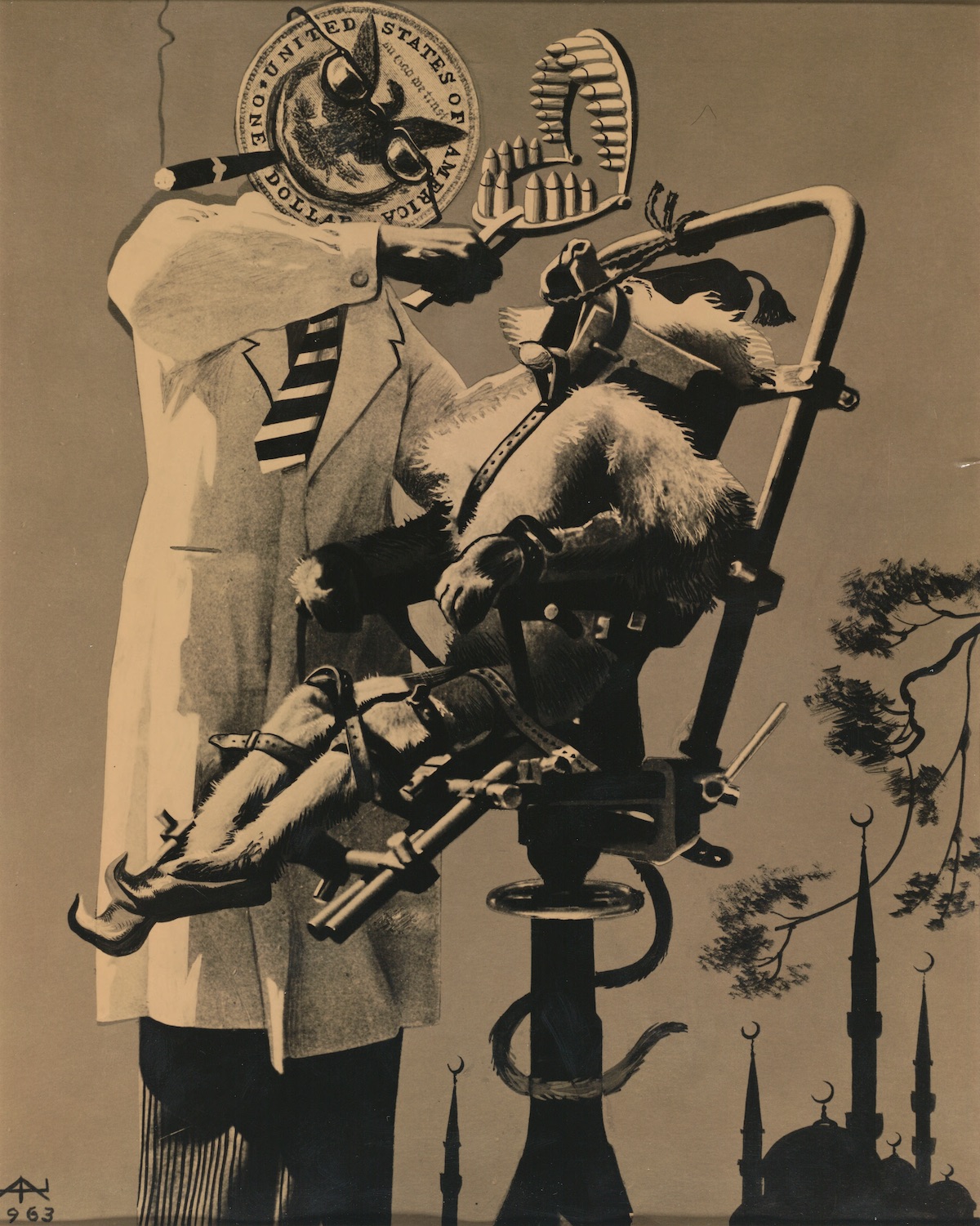
The United States is seen as a dentist placing a denture of bullets into an unwilling patient, 1963
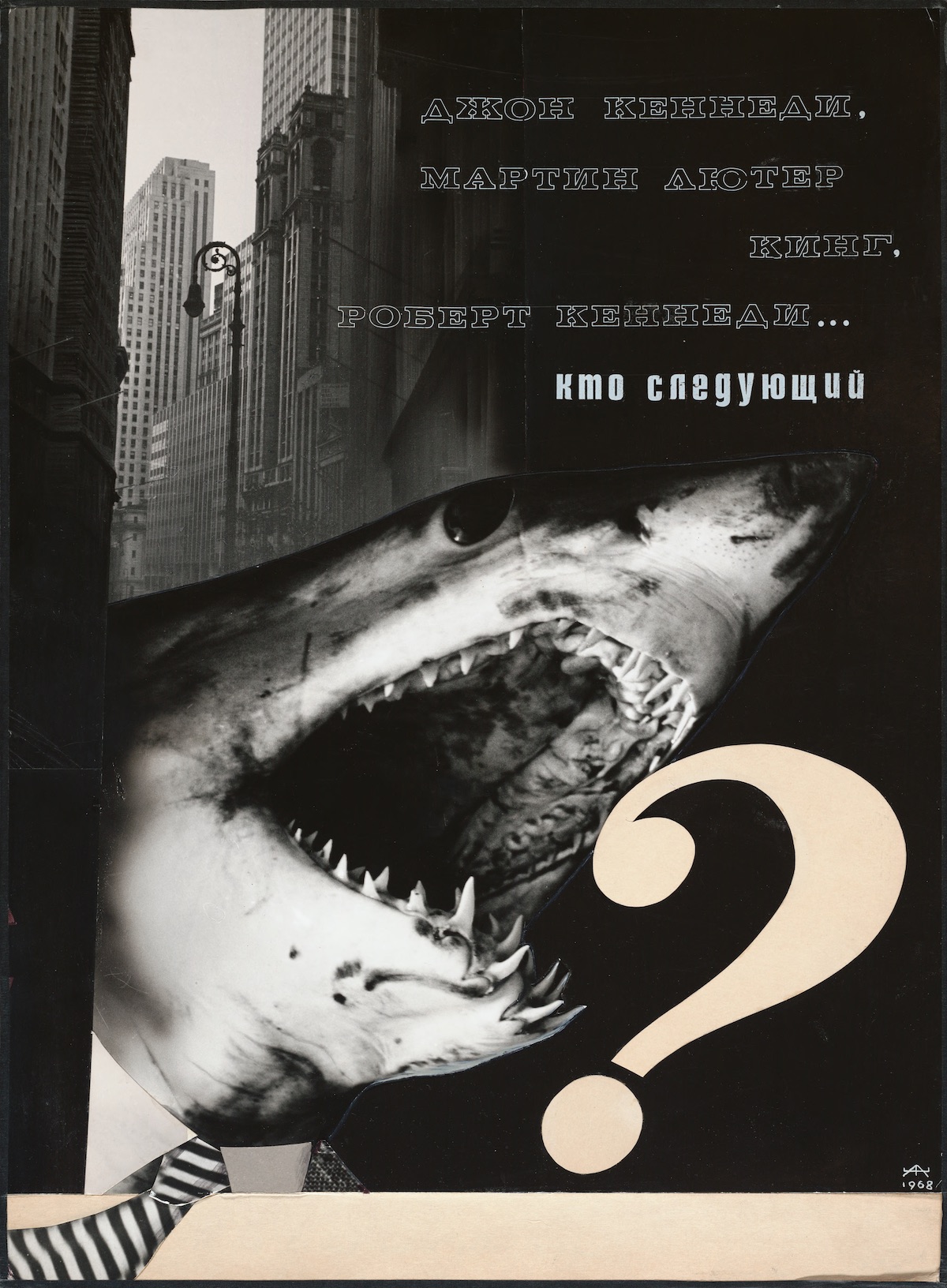
John Kennedy, Martin Luther King, Robert Kennedy … Who will be the next one?
A necktie-wearing shark is shown beneath the title, 1968
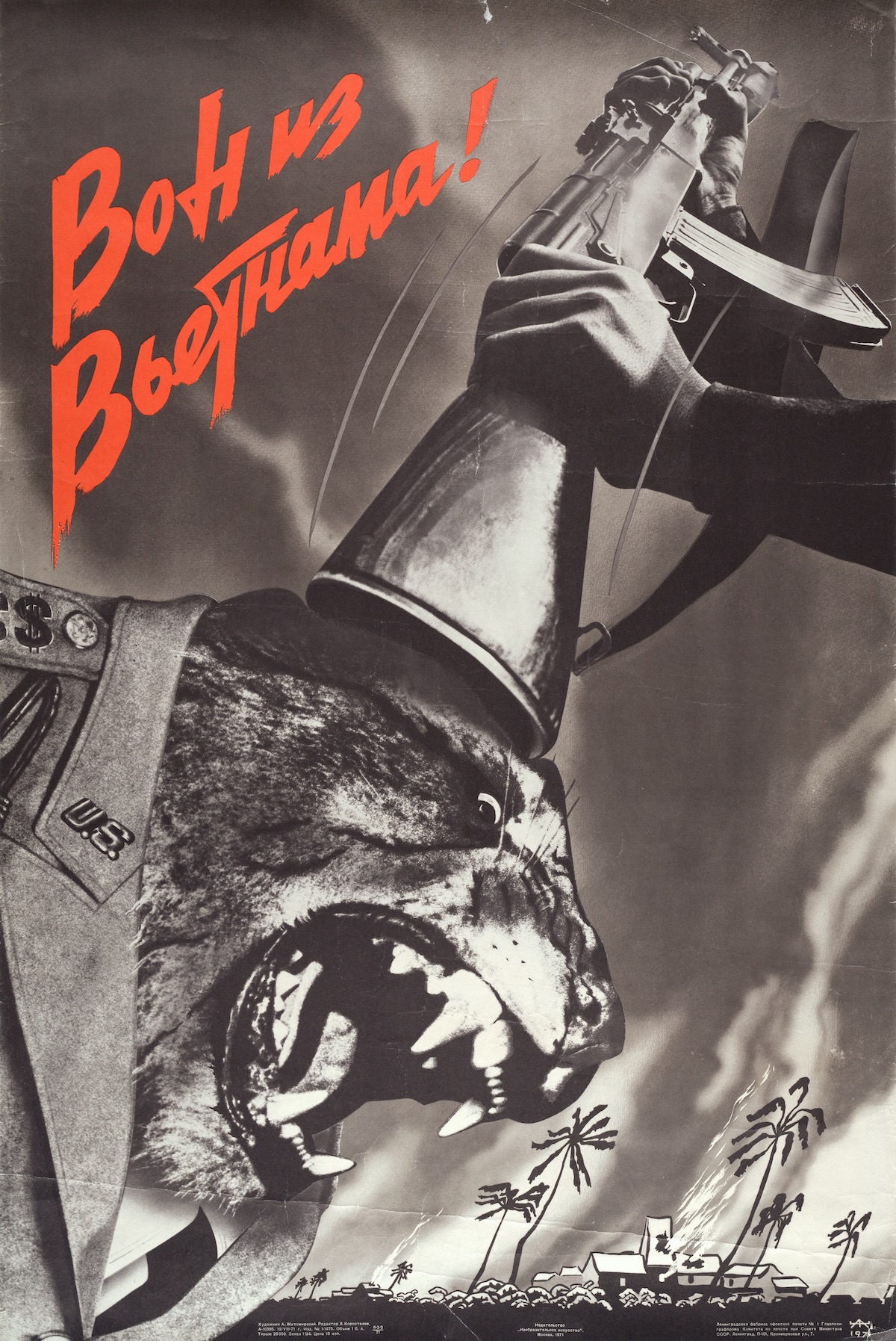
Get him out of Vietnam! The United States, pictured as a vicious animal, is being struck on the head by a rifle butt, 1971
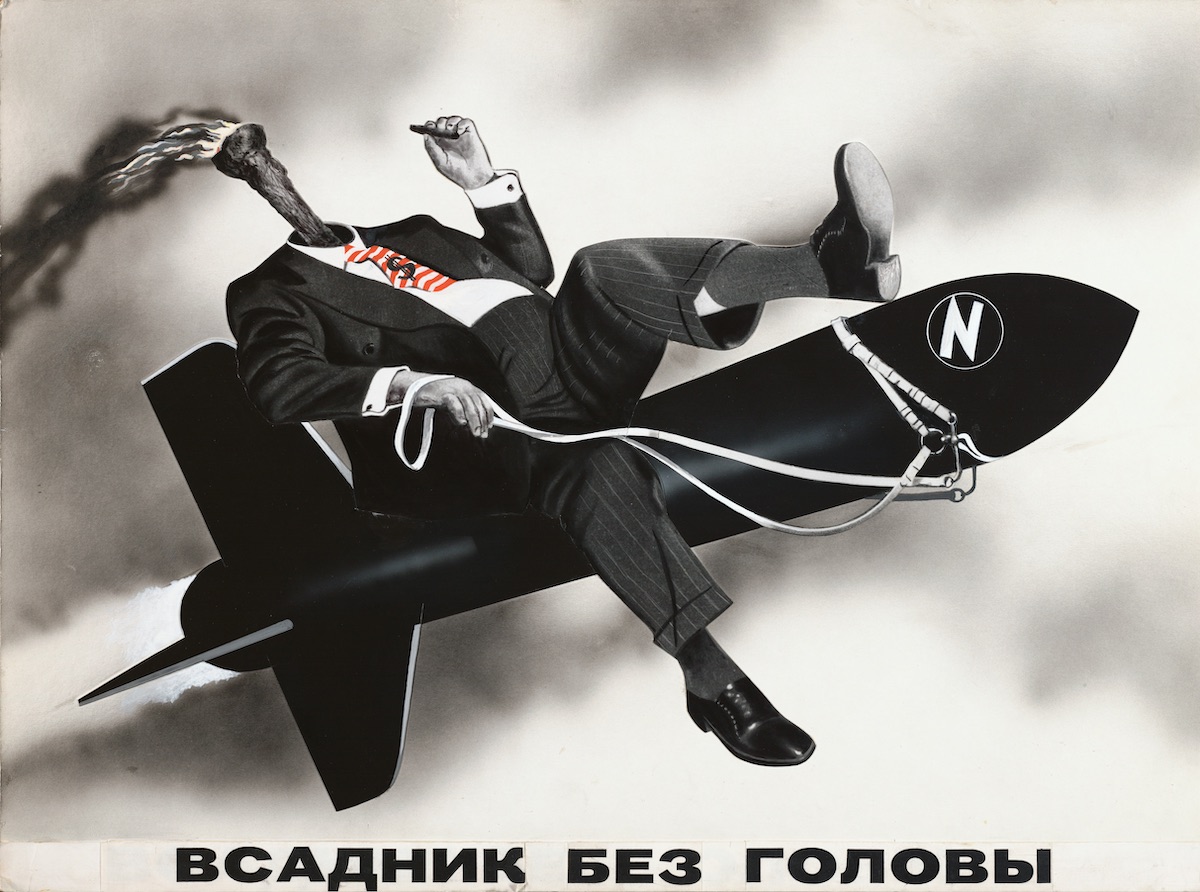
The headless rider: The capitalist, with a torch as a head, is pictured riding a bomb, 1981 by Aleksandr Zhitomirsky
Via: Brown,
Would you like to support Flashbak?
Please consider making a donation to our site. We don't want to rely on ads to bring you the best of visual culture. You can also support us by signing up to our Mailing List. And you can also follow us on Facebook, Instagram and Twitter. For great art and culture delivered to your door, visit our shop.