“Women do not do any of the creative work in connection with preparing the cartoons for the screen, as that work is performed entirely by young men.”
– Disney, 1938
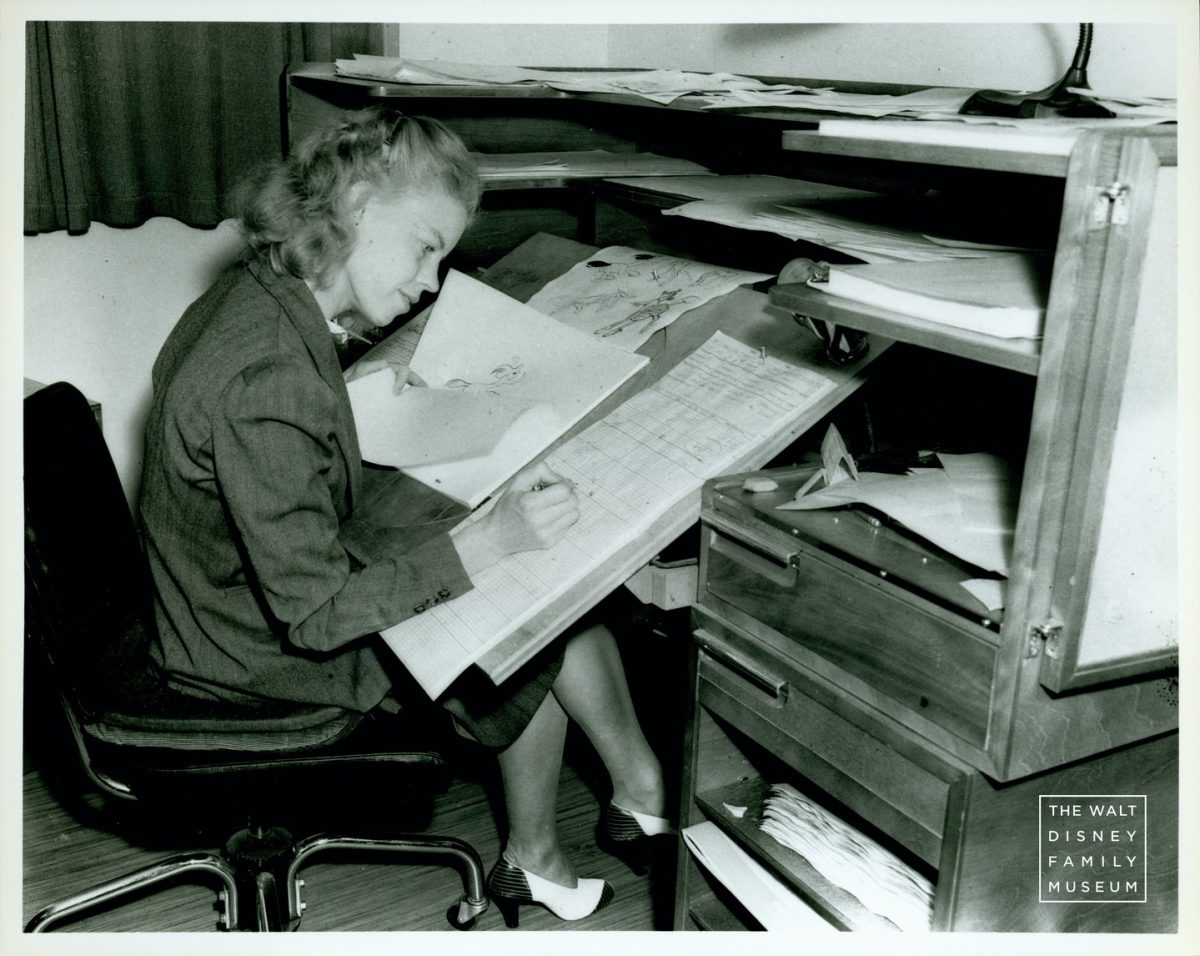
Portrait of Disney animator Retta Scott working on Bambi in 1941
In June 1938, Mary V. Ford applied for work at Disney. A year earlier she’d seen Disney’s Snow White and the Seven Dwarfs. Excited by the cel-based cinematic animation, she wanted to pursue a career as an artist.
The Disney company sent her the standard rejection letter sent to all female applicants at a time when the so-called “Nine Old Men” – a group of animators responsible for some of Disney’s greatest hits – were producing great work. It would be another four years until Disney’s first female animator, Retta Scott, was allowed to work on Bambi.
Mary V. Ford never got her dream job in animation. She taught art at a middle school in Hattiesburg, Mississippi. After Mary’s death in 2003, her family discovered this letter in a box in her basement. For added impact, the letter was sent to her by another woman.
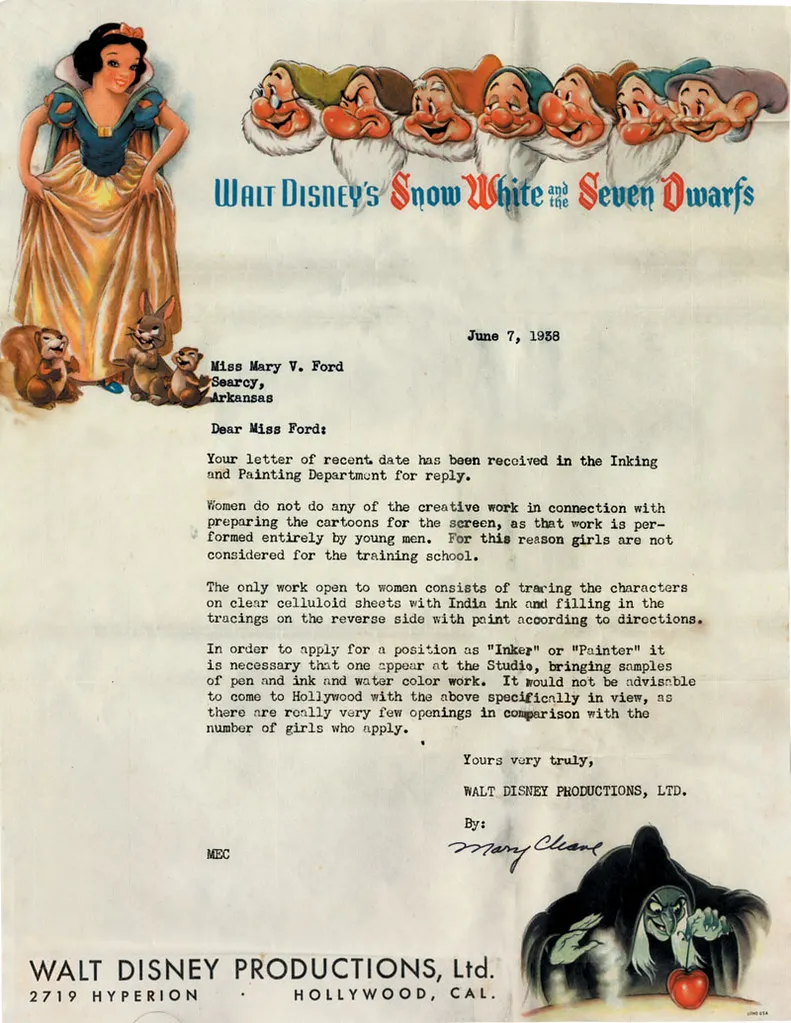
June 7, 1938
Miss Mary V. Ford
Searcy,
ArkansasDear Miss Ford,
Your letter of recent date has been received in the Inking and Painting Department for reply.
Women do not do any of the creative work in connection with preparing the cartoons for the screen, as that work is performed entirely by young men. For this reason girls are not considered for the training school.
The only work open to women consists of tracing the characters on clear celluloid sheets with Indian ink and filling in the tracings on the reverse side with paint according to directions.
In order to apply for a position as “Inker” or “Painter” it is necessary that one appear at the Studio, bringing samples of pen and ink and water color work. It would not be advisable to come to Hollywood with the above specifically in view, as there are really very few openings in comparison with the number of girls who apply.
Yours very truly,
WALT DISNEY PRODUCTIONS, LTD
By:
[Signed by ‘Mary Cleave’]
The Wartime Revolution And Walt Hires Women
On February 10, 1941, Walt Disney said the studio would begin to train women artists:
“Another ugly rumor is that we are trying to develop girls for animation to replace higher-priced men. This is the silliest thing I have ever heard of. We are not interested in low-priced help. We are interested in efficient help. Maybe an explanation of why we are training the girls is in order. First, I would like to qualify it with this – that if a woman can do the work as well, she is worth as much as a man.
“The girls are being trained for inbetweens for very good reasons. The first is, to make them more versatile, so that the peak loads of inbetweening and inking can be handled. Believe me when I say that the more versatile our organization is, the more beneficial it is to the employees, for it assures steady employment for the employee, as well as steady production turnover for the Studio.
“The second reason is that the possibility of a war, let alone the peacetime conscription, may take many of our young men now employed, and especially many of the young applicants. I believe that if there is to be a business for these young men to come back to after the war, it must be maintained during the war. The girls can help here.
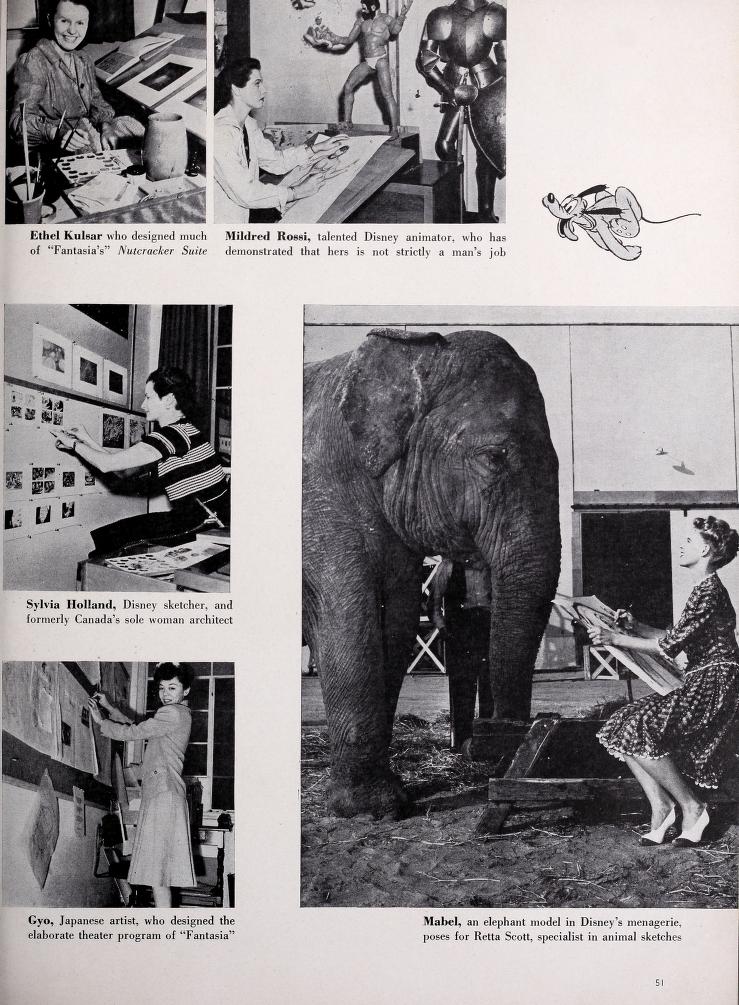
“Third, the girl artists have the right to expect the same chances for advancement as men, and I honestly believe that they may eventually contribute something to this business that men never would or could. In the present group that are training for inbetweens there are definite prospects, and a good example is to mention the work of Ethel Kulsar and Sylvia Holland on The Nutcracker Suite, and little Retta Scott, of whom you will hear more when you see Bambi.”
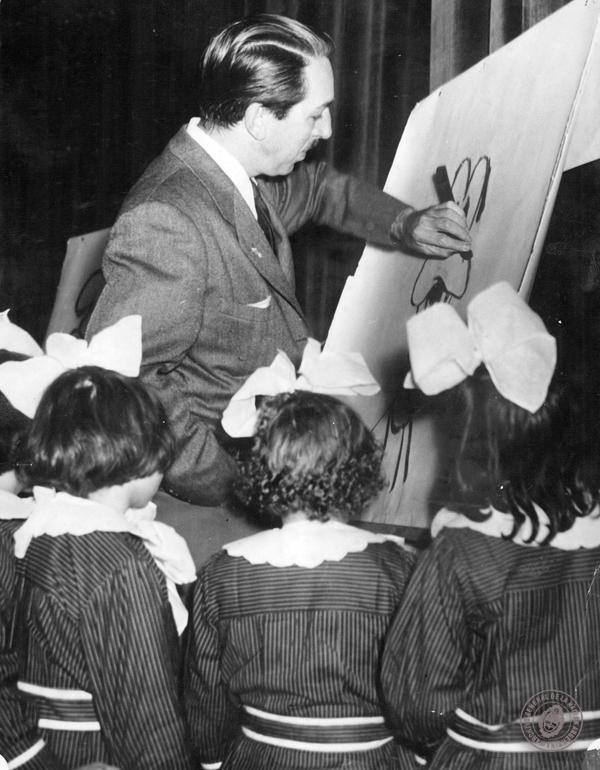
Disney drawing Goofy for a group of girls in Argentina, 1941
Girls at Work for Disney
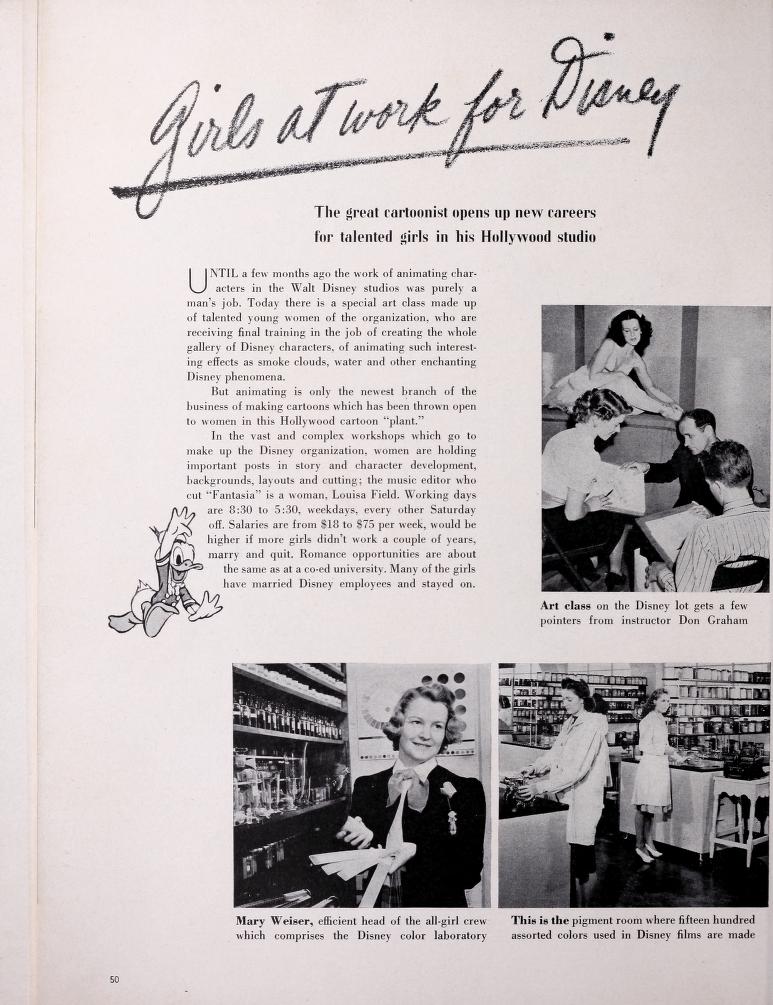
In May 1941, Glamour magazine published a two-page spread entitled “Girls at Work for Disney,” that featured photos of some of the women who were “holding important posts in story and character development, backgrounds, layouts, and cutting.” The author of the piece (and keep in mind this was a women’s magazine) wrote, “Salaries are from $18 to $75 per week, would be higher if more girls didn’t work a couple of years, marry and quit,” and continued, “Romance opportunities are about the same as at a co-ed university.”

How Walt Disney Cartoons Are Made, 1939
To get more of an idea of what life was like at Disney in the pre-war years, here’s a snippet of the 1939 promotional documentary short How Walt Disney Cartoons Are Made. Men work and “pretty girls” do the inking and colour.
via Sociological Images & Mefi
Would you like to support Flashbak?
Please consider making a donation to our site. We don't want to rely on ads to bring you the best of visual culture. You can also support us by signing up to our Mailing List. And you can also follow us on Facebook, Instagram and Twitter. For great art and culture delivered to your door, visit our shop.