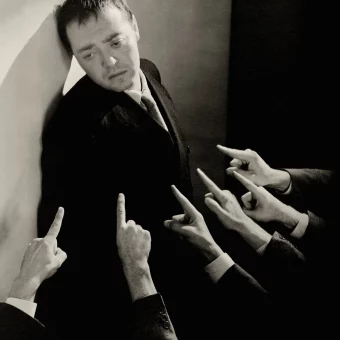
“I don’t know anything about boxing, I’m just painting two men trying to kill each other”
– George Bellows
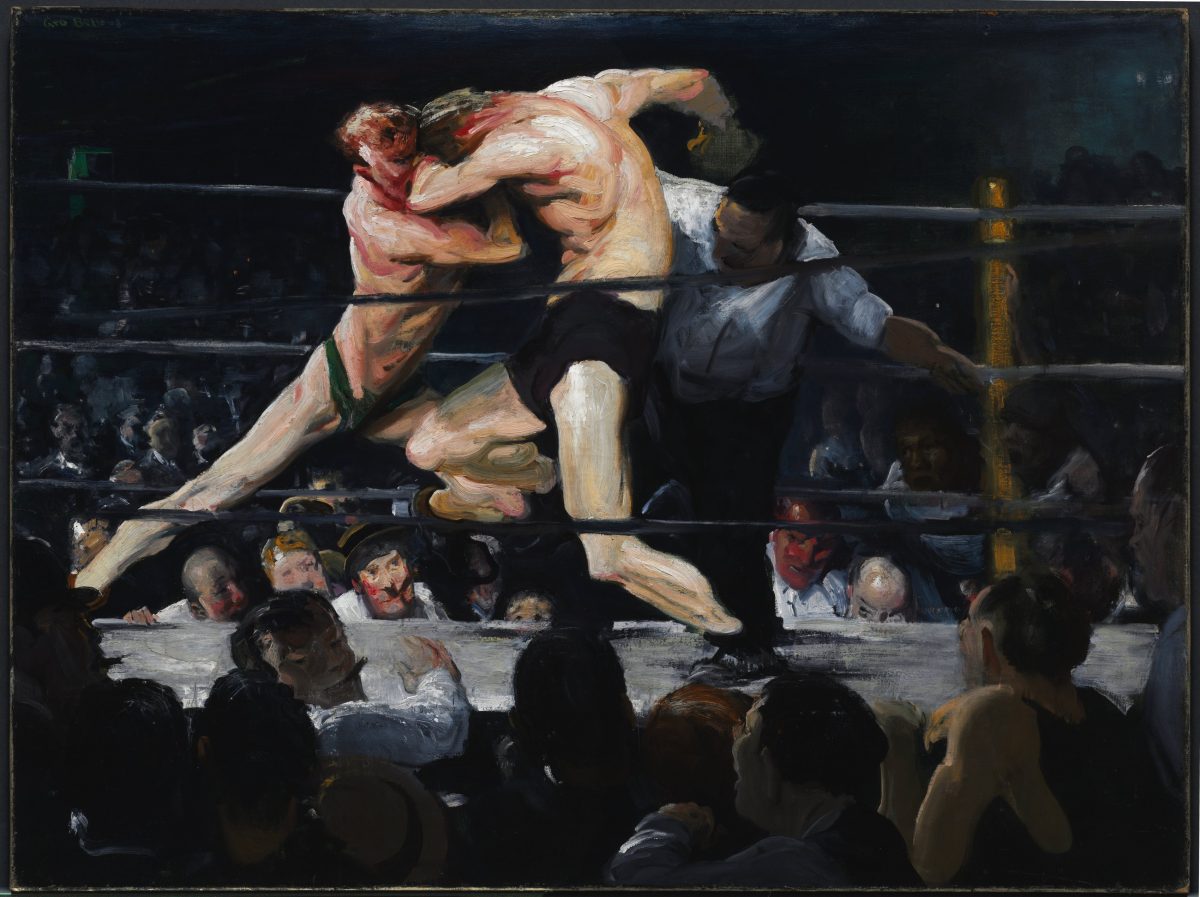
George Bellows (August 1882 – January 1925) was a frequent visitor to Sharkey’s Athletic Club, the lively saloon in Manhattan with a backroom boxing ring. Founded by Tom “Sailor” Sharkey (November 26, 1873 – April 17, 1953), an ex-boxer who had served in the US Navy, the club was a place for fighters and fans when public boxing was illegal in New York.
Participation was usually limited to members of a particular club, but whenever an outsider competed, he was given temporary membership and known as a ‘stag’.
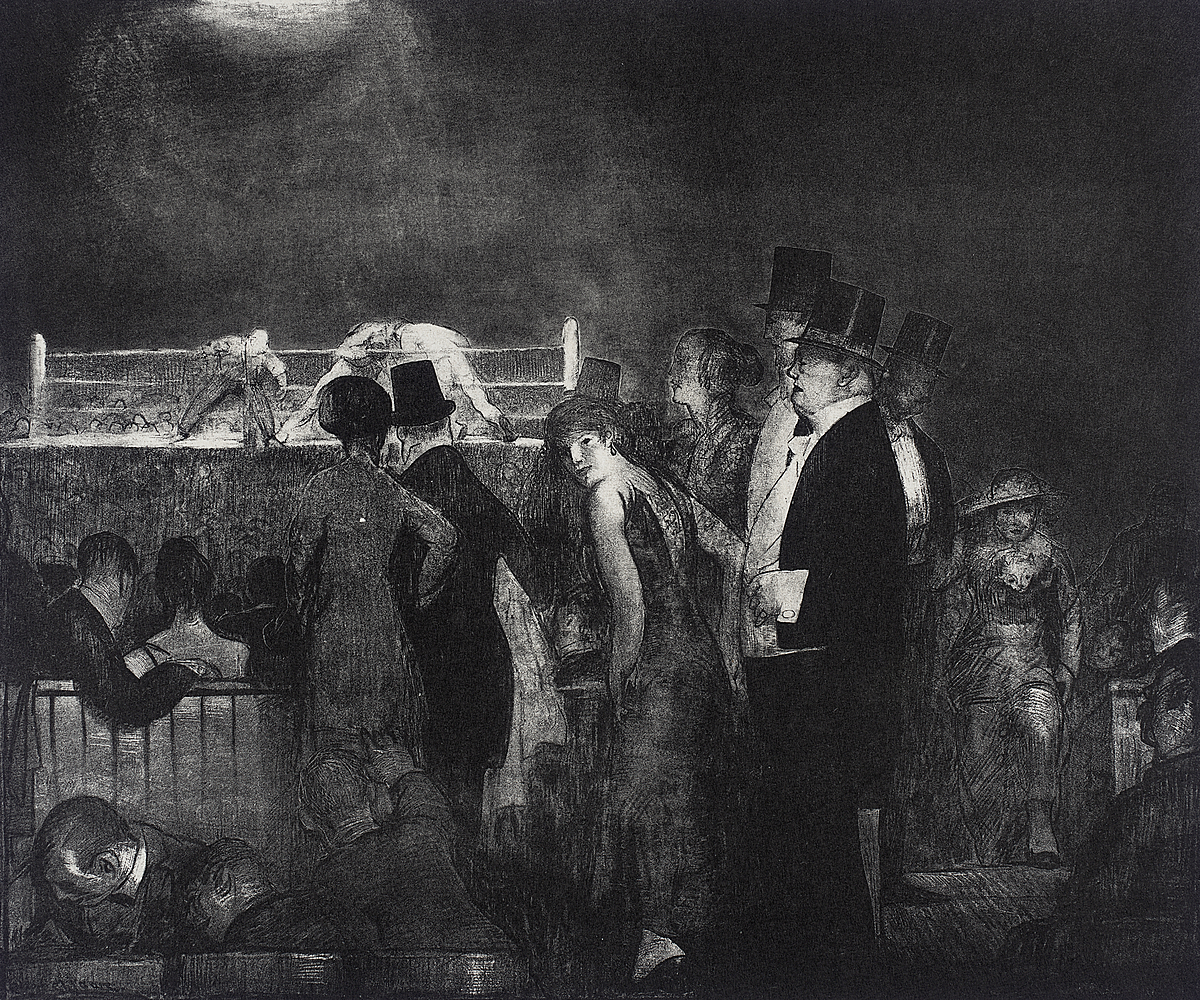
Preliminaries, 1916 by George Bellows, via
George Bellows and the Empire State
George Bellows painted canvases that throb with the rollicking energy of modern New York city. A member of the Ashcan School, a group of painters intent on showing American life in its unalloyed immediacy, Bellows painted a tough, rough, freewheeling New York City, seeped in sweat, endeavour and the swirling energy of the skyscraper age.
The New York Sun summed up in its review of Bellows’ Pennsylvania Station Excavation (1909):
“Here is a slice of New York cleanly observed, cleanly transcribed. It is not pretty. Nor is the tunnel at full blast very alluring. When you paint a crab-apple don’t paint us a luscious peach (but the idealists always clamour for the pretty peach).”
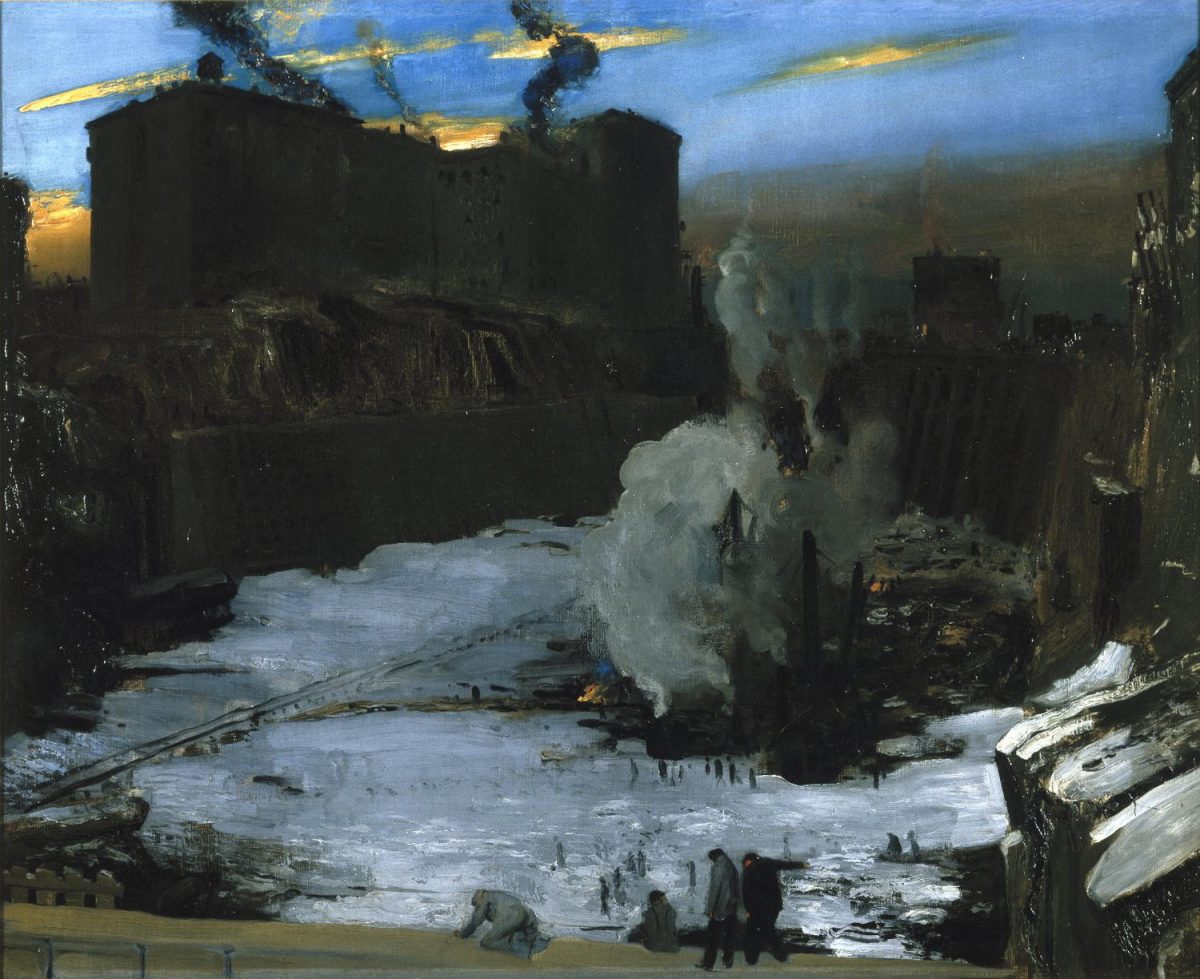
Pennsylvania Station Excavation, via
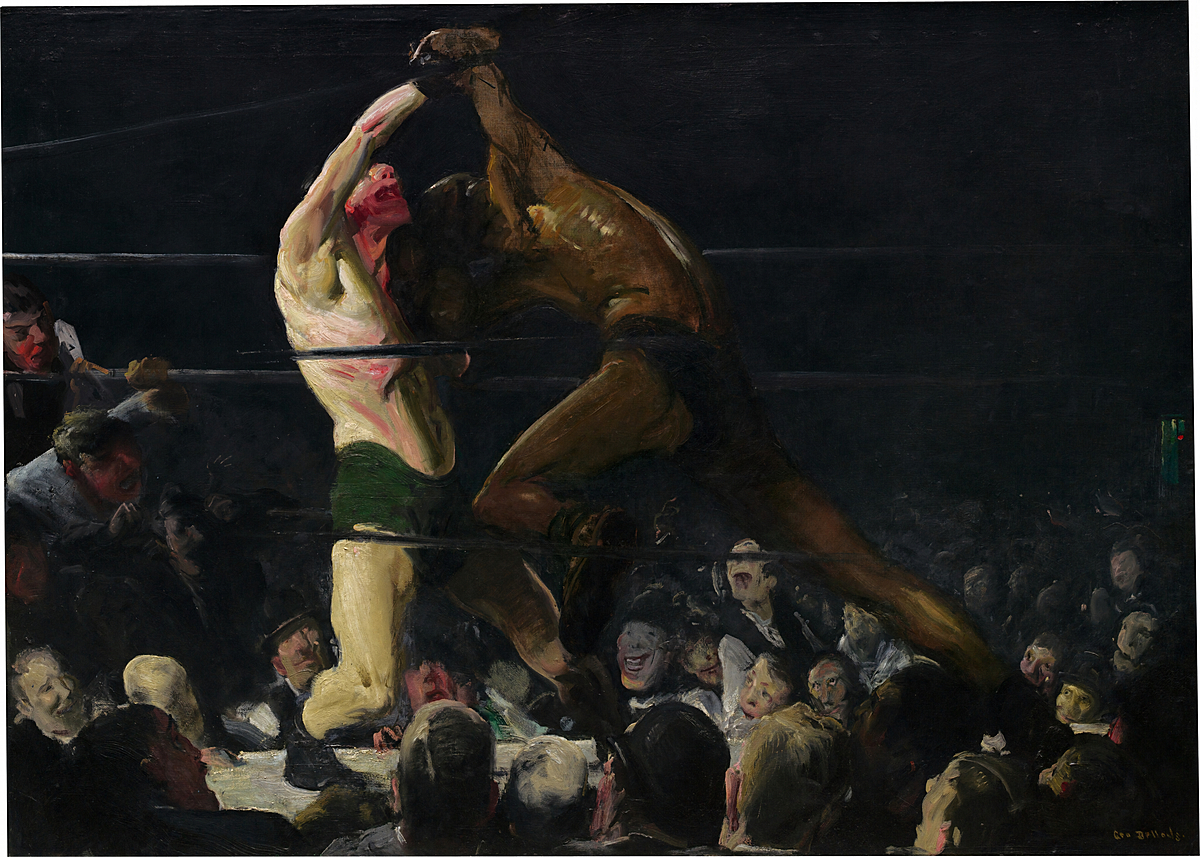

Both Members of This Club by George Bellows – 1909
Arriving in New York from his native Ohio in 1904, Bellows painted the city as a site where, as his mentor Robert Henri said, “the battle of human evolution is going on”. Stag at Sharkey’s established Bellows “as a really gutsy, formidable force as a painter on the New York scene. I think people were very shocked by the works. There really hadn’t been anything like this in American painting before.”
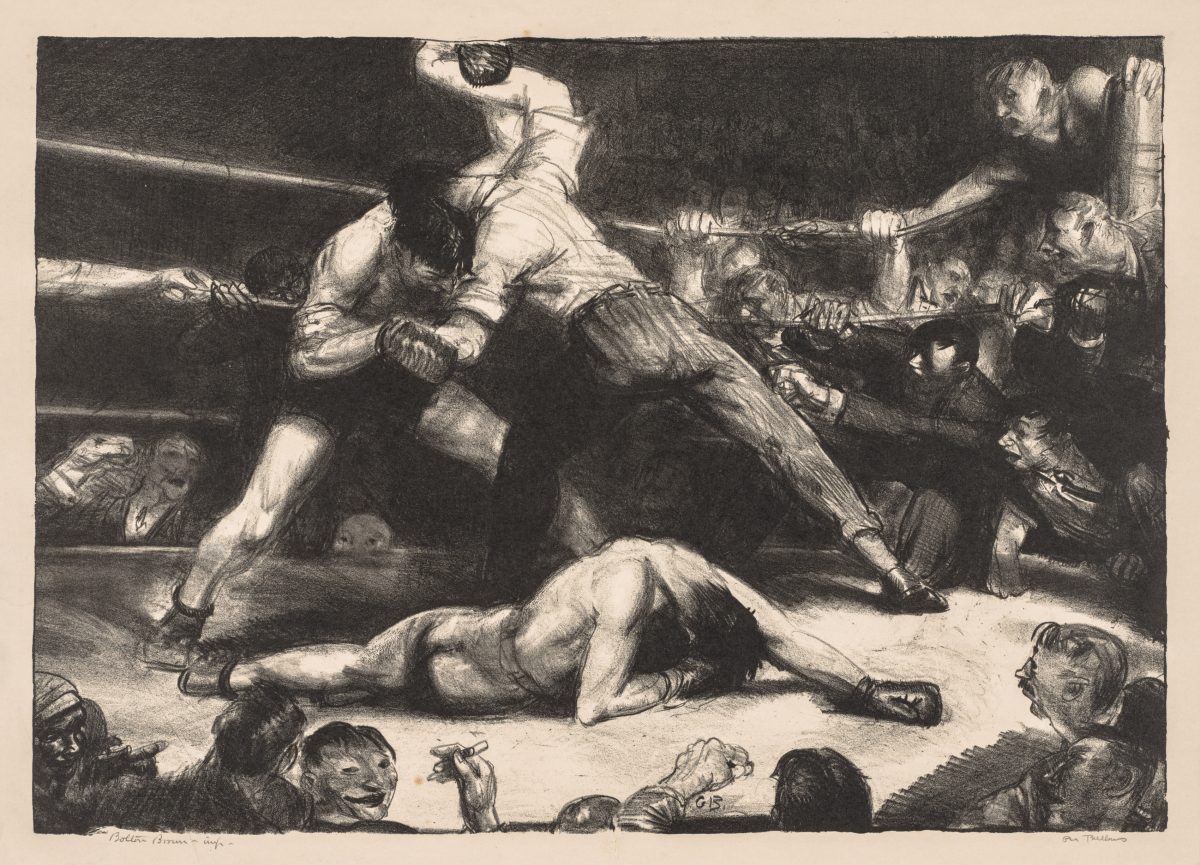
A Knockout, 1921
In addition to painting, Bellows made significant contributions to lithography, helping to expand the use of the medium as a fine art in the U.S. He installed a lithography press in his studio in 1916, and between 1921 and 1924 he collaborated with master printer Bolton Brown on more than a hundred images, some of which you can see here.
Bellows also illustrated numerous books in his later career, including several by H.G. Wells. It was a perfect match. For Wells, New York possessed “a blindly furious energy of growth” combined with “the sense of soulless gigantic forces, that took no heed of men”.
New York was the epicentre and epitome of what President Theodore Roosevelt (1858-1919) called “the strenuous life”.
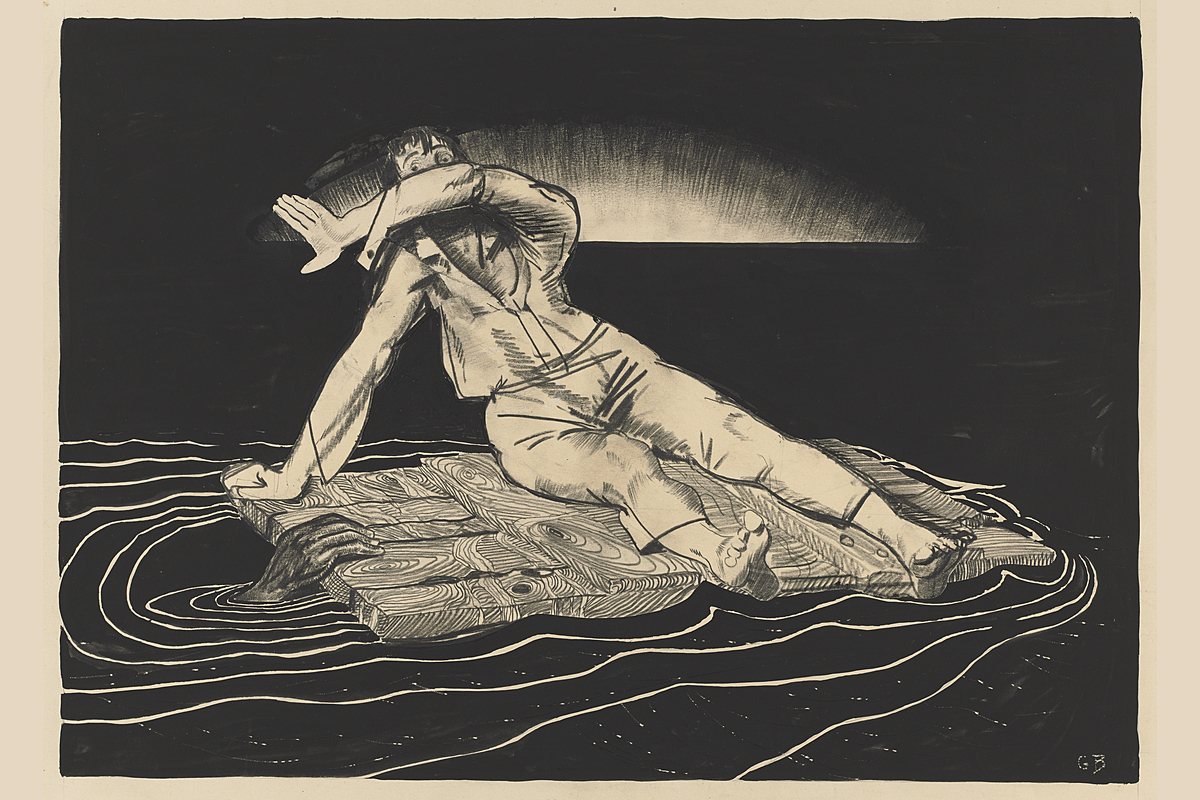

On a Raft c. 1900–1923 George Bellows
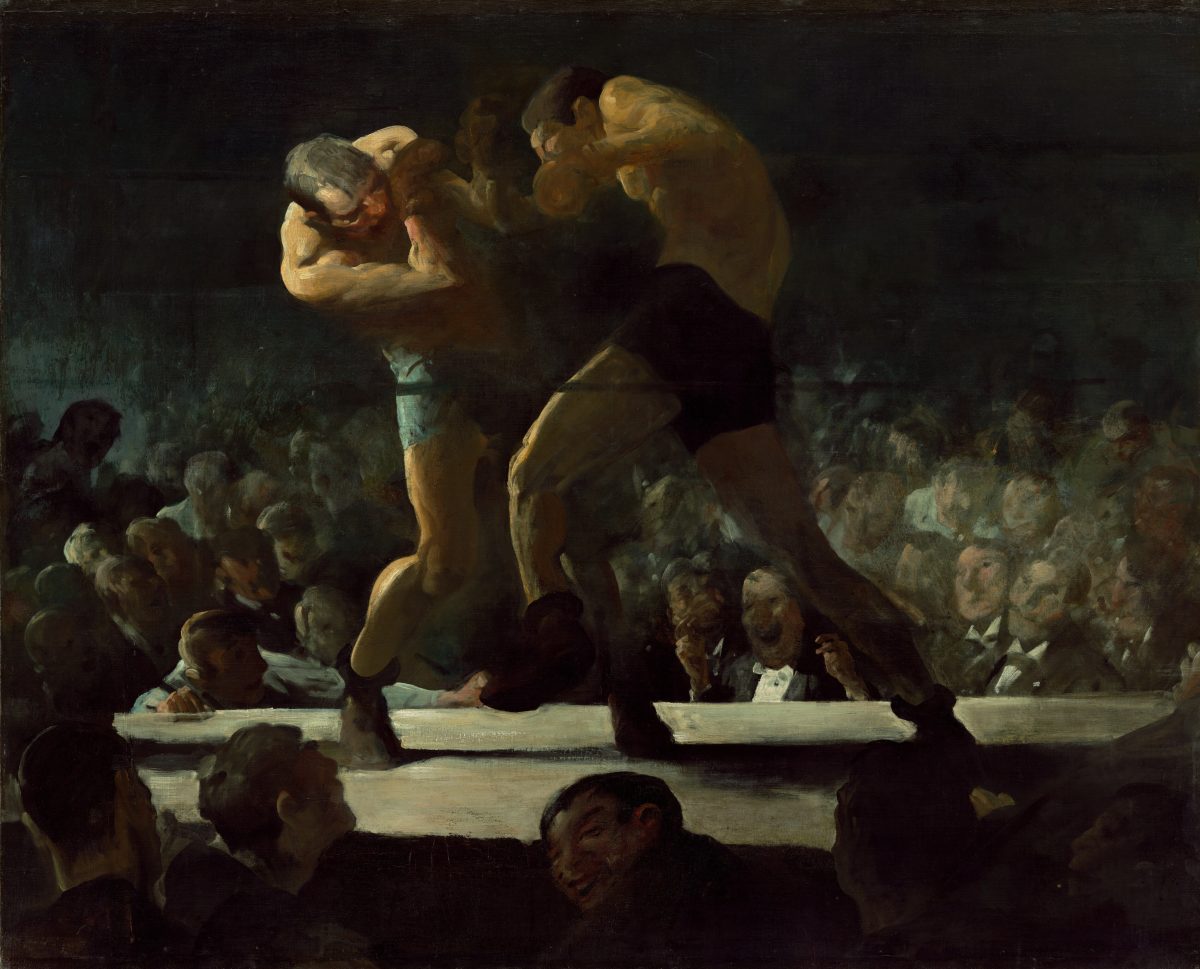
Club Night, 1907, oil on canvas, John Hay Whitney Collection
“The outline of the city became frantic in its effort to explain something that defied meaning. Power seemed to have outgrown its servitude and to have asserted its freedom. The cylinder had exploded, and thrown great masses of stone and steel against the sky. The city had the air and movement of hysteria, and the citizens were crying, in every accent of anger and alarm, that the new forces must at any cost be brought under control.”
– Henry Adams on the New York depicted in Bellows work
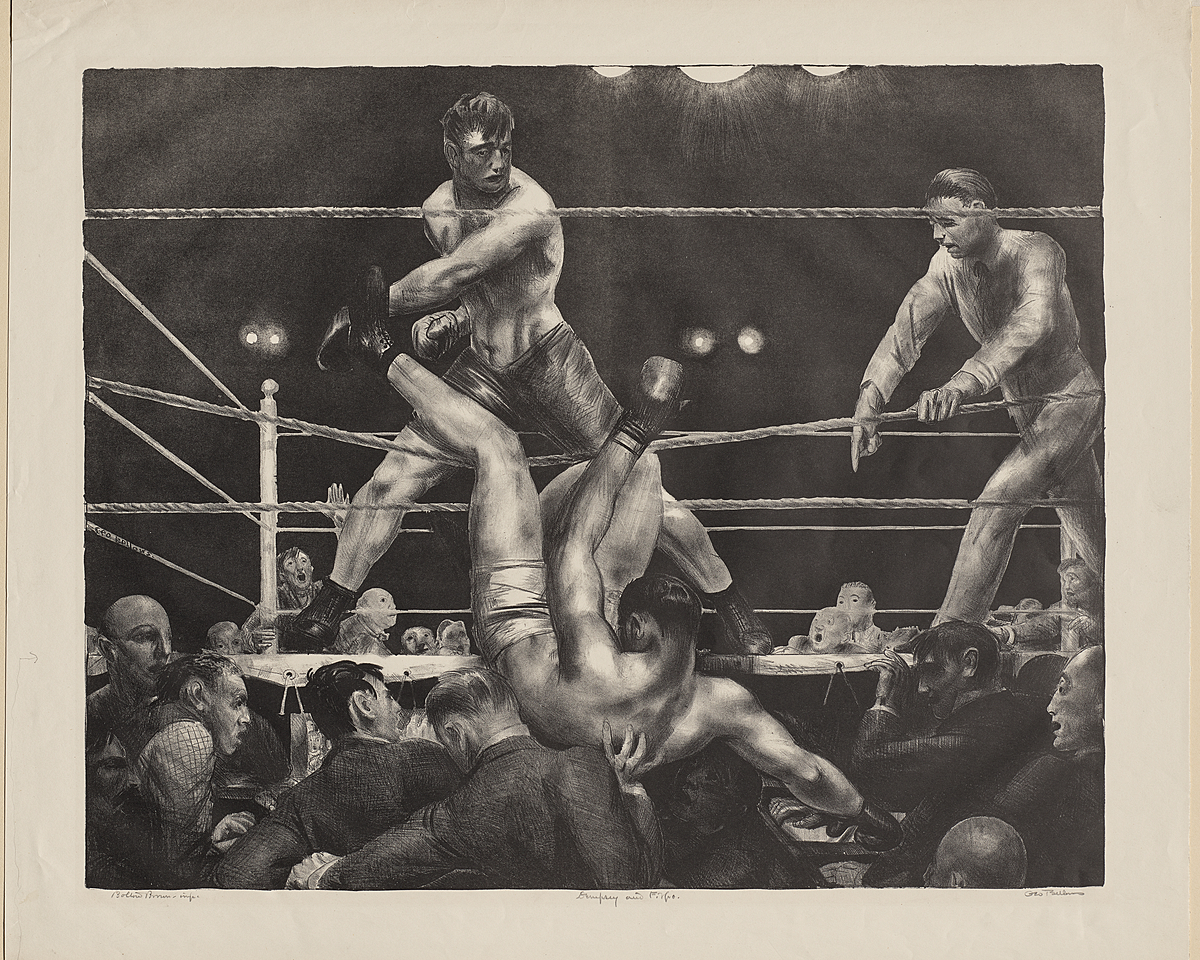
Dempsey and Firpo 1924 George Bellows
“The student of art must be a man first with a good strong conscience and the courage to live up to it. Art could come later… The first prerequisite of a student… was that he be a man and by that was meant that he have guts. Without the attributes of a fighter, he could expect little or no success with an uninterested American public… Henri did not expect the artist to be a normal man, of which there are always too many. He expected him to be a real man, of which there are always too few. Art and manhood was thus compounded into one – an incredibly healthy unity for that time.”
– Guy Pène du Bois, a painter who studied with Bellows under Henri, here explaining Henri’s approach to art
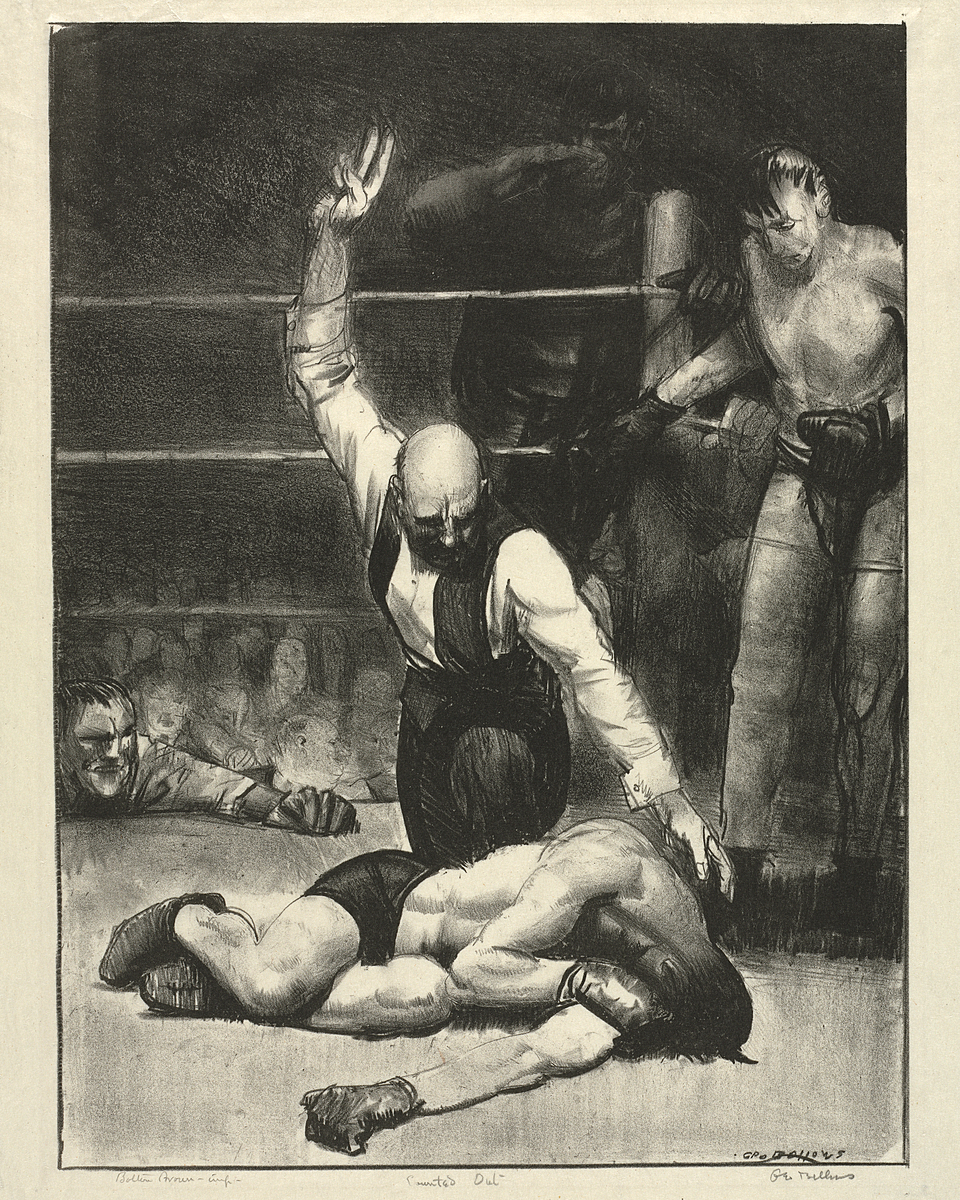
Counted Out, Second Stone, lithograph, 1921
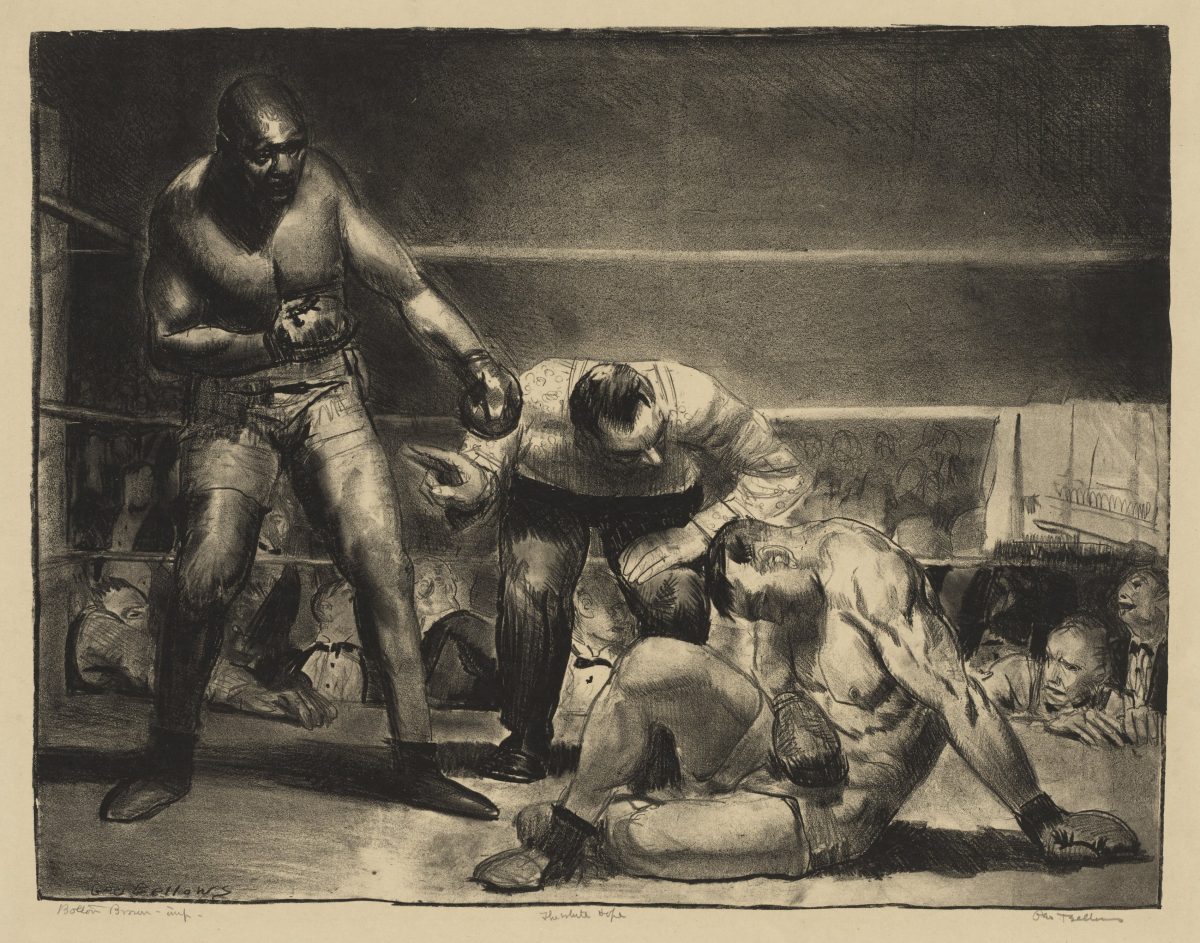
The White Hope, 1921
After Jack Johnson became the first African American world heavyweight champion in 1908, a series of boxing promoters searched for the so-dubbed “Great White Hope” (above) who could dethrone him. Looking at the facial features of the two fighters in this print, some believe its subject commemorates Johnson’s victory over former champion James J. Jeffries in 1910 (Jeffries also fought the aforementioned Sharkey). The outcome of this “fight of the century” sparked racially motivated riots in more than 50 cities across 25 states, leaving 20 people dead. Whether or not The White Hope can be associated with a specific bout, Bellows’s image undercuts notions of white racial superiority with caustic irony.
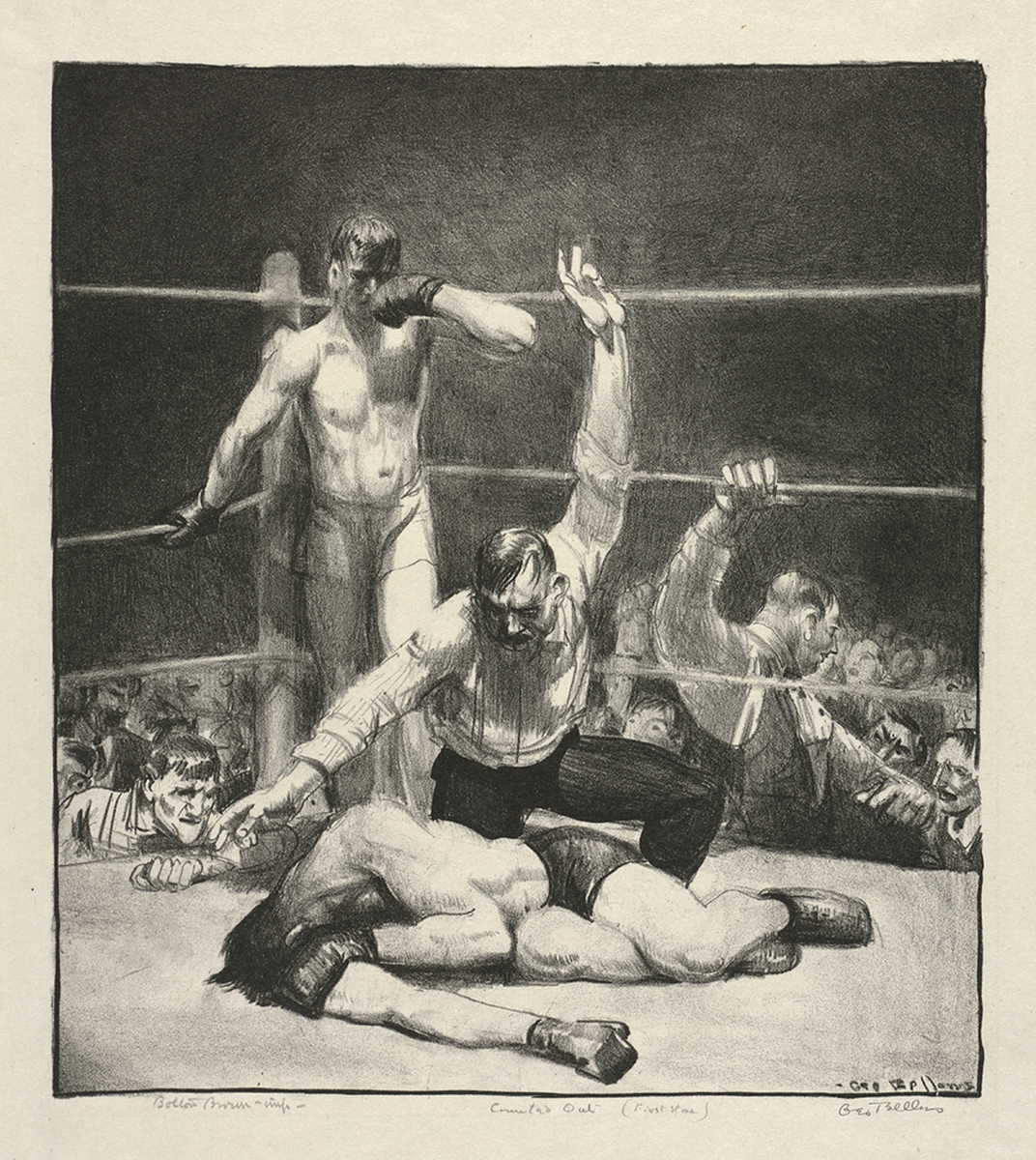
Counted Out, First Stone 1921
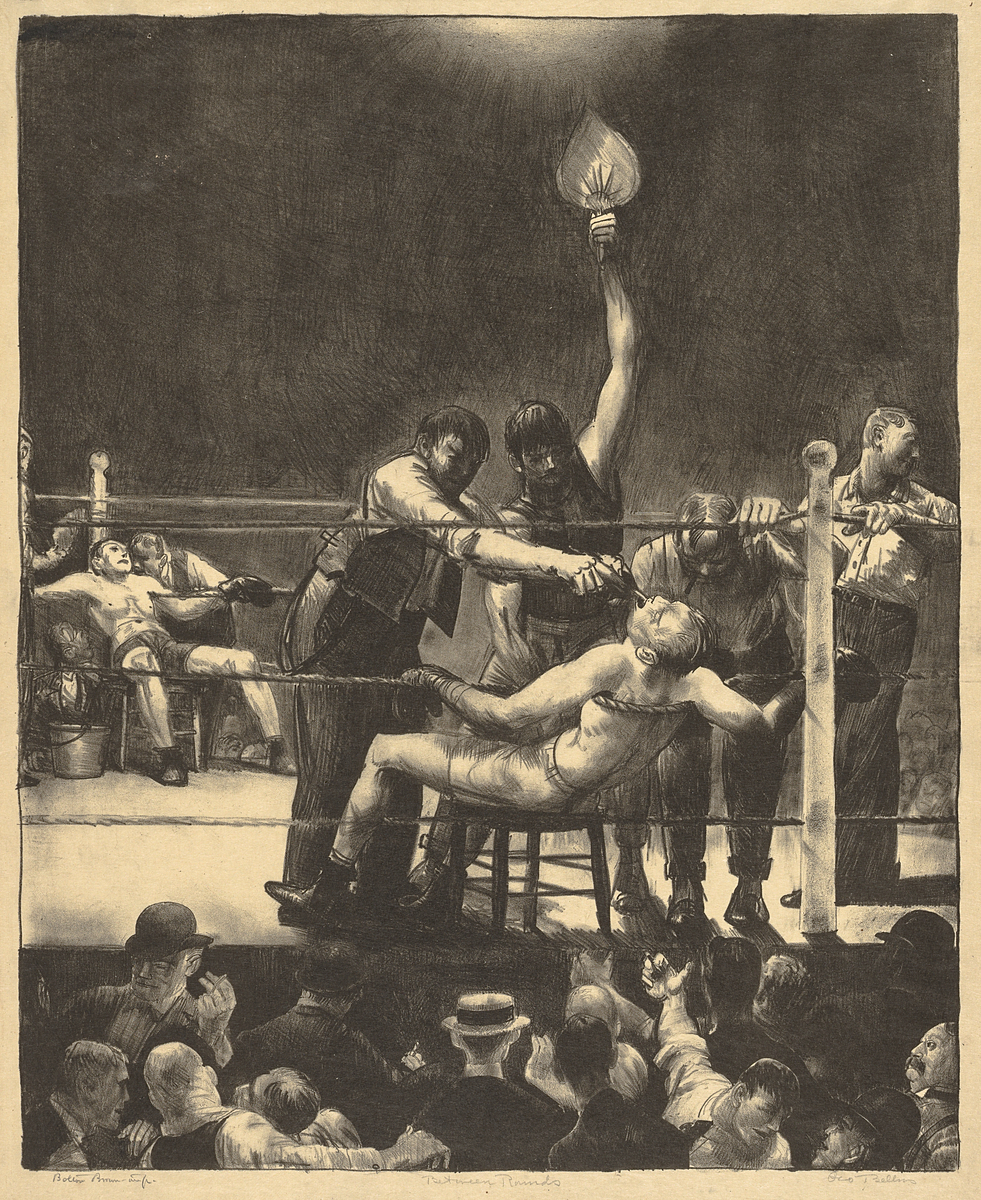
Between Rounds, Large, First Stone 1916 George Bellows
George Bellows work is in the shop.
Would you like to support Flashbak?
Please consider making a donation to our site. We don't want to rely on ads to bring you the best of visual culture. You can also support us by signing up to our Mailing List. And you can also follow us on Facebook, Instagram and Twitter. For great art and culture delivered to your door, visit our shop.