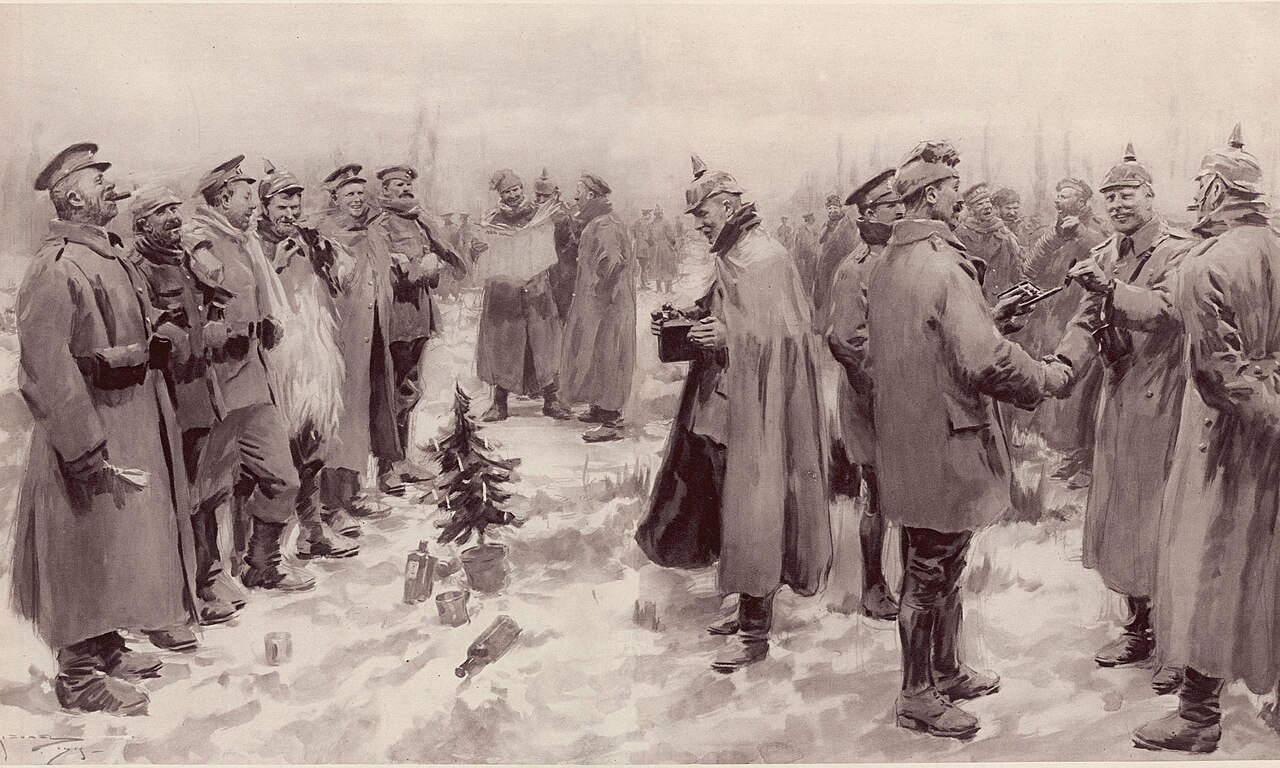
On Christmas in 1914, British and German troops stopped fighting in World War 1. The din of gunfire was replaced by seasonal greetings and song. An impression of what became known as the Christmas Truce was published in the Illustrated London News on January 9, 1915. A. C. Michael’s artwork was captioned “British and German Soldiers Arm-in-Arm Exchanging Headgear: A Christmas Truce between Opposing Trenches”.
Henry William Williams (1 December 1895 – 13 August 1977) was in the trenches. The 19-year-old private in the London Rifle Brigade, a Territorial battalion in the front-line trenches at Ploegsteert (popularly known as ‘Plugstreet’) Wood, Belgium, wrote to his mother immediately after the event, giving an eyewitness account”
Dear Mother, I am writing from the trenches. It is 11 o’clock in the morning. Beside me is a coke fire, opposite me a ‘dug-out’ (wet) with straw in it. The ground is sloppy in the actual trench, but frozen elsewhere. In my mouth is a pipe presented by the Princess Mary. In the pipe is tobacco. Of course, you say. But wait. In the pipe is German tobacco. Haha, you say, from a prisoner or found in a captured trench. Oh dear, no! From a German soldier. Yes a live German soldier from his own trench. Yesterday the British & Germans met & shook hands in the Ground between the trenches, & exchanged souvenirs, & shook hands. Yes, all day Xmas day, & as I write. Marvellous, isn’t it?
This is only for about a mile or two on either side of us (so far as we know). It happened thuswise.
On Xmas eve both armies sang carols and cheered & there was very little firing. The Germans (in some places 80 yds away) called to our men to come and fetch a cigar & our men told them to come to us. This went on for some time, neither fully trusting the other, until, after much promising to ‘play the game’ a bold Tommy crept out & stood between the trenches, & immediately a Saxon came to meet him. They shook hands & laughed & then 16 Germans came out.
Thus the ice was broken. Our men are speaking to them now…
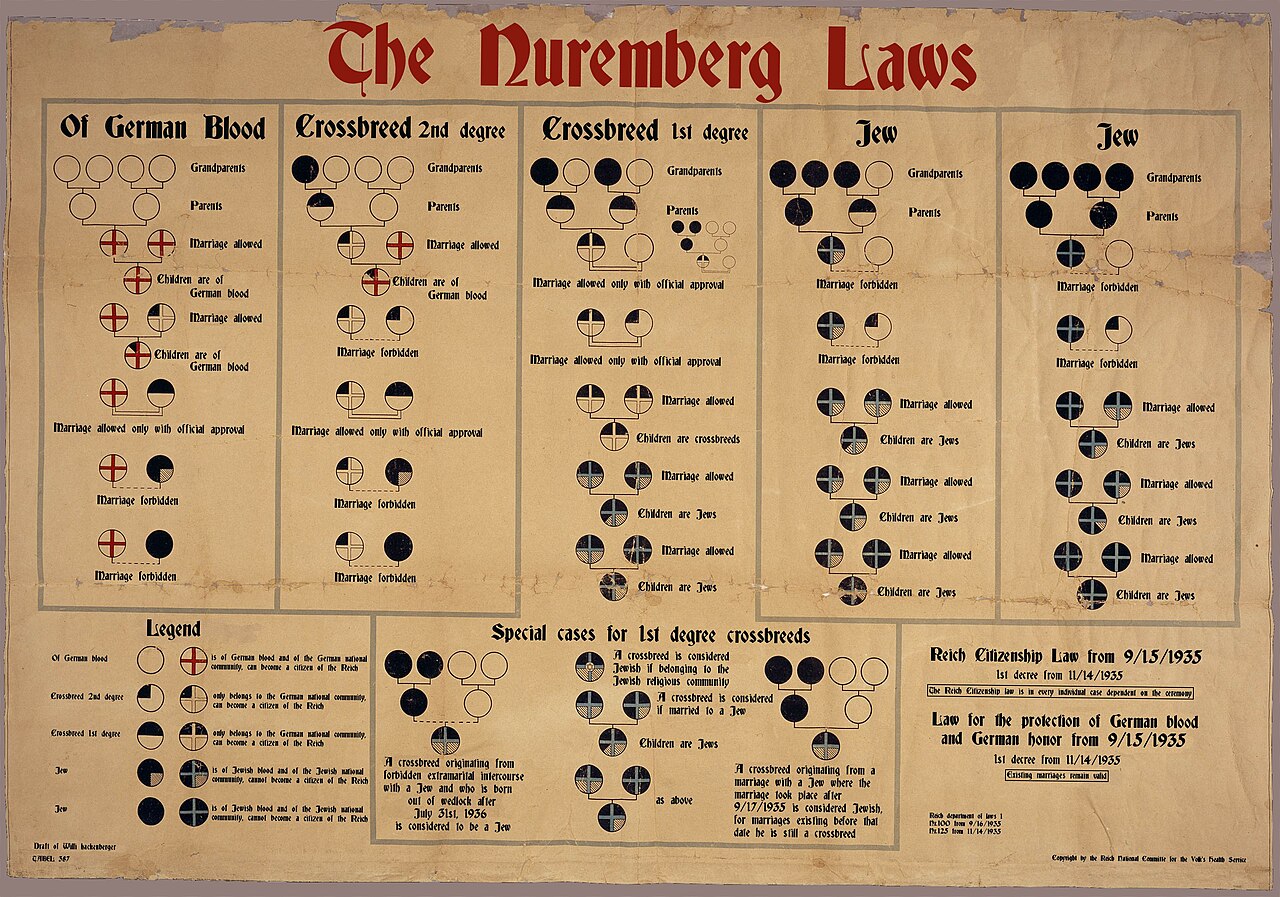
1935 chart, edited with English translations, showing racial classifications under the Nuremberg Laws: German, Mischlinge, and Jew.
Williamson would go on to be an antisemite, a Nazi sympathiser and a member of Oswald Mosley’s British Union of Fascists. In a letter to Time and Tide magazine in 1936, as Jews were being persecuted throughout Germany, he called Adolf Hitler “a very wise and steadfast and truth-perceiving father of his people; a man… without personal ambitions, a vegetarian, non-smoker, non-drinker, without even a bank-balance.”
Williamson is though best known as the author of Tarka the Otter, which won the Hawthornden Prize for Literature in 1928 and was filmed in 1977.
Does the man’s politics cloud his art? Can we separate Williamson’s books from his personal bigotry – a question many have asked for the racist author Roald Dahl? The BBC paints a highly sympathetic picture of Williamson’s life, applying a light gloss to his vicious racism and notes that poet laureate Ted Hughes in delivering the author’s funeral address in 1977, recalled reading Tarka for the first time aged 11, and recognising it as “a holy book, a soul-book, written with the life blood of an unusual poet”.
Williamson was a fascist. But his letter from the trenches can be viewed as a witness statement of how in dark times the light can still get in. So let’s end with horror, but with hope. This short film that captures the story and spirit of this symbolic moment of peace, grace, and humility amid one of history’s most violent and disgraceful failures of humanity.
Would you like to support Flashbak?
Please consider making a donation to our site. We don't want to rely on ads to bring you the best of visual culture. You can also support us by signing up to our Mailing List. And you can also follow us on Facebook, Instagram and Twitter. For great art and culture delivered to your door, visit our shop.