Unrest in Paris. We’ve been back to the French captial in the spring and summer of 1968 before, sharing pubic artork from The Atelier Populaire and the homemade flyers that issued a call to arms and demanded a revolution. Now we see more of the posters stuck to the city’s walls.
Beneath some of the images are rough translations of the original French into English.
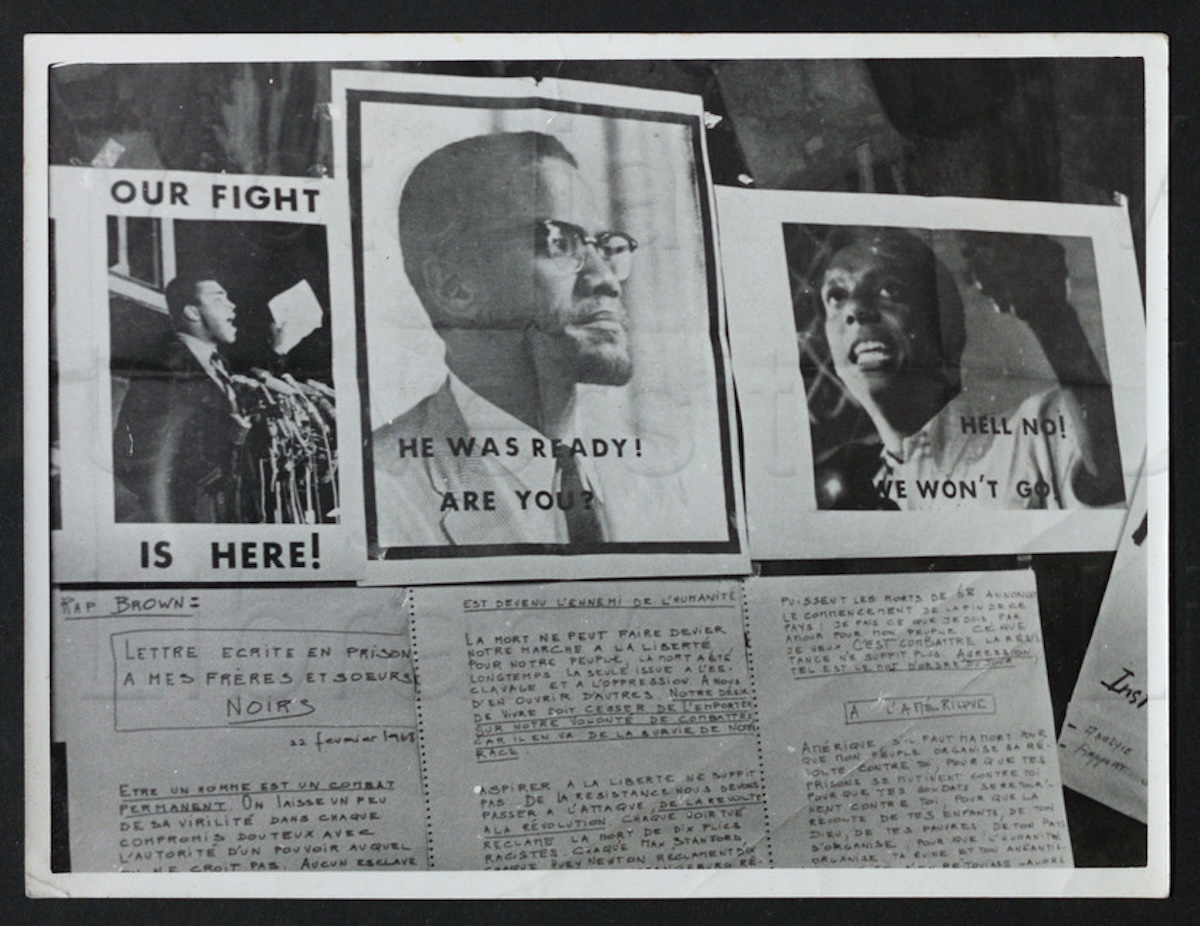
Letters written in prison to my black brothers and sisters.
22 February 1968
Being a man is a constant battle. One loses a bit of their manhood in each stale compromise to the authority of a power in which [cut off]
[…] has become the enemy of humanity.
Death cannot divert our path to liberty. For our people, death was always the only way out of slavery and oppression. We must open others. Our will to live must no longer supersede our will to fight, fighting will determine the survival of our race.
Aspiring to freedom is not enough. We must move from resistance to the attack, from revolt to revolution. Every black killed demands the death of 10 racist cops. Every Max Standford, every Huey Newton [cut off]
[…] May the deaths of 68 signal the beginning of the end of this country. I do what I must out of love for my people. What I want is to fight. Resistance is not enough. Aggression is the order of the day.
To America:
America, if it takes my death for my people to organize a revolt against you, so that your prisons mutiny against you, so that your soldiers turn against you, to organize your children, your God, your poor, your country in revolt, so that humanity organizes your ruin [cut off]
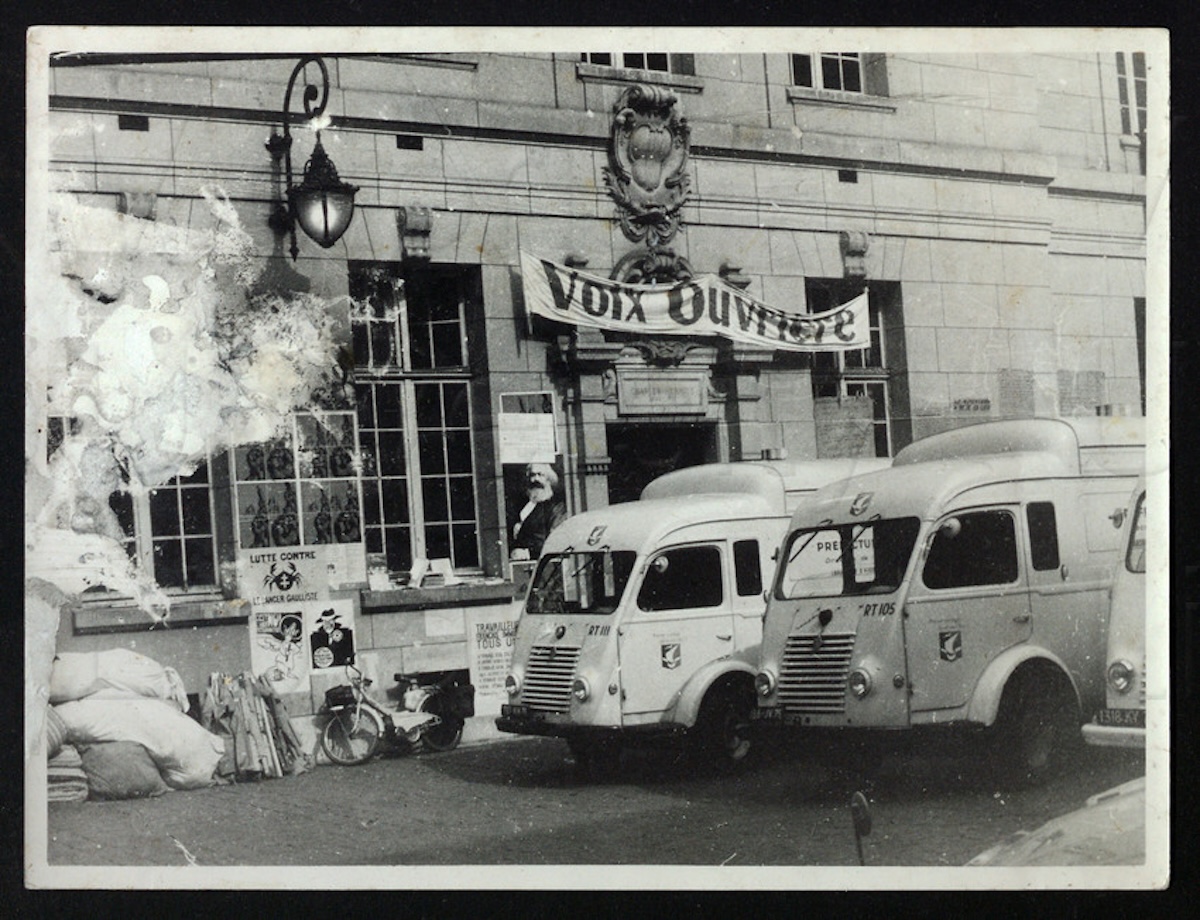
Collection of vehicles parked at Sorbonne. Posters and a banner are visible affixed to the building walls. The entrance and lower facade pictured is the tribute to Charles Hermite at Sorbonne University.
[Central banner reads:]
“Workers’ Voice”
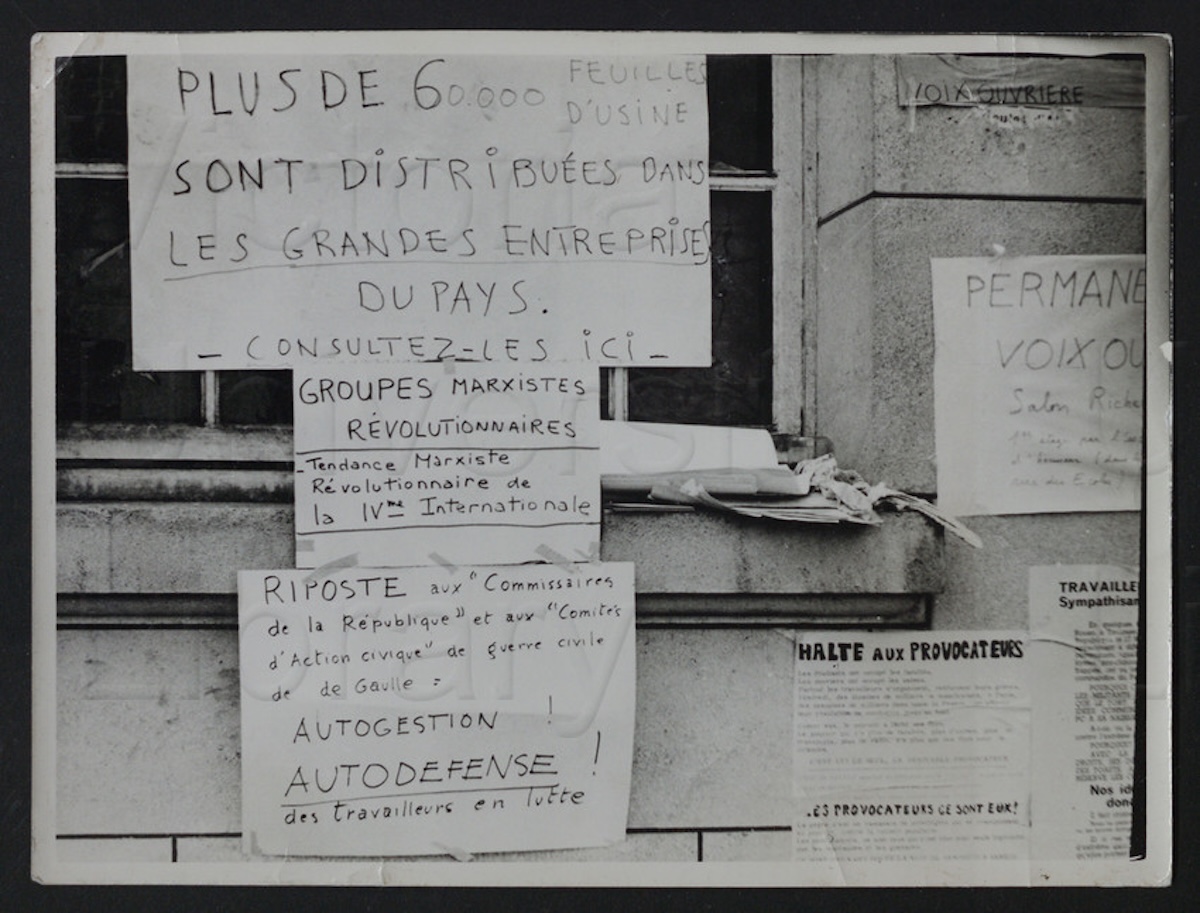
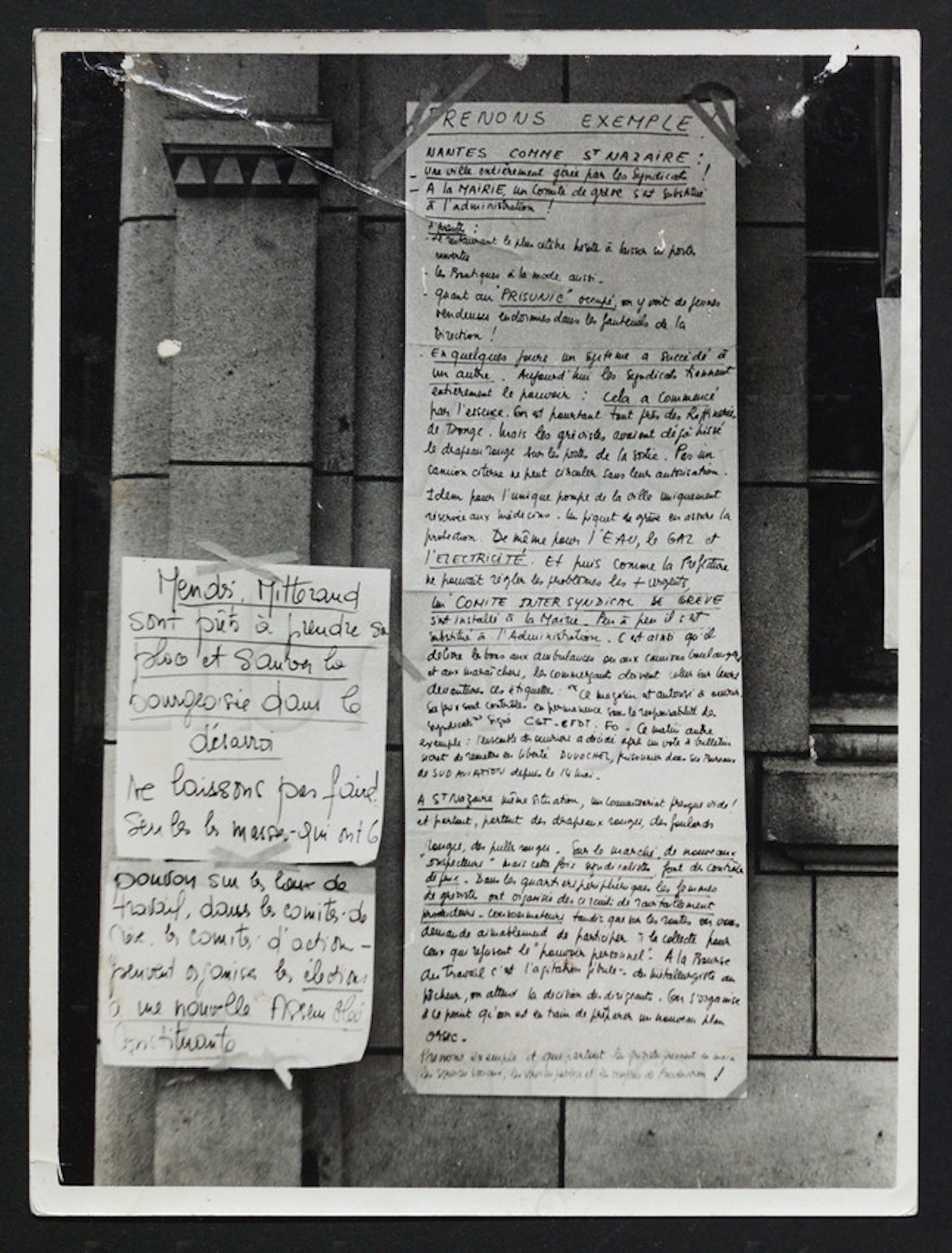

TRANSLATION:
[POSTER ON THE RIGHT:]
Take for exampleNantes like St Nazaire:
-The entire city lead by the unions!
-At the town hall a striking committee [s’est substitute a l’administration] Nantes:
-the most famous restaurant hesitates to leave its doors open.
-the fashion boutiques as well
-when at ‘Prisunic’ occupied, they saw the youth asleep in the leaders’ chairs
-in a few days one system had succeeded another. Today the unions completely hold the power: this started by l’essence. [E nest pourtant tout pres des rattineries de donge.] But the strikers have already hoisted the red flag on the doors of the… no tanker can circulate without their authorization. Same for the only pump in the city uniquely reserved for doctors. A picket assures its protection. Same for the water, gas, and electricity. And then like the… cannot regulate the most urgent problems, an intersyndical striking committee was installed in town hall. This is how they deliver les goods to ambulances or to…and to… the traders must paste on themselves and other labels. “This store is authorized to open their… are controlled… signed CGT-EFDT. FO
This morning another example: a group of workers decided after a secret vote to liberate Duvochel, prisoners in the offices of South Aviation since the 14th May.At St Nazaire same situation, a … almost empty! And everywhere, everywhere red flags, red scarves, red sweaters. [Sur le marche de nouveaux suspectures mais cette fois syndicaistes, font de controle de] … in the neighbourhoods… the strikers’ wives organized circuits of revitaillement producers-consumers while on the streets… to participate collectively for those who refuse ‘personal power.’ At the job exchange the trades’ council its unrest… from metallurgists to fishers, they await the leaders’ decision… take example that everywhere strikers take charge of social services, public services, and the means of production!
[POSTER ON THE LEFT:]
Mends: Mitterand is ready to [prendre sa bloc] and save the bourgeois in disarrayDon’t let them do it! Only the masses have the power over the places of work in the striking committees, the action committees can organize elections to a new constituent assembly.
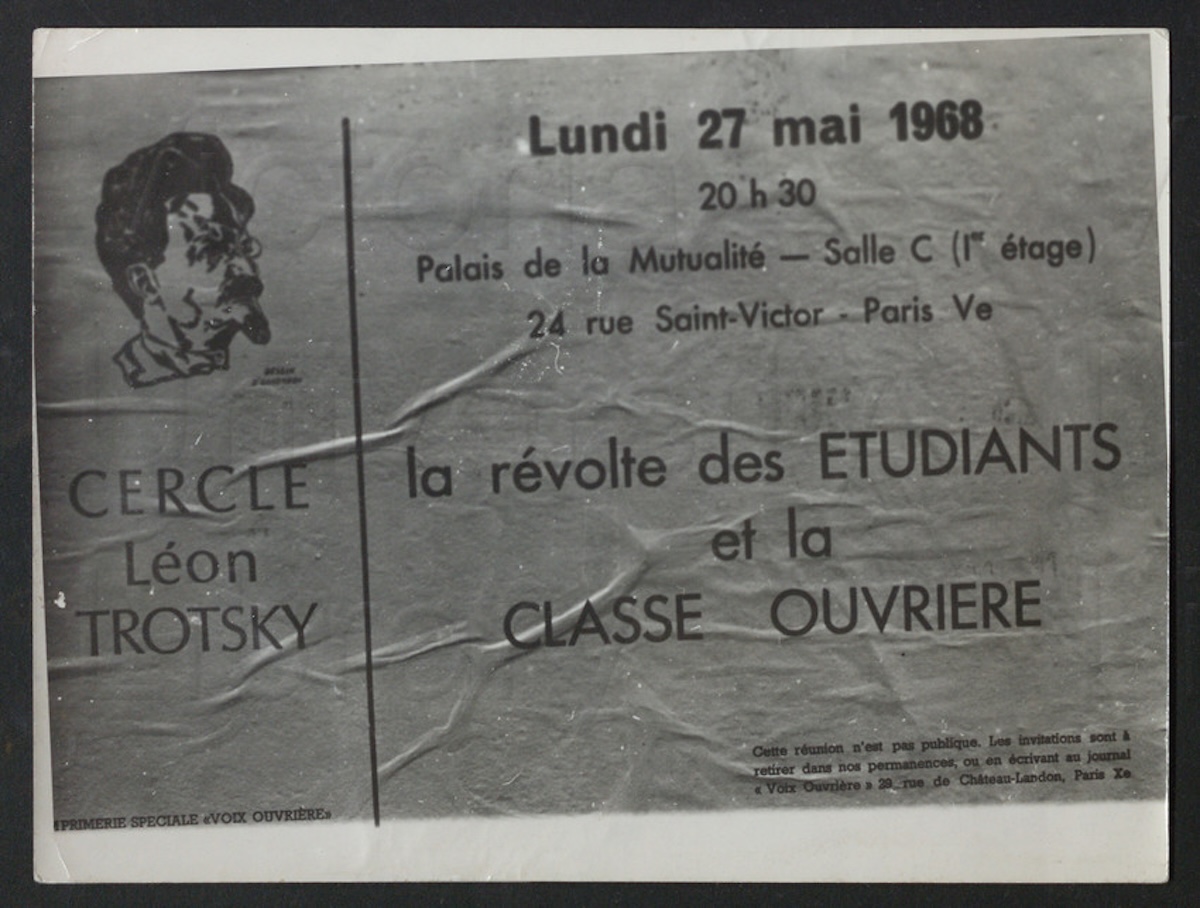
TRANSLATION:
Monday 27 May 196820 h 30
Palais de la Mutualite – Room C (1st Floor)
24 Saint-Victor Street – Paris Ve
The revolt of the students and working class.
This meeting is not public. Retrieve invitations in our offices, or by writing to the journal “Voix Ouvriere” 29 Chateau-Landon street, Paris Xe
[Side bar reads:]
Leon Trotsky Circle
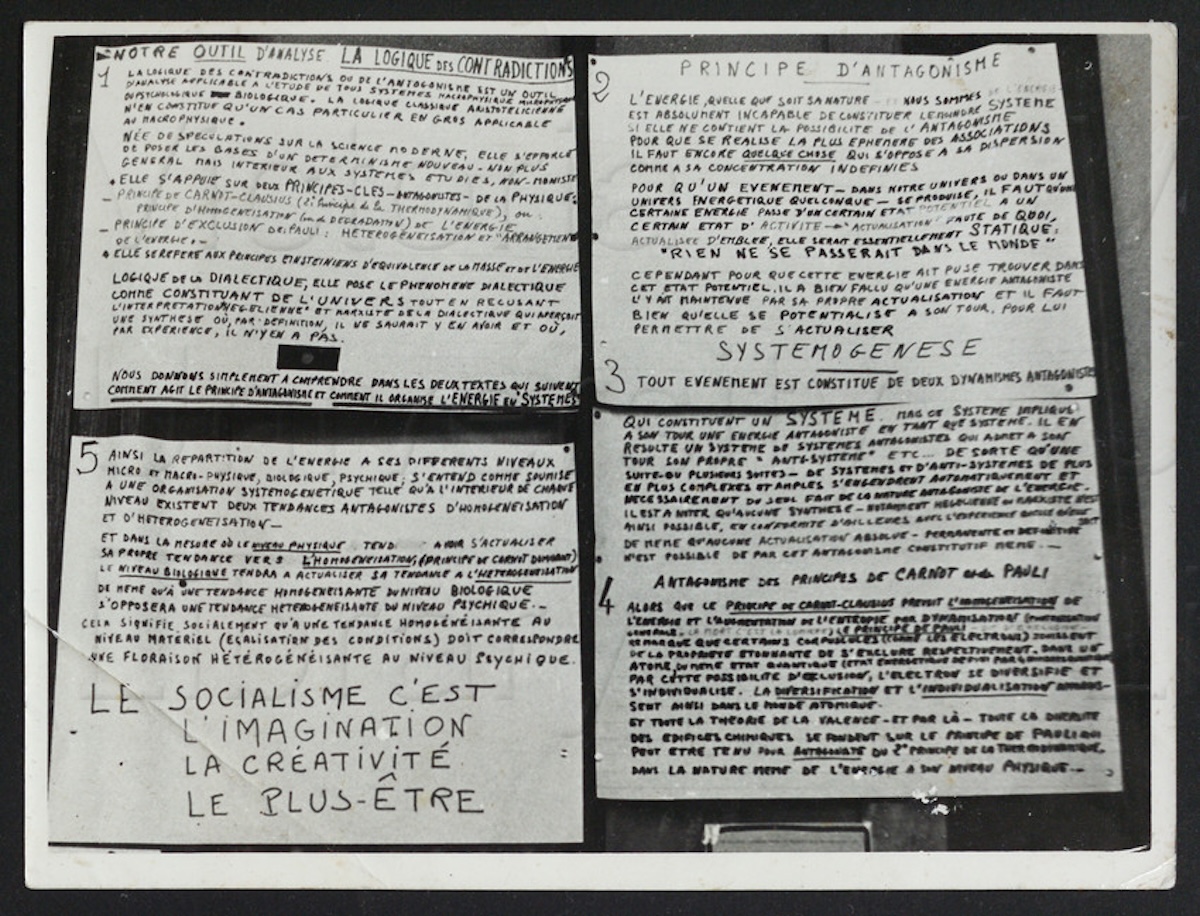

TRANSLATION:
Our tool to analyze. The logic of contradictions.
1) The logic of contradictions or of antagonism is a tool of analysis applicable to the study of all systems, macrophysics microphysics or psychological biological. The classic aristocratic logic is just one particular case in the larger application of macrophysics. Born of speculations on modern science, it is trying to lay the groundwork of a new determinism- no longer general but interior to studied systems, non-monistic. It relies on two key – antagonistic – principles of physics:Carnot-Clausius Law (2nd law of thermodynamics), or: principle of homogenization (or degradation) of energy.
Pauli’s law of exclusion: heterogenization ‘energy arrangement’
It refers to Einsteinian laws of equivalence of mass and energy.
Dialectic logic poses the dialectical phenomenon as a constituent of the universe all while recusing the ‘Hegelian’ and Marxist interpretation of the dialectic which sees a synthesis where, by definition, it does not occur and where, by experience, there is none.
We (donnons a comprendre) in both texts that follow how the principle of antagonism acts and how it organizes energy in “systems”.
2) Principle of Antagonism
Energy, as is its nature- and we are energy- is absolutely incapable of constituting even the lowest system if it does not contain the possibility of antagonism. To realize even the most fleeting association there must still be something which opposes to its dispersion likewise to its indefinite concentration
For an event- in our universe or in some energetic universe or other- to occur, a certain energy must pass from a certain potential state to a certain state of activity -> ‘Actualization’
Otherwise, straightaway, it would essentially be static:
“Nothing would happen in the world”However, so that this energy can be found in a state of potential, antagonistic energy must be maintained by its own actualization and it must in turn potentialize, so it is permitted to actualize itself.
3) Systemogenese (???)
Every event is constituted of two antagonistic dynamisms that constitute a system. But this system, in turn, implies an antagonistic energy as a system. This results in a system of antagonistic systems which in turn implies its own ‘anti-system’ etc… so that a series- or many series- of systems and anti-systems more and more complex and ample self-perpetuate automatically and necessarily of mere fact of the antagonistic nature of energy. It must be noted that no synthesis – notably Hegelian or Marxist is thus possible in accordance with [illegible] any experience, whatever it is, as well as no permanent or definitive is possible this constitutive antagonism itself.
4) Antagonism of the principles of Carnot and Paul
Since the laws of Carnot-Clausius foresaw the homogenization of energy and the increase of entropy by dynamizations [illegible] The principles of Pauli- [illegible] mark that certain corpuscles (like electrons) [illegible] the amazing property to exclude each other respectively. In an atom or even quantum state (energy state defined by 4 quantum numbers) by this principle of exclusion, the electron diversifies and individualizes. Diversification and Individualization applies even in the atomic world.
And the whole valence theory- and by this- all the diversity of the chemical elements is founded in this law of Pauli which is held to be [illegible] or the 2nd principle of thermodynamics.
In nature even energy has a physical level.5) So the distribution of energy at its different levels micro and macro physical, biological, psychic means that it is subject to a systemogenetic organization such that inside of each level exists two antagonistic forces (trends) of homogenization and heterogenization- And to the extent that the physical level tends to see its own trend towards homogenization,
(Carnot’s principle [illegible]) the biological level will tend to actualize its tendency to heterogenization. Likewise, a homogenizing trend at the biological level opposes a tendency towards heterogenization at the psychical level. This signifies, socially that a homogenizing trend at the material level (equalization of conditions) must correspond to a heterogenizing flowering at the physical level.Socialism is
Imagination
Creativity
Wellbeing
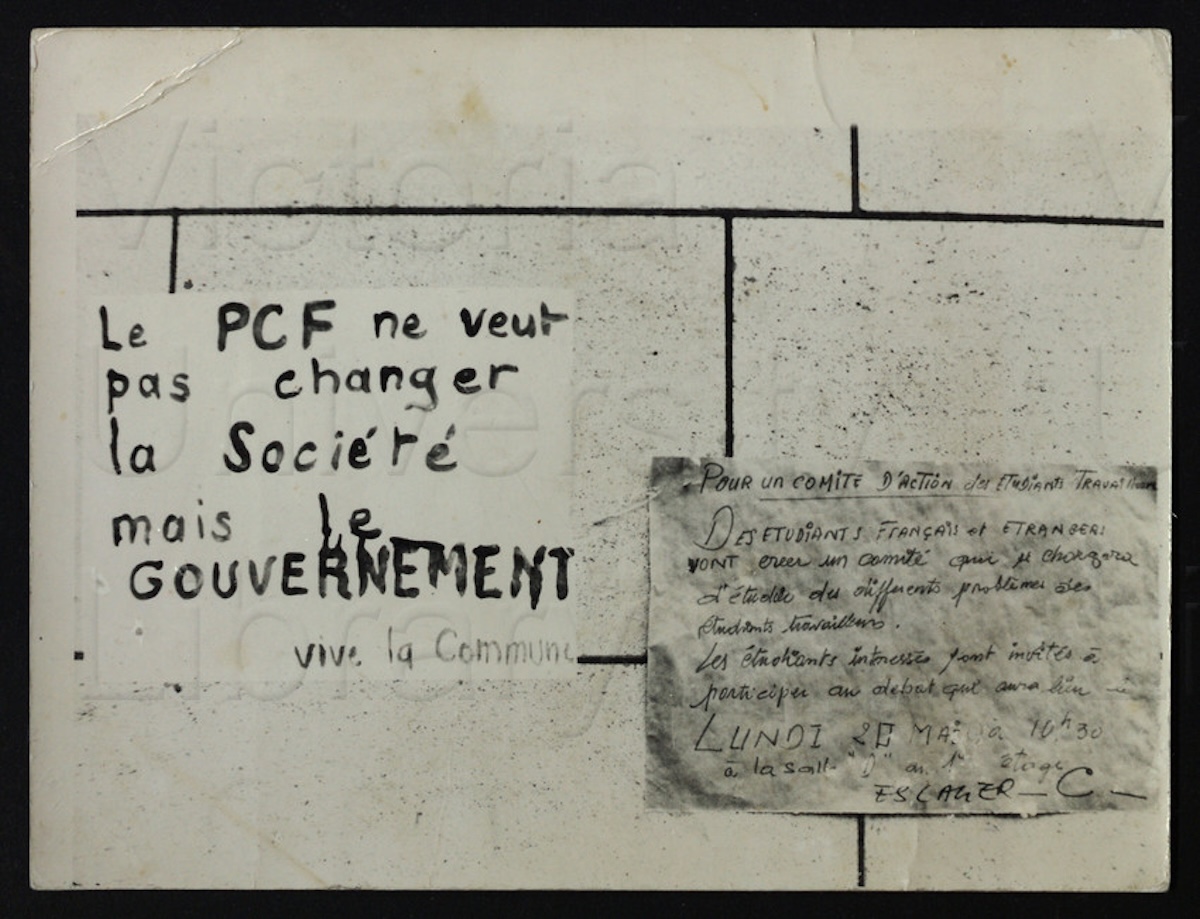
TRANSLATION:
[Poster to the left reads:]The PCF does not want to change society but the government
Long live the Commune[Poster to the right reads:]
For an action committee of student workers
The students, French and foreign, will create a committee who will be in charge of studying the different problems of student workers. Interested students are invited to participate in a debate which will take place
Monday 20th May at 10:30 in room ‘D’ on the first floor staircase – C –
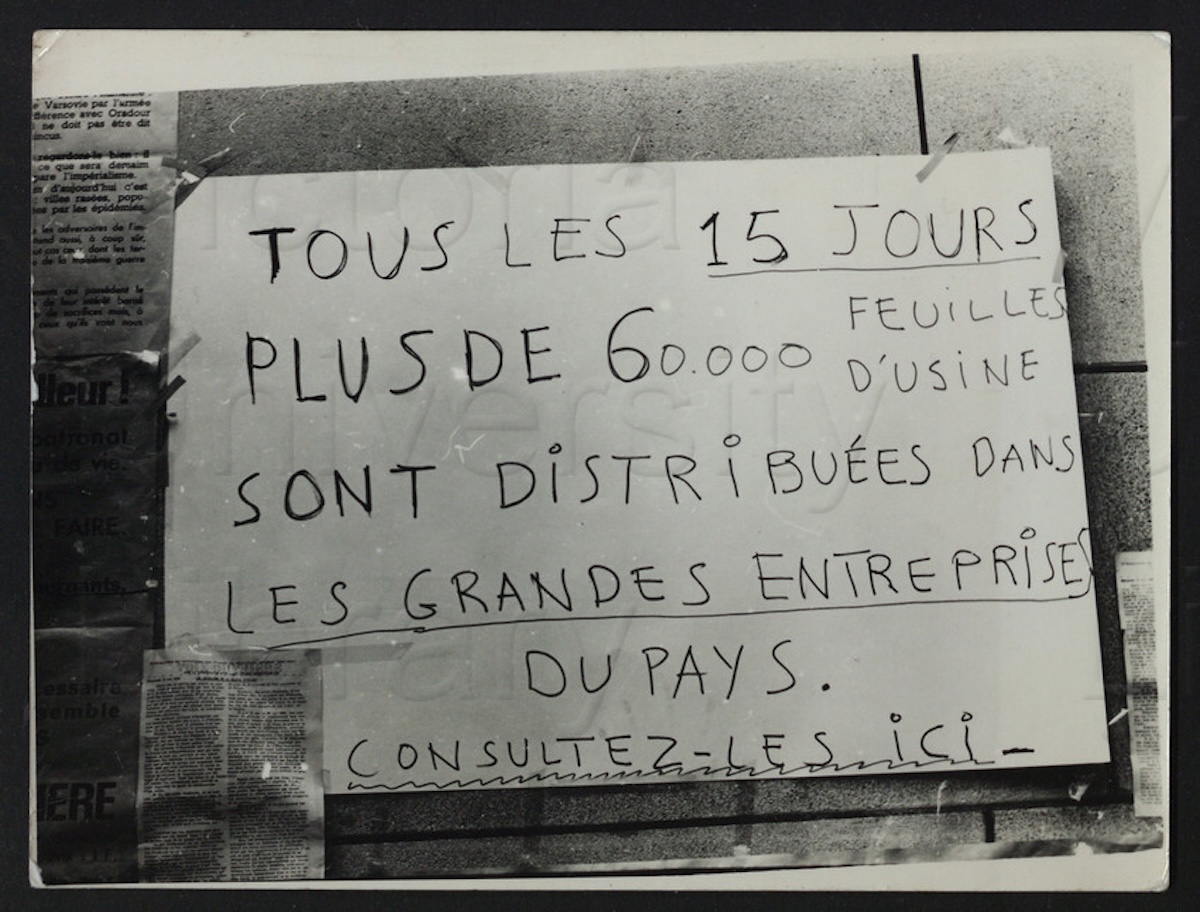
TRANSLATION:
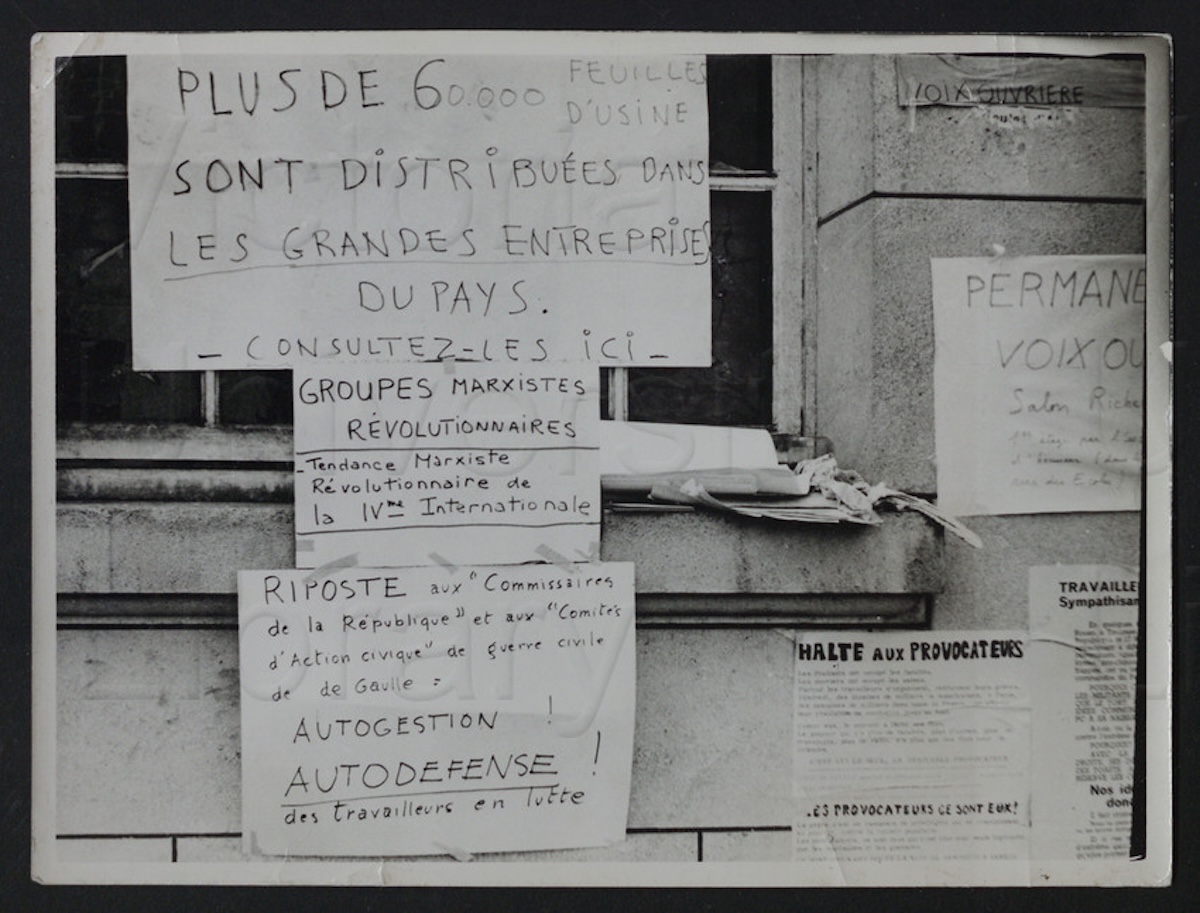
Every 15 days more than 60,000 factory leaflets are distributed in the country’s major enterprises. Consult them here.
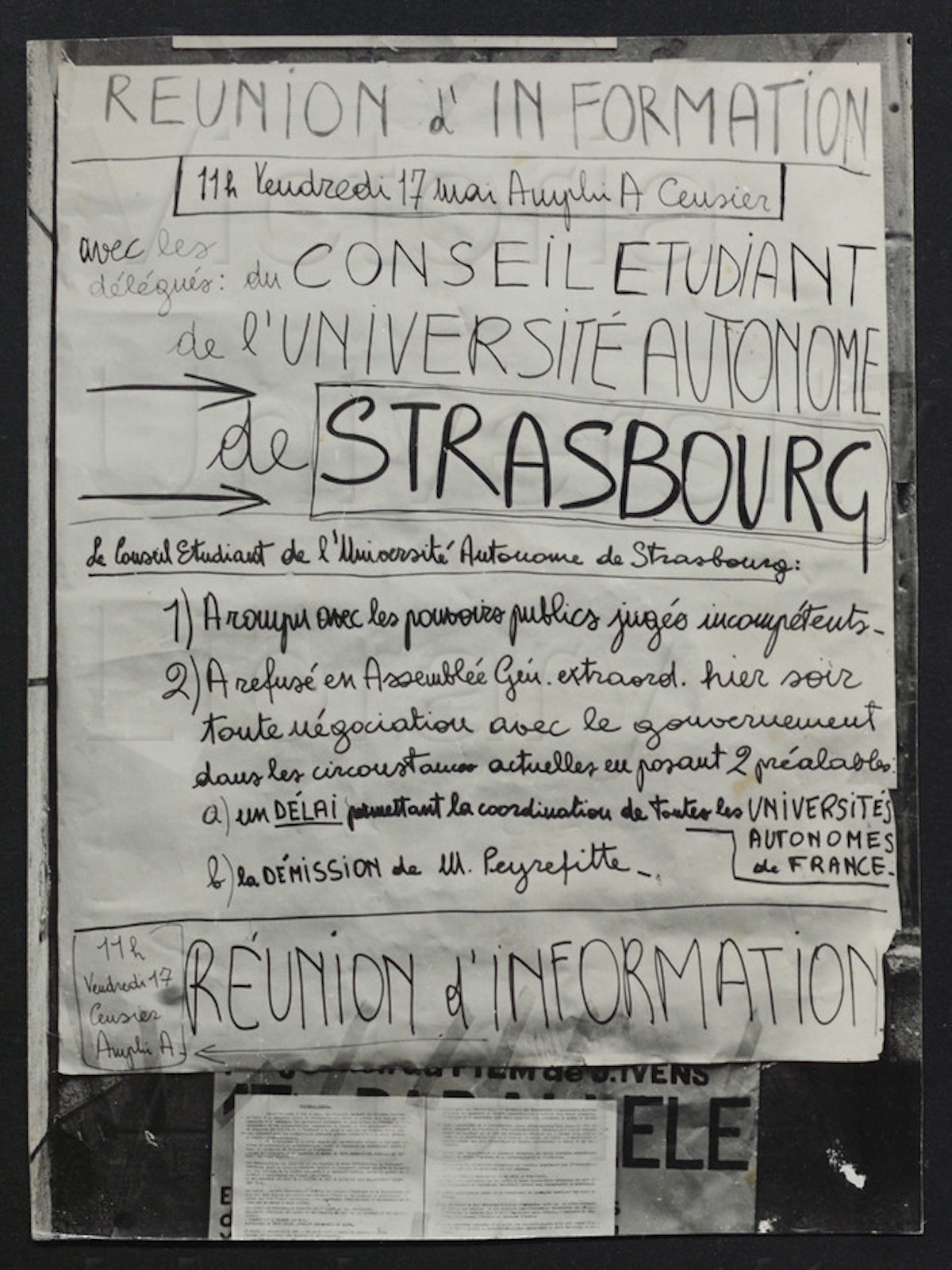
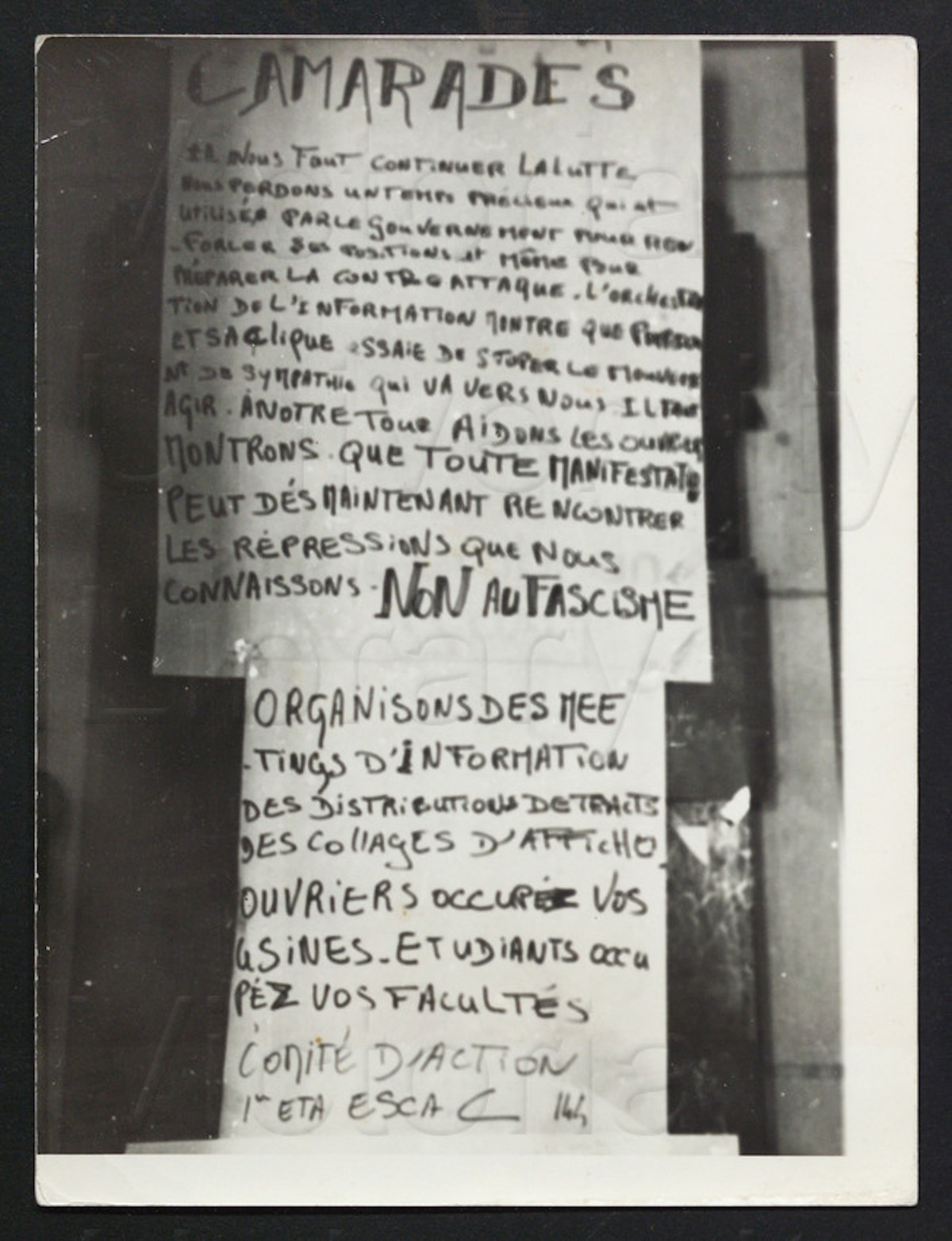
TRANSLATION:
ComradesWe must continue the fight. We are losing precious time that the government will use to re-enforce its positions and even prepare for counterattack. The orchestration of information shows that [illegible]
[…] On our part let us help the workers show that all demonstration can, starting now, meet the repression that we know.
No to fascism.
Organizing information meetings. Leafletting. Poster collages. Workers occupy your factories. Students occupy your faculties.
Action committee 1st floor stairway C [illegible]
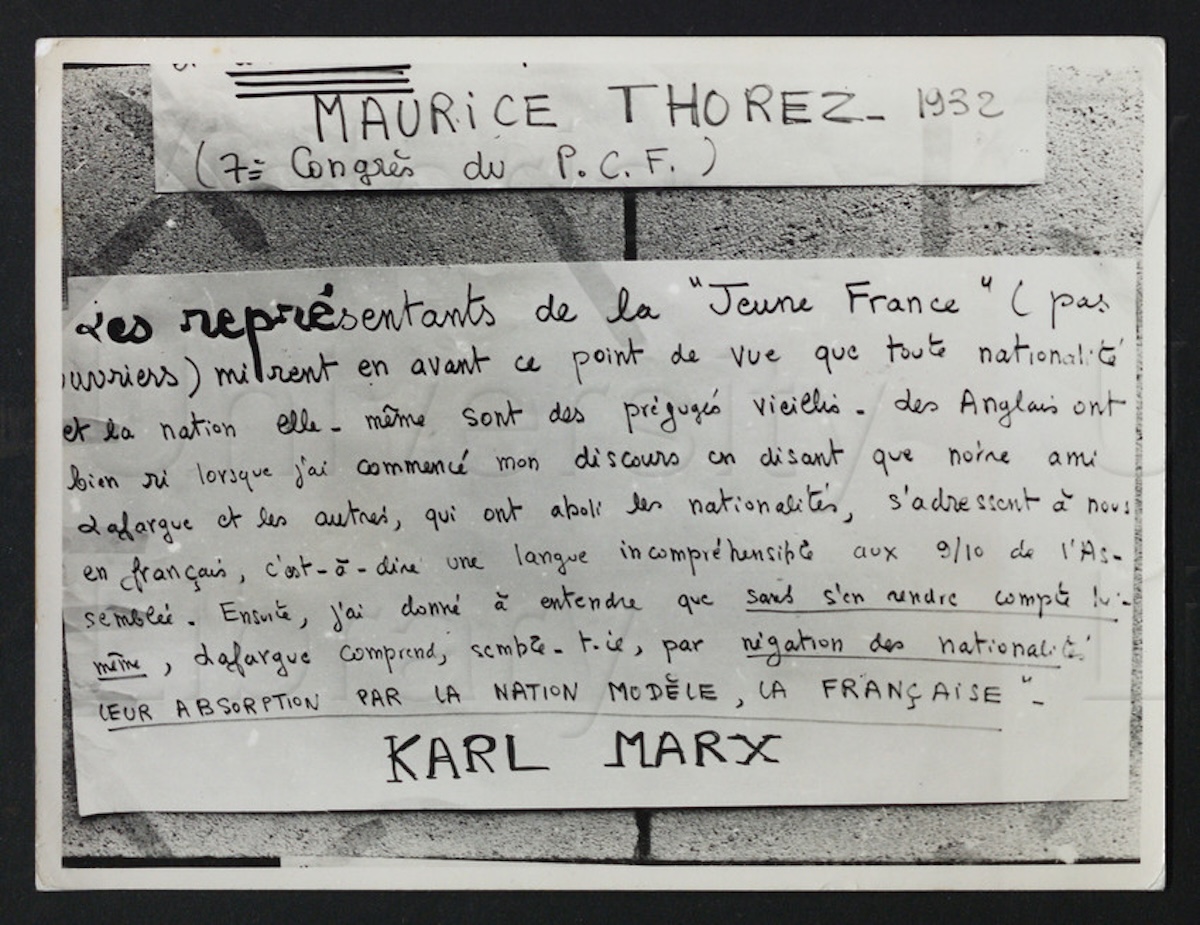
TRANSLATION:
The representatives of the “Young France” (not workers) put forward this point of view that all nationality and the nation itself are old prejudices- the English had a good laugh when I started my speech by saying that our friend Lafargue and the others, who have abolished nationalities, address us in French, that is to say a language that is incomprehensible to 9/10 of the assembly. Then, I suggested that without knowing it himself Lafargue understands, apparently, by negation of nationalities, their absorption by the model nation, the French.
Karl Marx
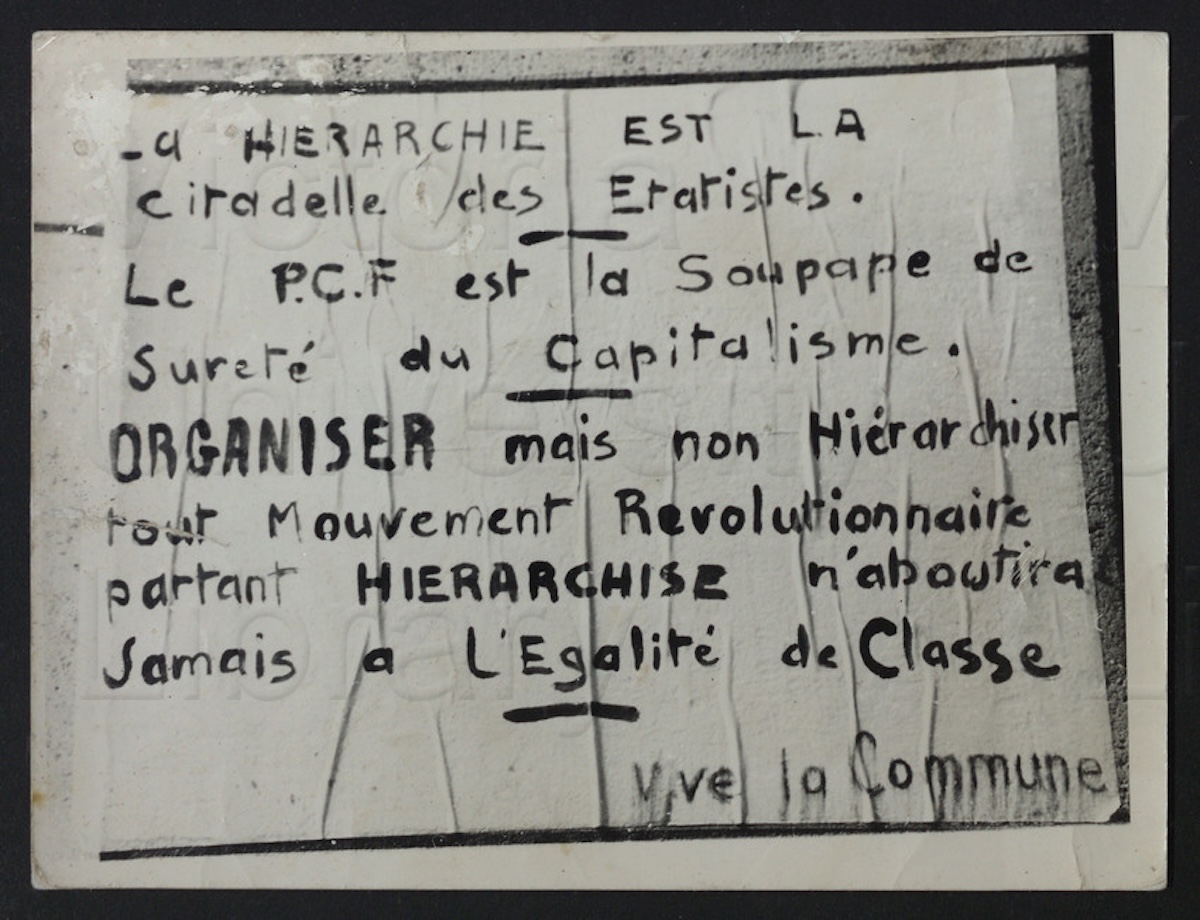
TRANSLATION:
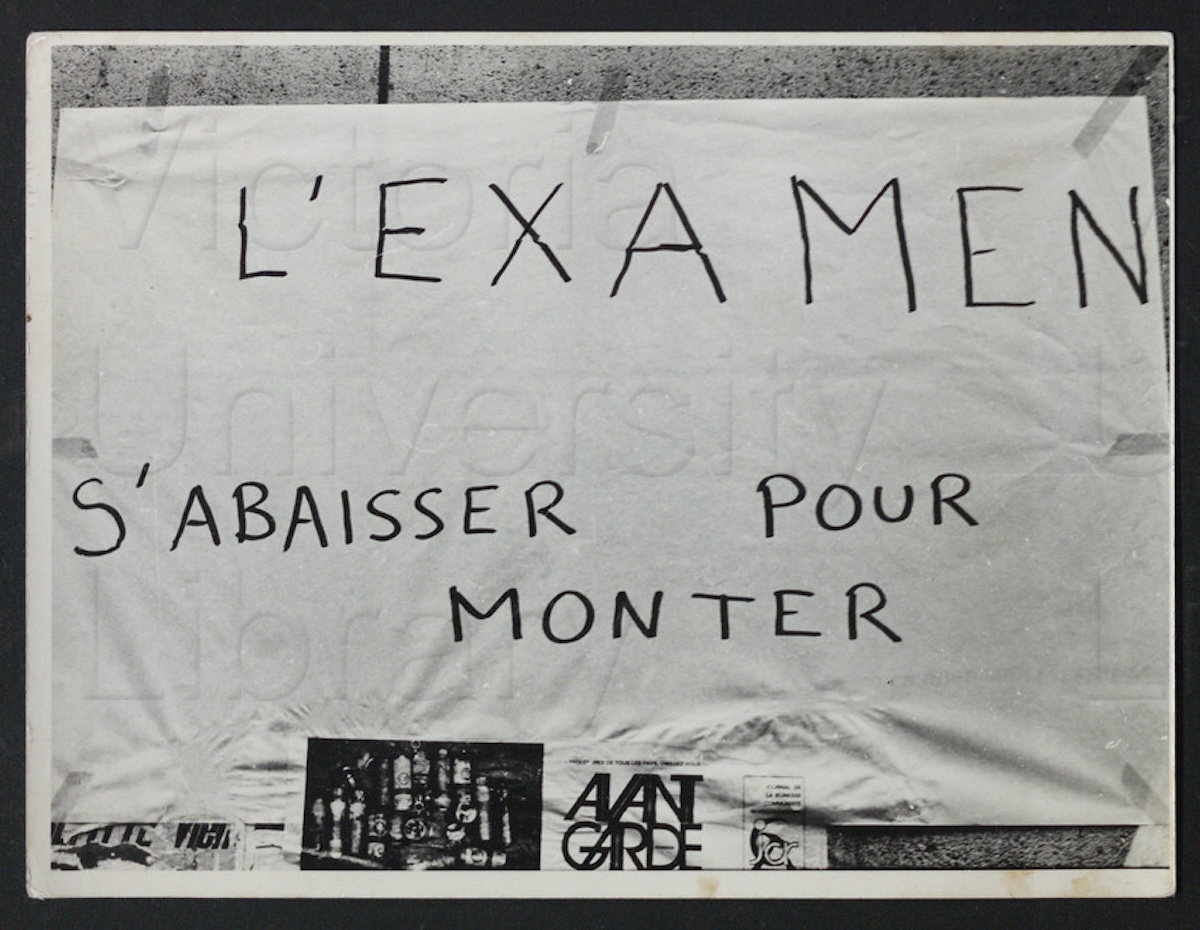
Hierarchy is the citadel of the statists.
The PCF is the safety value of capitalism.
Organize but do not hierarchize the revolutionary movement since hierarchy will never lead to class equality.
Long live the commune
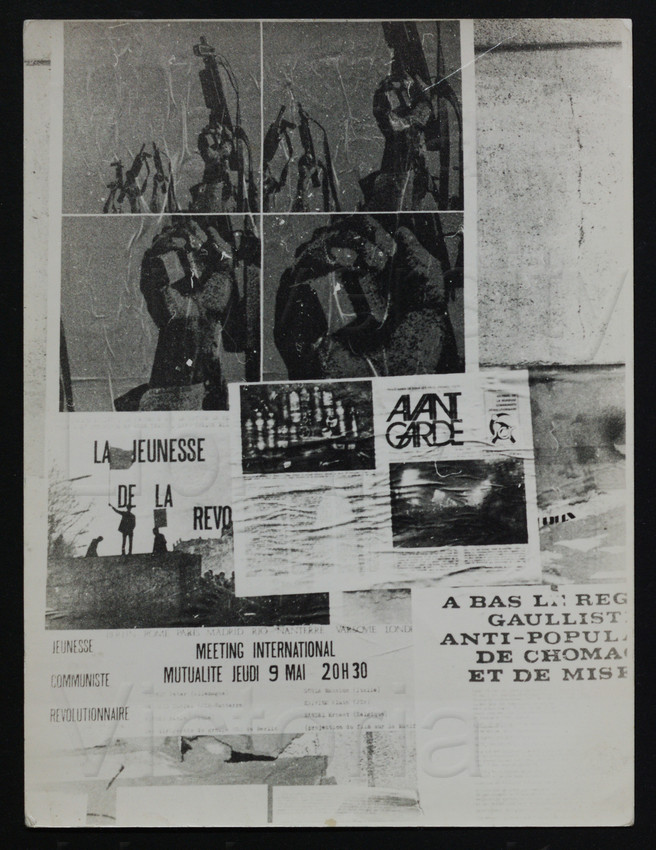
The potests began on 22 March 1968 when student radicals stormed an administration building at the University of Paris at Nanterre University and held a meeting in the university council room dealing with class discrimination in French society and what they saw as the political bureaucracy that controlled the school’s funding. The protest spread into a mass movement. There were barricades in the streets, fighting and a national strike. Carrying flags and banners, workers, students and teachers chanted “De Gaulle assassin” and “CRS-SS”, comparing the riot police to Nazist. In ealy June the police retook the Sorbonne. President De Gaulle triumphed in the legislative elections held later in June, and the crisis came to an end.
Via: Victoria University
Would you like to support Flashbak?
Please consider making a donation to our site. We don't want to rely on ads to bring you the best of visual culture. You can also support us by signing up to our Mailing List. And you can also follow us on Facebook, Instagram and Twitter. For great art and culture delivered to your door, visit our shop.