
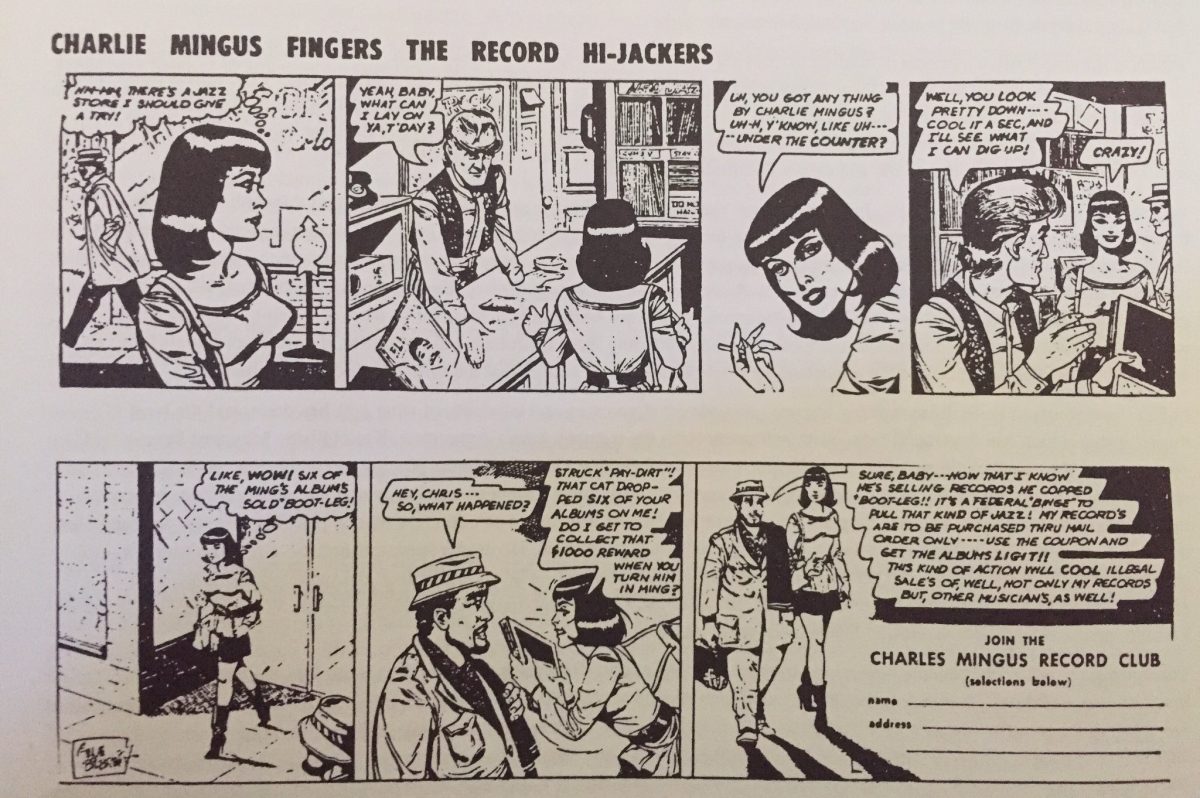
In the mid 1960s, Charlie Mingus, the American jazz musician, bandleader and famed composer, produced a comic strip to better explain his mission to beat the bootleggers.
It was about control. And Mingus also feared that labels and retailers were exerting too much control over the production and distribution of his music.
In his autobiography, Beneath the Underdog, Mingus spoke more of how musicians should take charge:
“I think jazz musicians should write their own books so they’ll get the money. I never got a job from anything that was written about me. I’m on the cover of one jazz magazine right now. Do you think the agents care about that? The publicity has never done me any good”.
In 1951 he co-founded Debut Records with the drummer Max Roach (January 10, 1924– August 16, 2007) so he could conduct his recording career as he saw fit. He formed Charles Mingus Enterprises with the Charles Mingus Record Club to self-distribute his albums via mail order. And he hired artists and designers to make newspaper ads advertising his albums.
In Myself When I Am Real: The Life and Music of Charles Mingus, Gene Santoro tells us more:
Janet Coleman and Susan [Mingus’ fourth and final wife] and assorted others helped with Charles Mingus Enterprises. Some, in the Beat tradition, drew cartoons for ads and the album cover. But Charles and Susan ran it. Mingus wanted to sell only by mail order, so he couldn’t be ripped off by distributors or retailers. He wouldn’t lug stock and collect checks. It would be straightforward. It was his.
One of the Mingus strips appeared in the December 1966 issue of the Village Voice. In “Charles Mingus Fingers the Record Hi-Jackers”, a woman heads to a record shop and asks for LPs by Charlie Mingus. She buys six of these bootleg albums. Outside she meets Mingus and tells him: “That cat dropped six of your albums on me! Do I get to collect that $1000 reward when you turn him in Ming?”
According to Santoro, Mingus ran another ad in the form of a “Legal Notice” indicating a “$500.00 Reward for evidence which secures conviction of any person selling these records.”
For added value, the advert was the work of Eugene Bilbrew, an artist best known for his racy covers for pulp fiction fetish and sex stories.
At the bottom of the strip Mingus added a coupon for readers to order Mingus at Monterey, “the latest Mingus Town Hall 1964 album”.
The Mingus Jazz Workshop And Owning The Music
As well as wanting to retain control of his records, Mingus was disenchanted with the technical preoccupations of certain musicians. He recalled a meeting with trumpeter Roy Eldridge, who, preferring not to play a passage which had been written for him, told Mingus:
“You see this horn. I play what I feel on it. That’s jazz. You’d better find out about the music of your people. Some day, you‘re going to thank me for talking to you like this.”
His Mingus Jazz Workshop would allow musicians to express themselves and remain a key part of everything. As he wrote in 1956,
“My whole conception with my present Jazz Workshop deals with nothing written. I write compositions – but only on mental score paper – then I lay out the composition part by part to the musicians. I play them the ‘framework’ on piano so that they are all familiar with my interpretation and feeling and with the scale and chord progressions to be used. Each man’s own particular style is taken into consideration, both in ensemble and in solos. For instance, they are given different rows of notes and play them in their own style, from scales as well as chords, except where a particular mood is indicated. In this way, I find it possible to keep my own compositional flavour in the pieces and yet to allow the musicians more individual freedom in the creation of their group lines and solos.”
So let’s play out with Take The A Train, performed on 12 April 1964 by the Charles Mingus Sextet:
Would you like to support Flashbak?
Please consider making a donation to our site. We don't want to rely on ads to bring you the best of visual culture. You can also support us by signing up to our Mailing List. And you can also follow us on Facebook, Instagram and Twitter. For great art and culture delivered to your door, visit our shop.