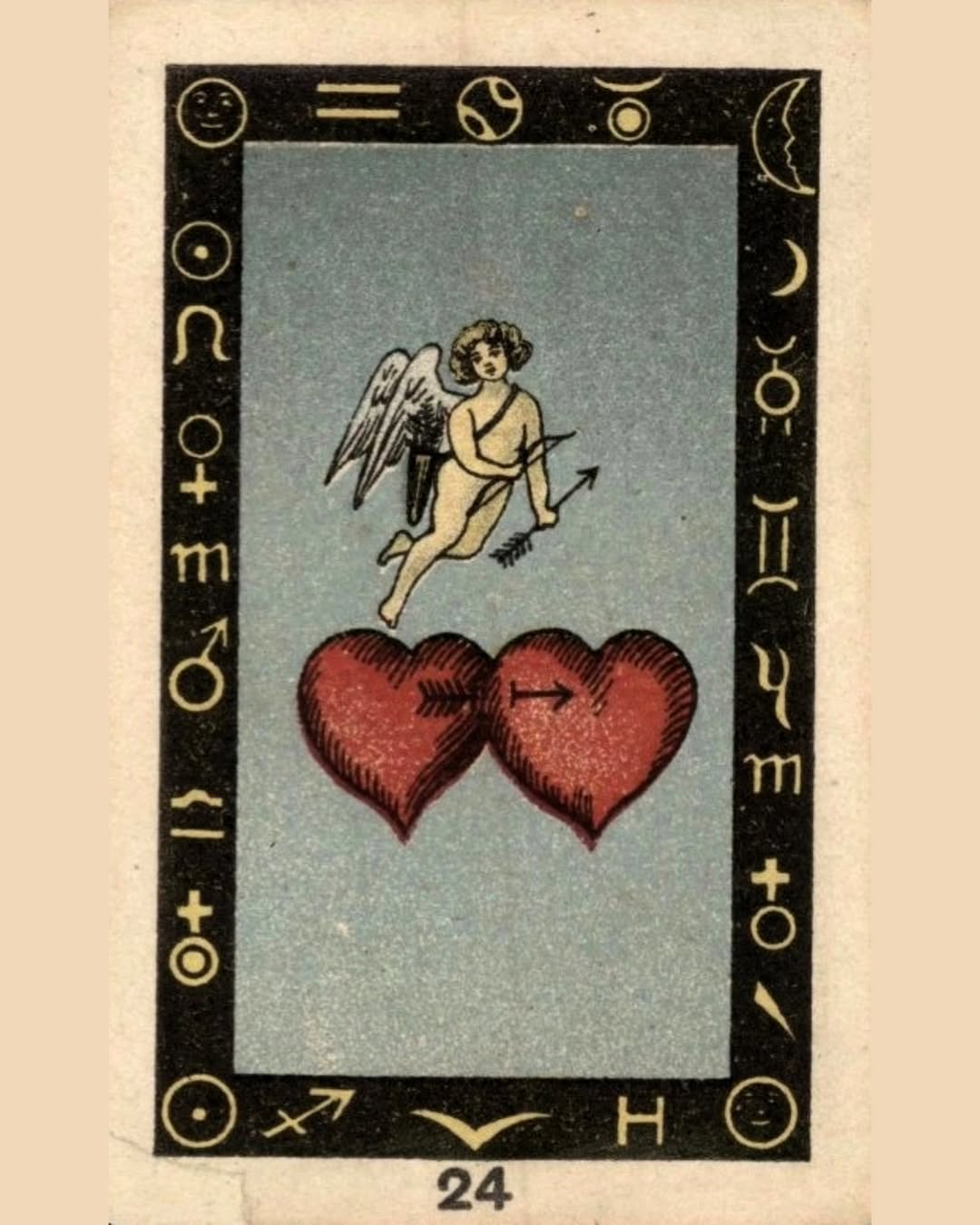
These cards form one of the most enduring systems in the Western divination tradition: the Petit Lenormand. It takes its name from Marie Anne Lenormand (May 27, 1772 – June 25, 1843), the most famous fortune-teller and sybil of her era. She claimed to have been consulted by Robespierre, Czar Alexander, Napoleon Bonaparte, the Empress Josephine (Josephine de Beauharnais) and Lord Wellington, who wanted to learn the name of the man who had attempted to assassinate him in 1818.
It wasn’t until two years after her death that a deck of cards called “Le Grand Jeu de Mlle. Lenormand” was first published. This deck was based on an earlier race game and multi-purpose set of cards called the “Spiel der Hoffnung” (“Game of Hope”; 1798) and the even earlier Viennese Coffee Cards (1794/6), published in both German and English.
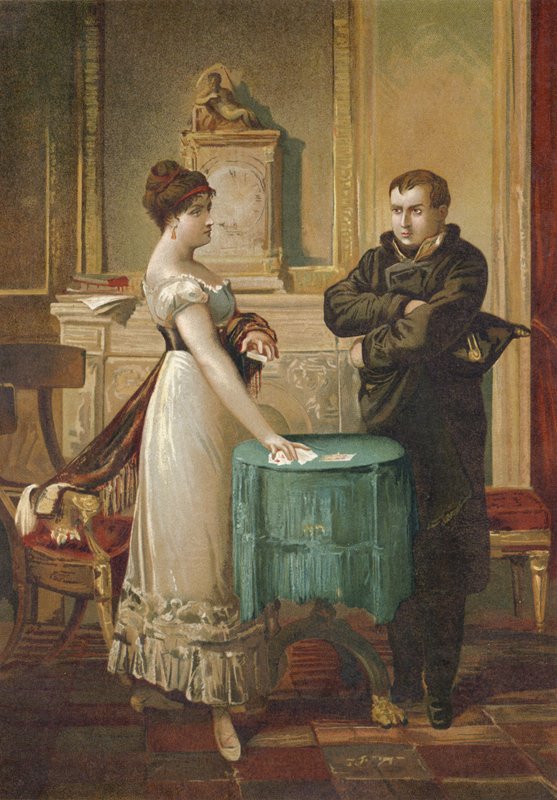
Napoleon consulting the fortune teller Marie Anne Lenormand. Illustration for Las Supersticiones De La Humanidad by Jose Coroleu (F Seix, 1881).
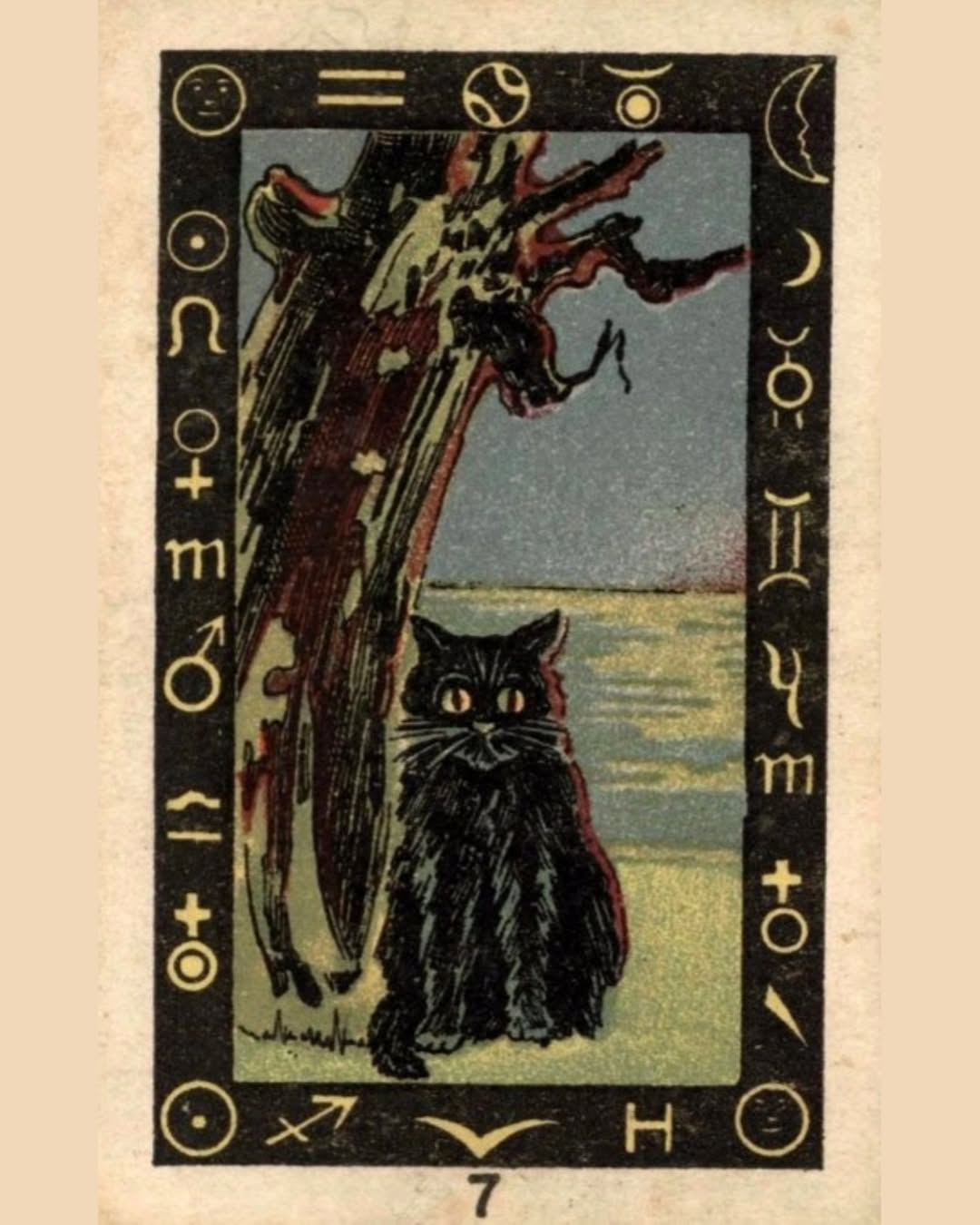
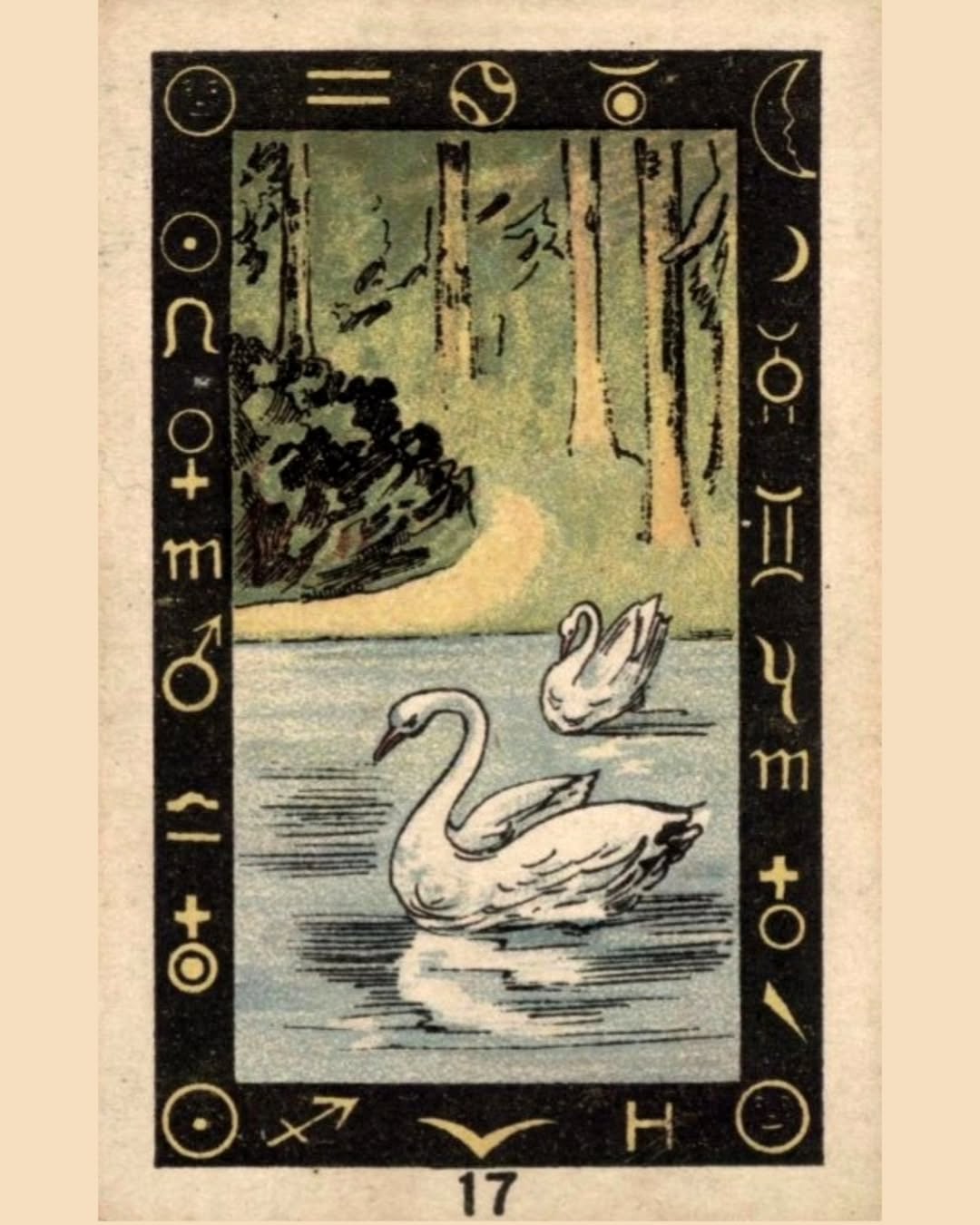
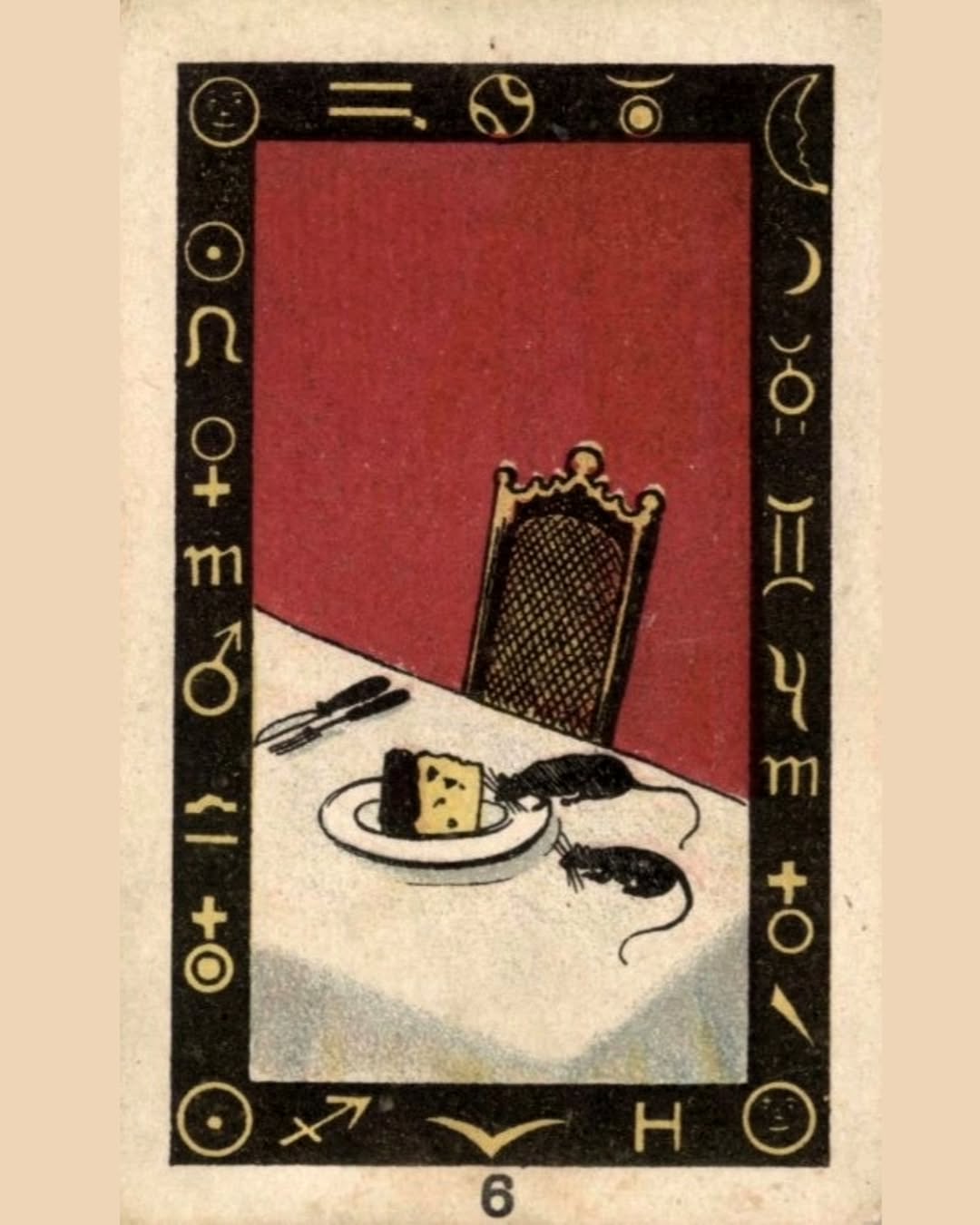
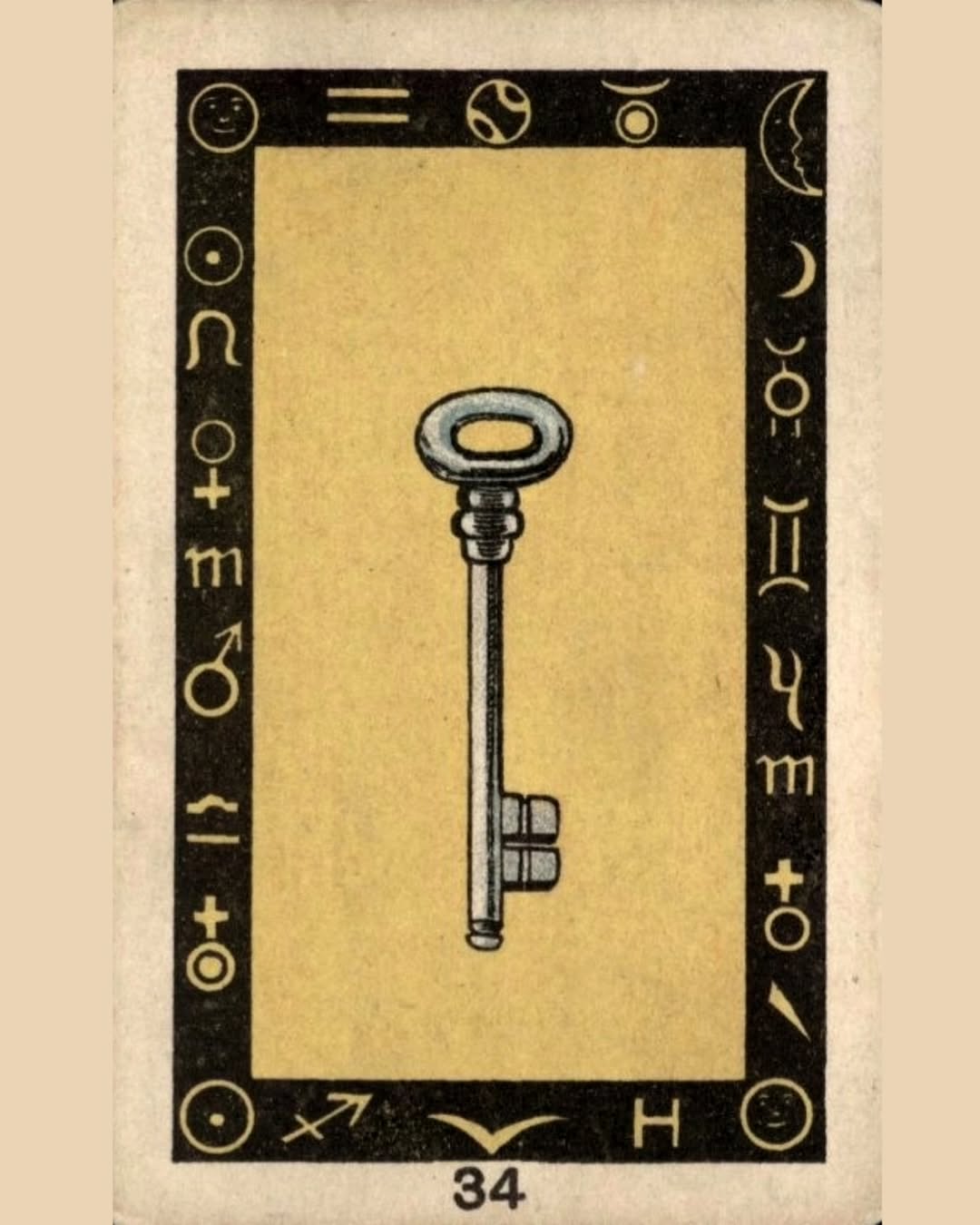
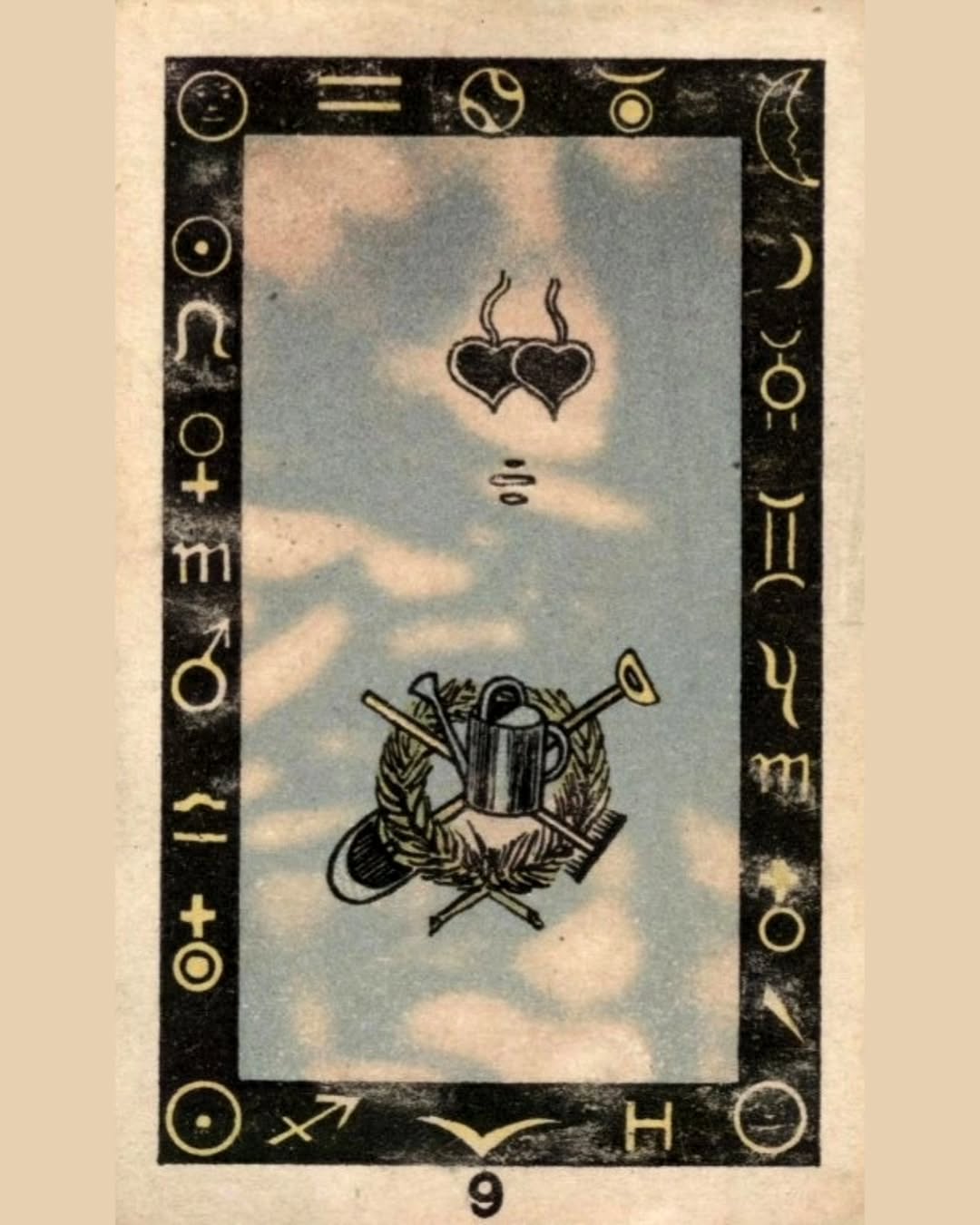
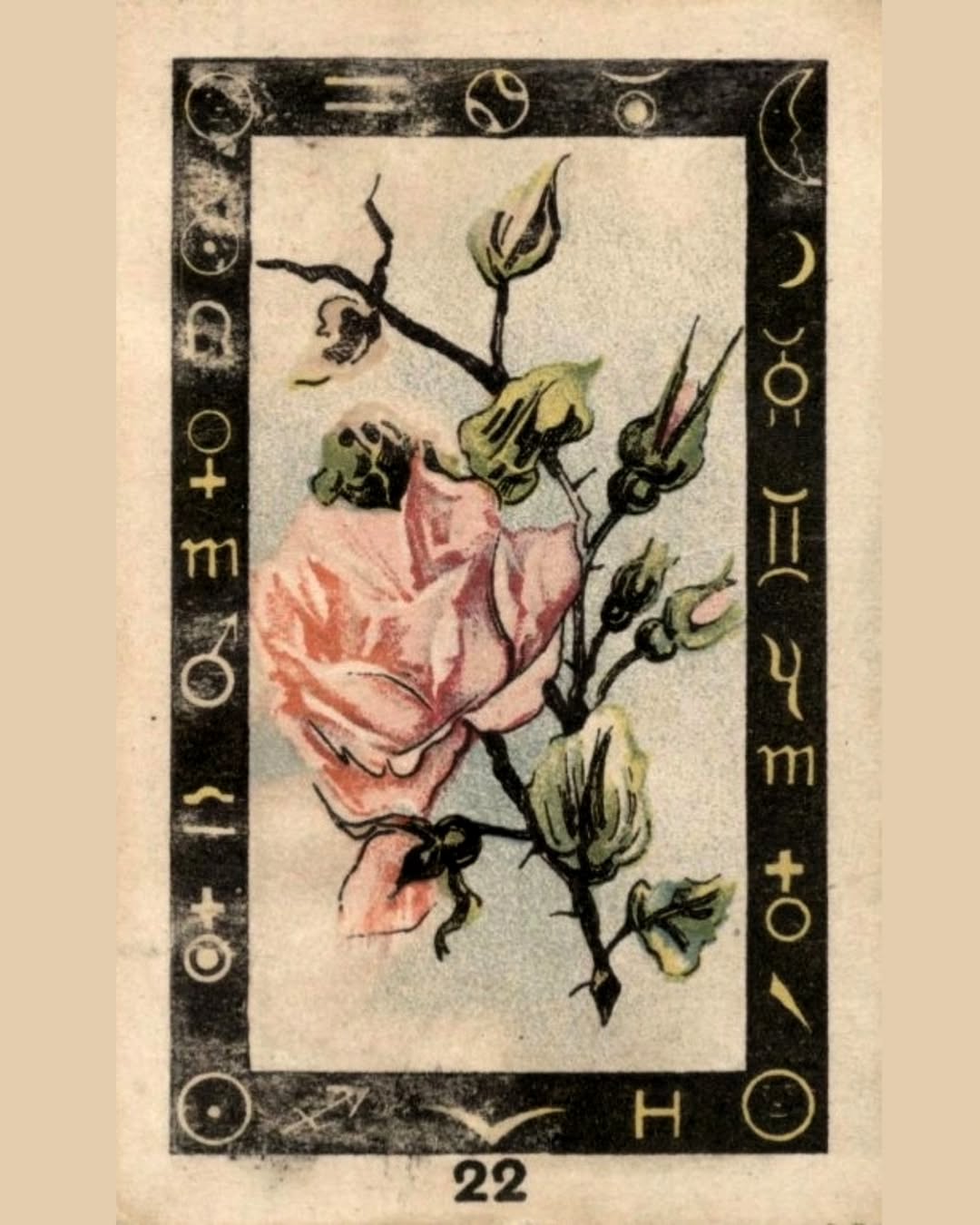
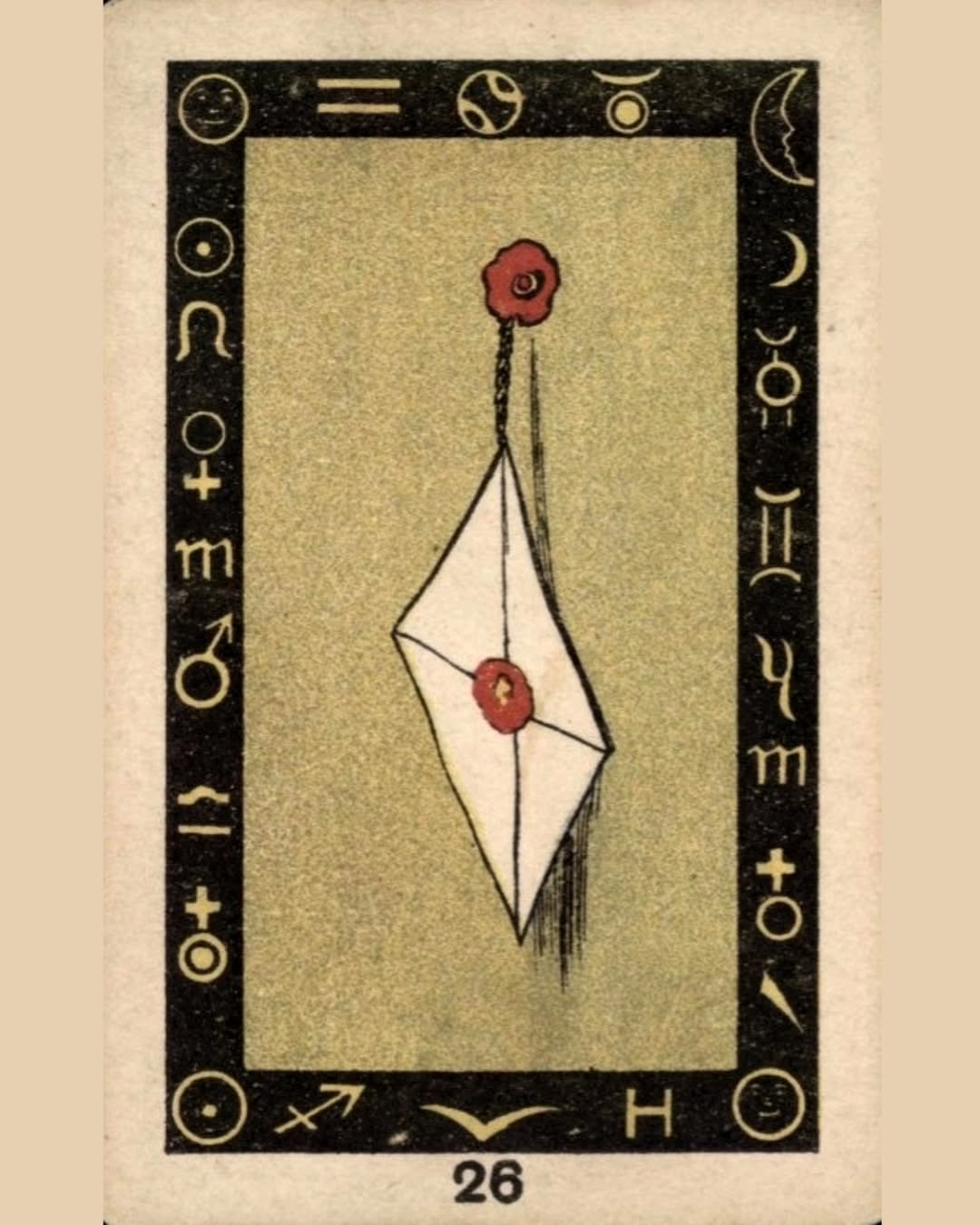
These Petit Lenormand cards are a small cross-section of this whole 36-card set. By way of a guide;
The Heart stands for love and joy; The Key is the solution to a problem or a “yes” answer; The Letter signifies news and correspondence; the Black Cat identifies with the Snake or Fox symbol, evoking anxiety in its context; the Sun stands for success and clarity; the Flower/Rose represents contentment and gifts; the Swans correspond to the Stork card, signalling change and evolution; the Cross represents burdens and meaningful obligations; and the table with mice and cheese is the Mice card, symbolising hidden losses, wear and tear, and theft.
The system’s logic is based on the idea that these symbols don’t gain meaning alone, but rather within the “sentences” they form when placed side by side. Just like words in a language, the symbols qualify, restrict, or amplify one another. That’s why in Lenormand readings, card combinations are far more decisive than the meaning of any single card.
Marie Anne Lenormand
The stories around Lenormad are legend, not last of all a long-running court case. You can correspondence between Lenomand the accused, Lord Stirling, here.
Major General William Alexander, also known as Lord Stirling (1726 – 1783) was a Continental Army officer who served in the American Revolutionary War. He held a claim to be the male heir to the Scottish title of Earl of Stirling through Scottish lineage (being the senior male descendant of the paternal grandfather of the 1st Earl of Stirling, who had died in 1640), and he sought the title sometime after 1756. His claim was initially granted by a Scottish court in 1759; however, the House of Lords ultimately overruled the court and denied the title in 1762. He continued to hold himself out as “Lord Stirling” regardless.
The case ran for four years. Lenormand explained her own position in an open letter:
“For many years Lord Stirling, a Scottish peer, has been reclaiming the heritage of his ancestors; yet today there is even a dispute as to his name and his legal titles. A chart of Canada by Guillaume de Lisle, First Geographer to the King, and covered with precious autographs of Fenelon, Flechier, Louis XV, etc., was submitted in support of the claim in question [given to him by Mlle. Lenormand in exchange for a bond for 400,000 francs]. And it is I who am accused of having co-operated!!! [The chart was eventually proved a forgery.] …
“All my efforts have tended for good; often I was quite happy to see them crowned with success, and it is with great pride when I think back to the ill-fated days of our bloody revolutions, I think of the many victims whom I could snatch from the scaffold or conceal from infamy, of the horrors of hunger.
“Like every good soul born, I have selflessly spread some benefits to the miserable, and offer consolations to suffering souls. Also my dedication in adversity, my firmness, all my conduct, has received at all times the approval of various parties. …
“Always willing to lend a helping hand to the oppressed, Miss Le Normand therefore wants the trial which is engaging Lord Stirling to be delayed; she asks this of all the authorities in order to enter the lists and contribute toward finding the truth.”
As Jim McKeague notes:
“The presiding Judge, Lord Meadowbank, in his summing up to the jury, was savage in his criticism of Marie-Anne Lenormand. Speaking of Humphrys-Alexander’s sojourn in Paris in 1836-7, the judge said that he was proved ‘to have been constantly engaged in negotiating with this sybil (sic) – this notorious adventuress in Paris, to whom at least the uttering of these forged documents has been traced – a person obviously of the worst character, and who, although she says that a lie never passed her lips, is proved to you to have had no profession but that of fortune-telling – no means of subsistence but that of imposture, and of telling falsehoods from morning to night.’“

Mademoiselle le Normand in all her glory
To help you visualise the fortune teller who amassed a fortune from her trade, we have the account of Captain Rees Howell Gronow (1794 – 22 November 1865) of the Grenadier Guards & MP for Stafford in his book Celebrities of London and Paris (London: Smith, Elder & Co., 1865):
“One of the most extraordinary persons of my younger days was the celebrated fortune-teller, Mademoiselle le Normand. Her original residence was in the Rue de Tournon, but at the time of which I write she lived in the Rue des Sts Pères. During the Restoration, the practice of the ‘black art’ was strictly forbidden by the police, and it was almost like entering a besieged citadel to make one’s way into her sanctum sanctorum.
“I was first admitted into a good-sized drawing-room, plainly but comfortably furnished, with books and newspapers about, as one sees them at a dentist’s. Two or three ladies were already there, who, from their quiet dress and the haste with which they drew down their veils, or got up and looked out of the window, evidently belonged to the upper ten thousand. Each person was summoned by an attendant to the sibyl’s boudoir, and remained a considerable time, disappearing by some other exit without returning to the waiting-room. At last I was summoned by the elderly servant to the mysterious chamber, which opened by secret panels in the walls, to prevent any unpleasant surprises by the police. I confess that it was not without a slight feeling of trepidation that I entered the small square room, lighted from above, where sat Mademoiselle le Normand in all her glory.
“It was impossible for imagination to conceive a more hideous being. She looked like a monstrous toad, bloated and venomous. She had one wall-eye, but the other was a piercer. She wore a fur cap upon her head , from beneath which she glared out upon her horrified visitors. The walls of the room were covered with huge bats, nailed by their wings to the ceiling, stuffed owls, cabalistic signs, skeletons – in short, everything that was likely to impress a weak or superstitious mind. This malignant-looking Hecate had spread out before her several packs of cards, with all kinds of strange figures and ciphers depicted on them. Her first question, uttered in a deep voice, was whether you would have the grand or petit jeu, which was merely a matter of form. She then inquired your age, and what was the colour and the animal you preferred. Then came, in an authoritative voice, the word “Coupez“, repeated at intervals, till the requisite number of cards from the various packs were selected and placed in rows side by side. No further questions were asked, and no attempt was made to discover who or what you were, or to watch upon your countenance the effect of the revelations. She neither prophesied smooth things to you nor tried to excite your fears, but seemed really to believe in her own power. She informed me that I was un militaire, that I should be twice married and have several children, and foretold many other events that have also come to pass, though I did not at the time believe one word of the sibyl’s prediction.
A German book on fortune telling from 1860 also recalls the scene:
“Above the door was a sign with the words: Mlle. Lenormand – Bookseller.
The profession of Sybil had not yet been sanctioned by the law, and just as every transaction had to bear a legal title in order to justify a levy, Mlle. Lenormand had sought and obtained a patent as a bookseller. She received her clients undisturbed here, and could conduct her prophecies here, without attracting suspicions among the police. In her capacity as a bookseller, she was even in the royal National almanac.
When a person came into Lenormand’s consulting room, the bell of the oracle was rung, a maid opened the door, and led the visitor into a room which was less than sibylline. Lenormand spurned the usual household of the vulgar fortune-tellers, she surrounded herself with no kind of phantasmic decoration. The interior of the room was bourgeois. On the wall, in two rows, about thirty volumes of books were seen . . . recent books by herself and those more or less cabalistic.
After having had time to look around, Mlle. Lenormand appeared. In later years she was a small, strong woman, with a large blond wig on which an oriental turban was thrust.
Alexandre Dumas
One of the most fascinating stories of Mlle Lenormand is the account in The First Republic, or The Whites and the Blues (Les Blancs et Les Bleus, 1867-68) by Alexandre Dumas, hymned author of The Three Musketeers. As Mary K. Greet writes, “This work is part of a series of Napoleonic romances that begin with the Revolution and end with the fall of the Empire. Volume 2 contains chapters called The Seeress and The Occult Art in which Lenormand reads for both Josephine and Napoleon (who have not yet officially met). Dumas, writing nineteen years after Lenormand’s death, claimed that what he wrote was not fiction:
“I can guarantee the truth of this scene, for these details were given me by the friend and pupil of Mademoiselle Lenormand, Madame Moreau, who still lives (1867) at No. 5 Rue du Tournon, in the same rooms as the famous seeress, where she devotes herself to the same art with immense success.”
Read on..
Mademoiselle Lenormand at this period of her life was a woman somewhere between twenty-four and twenty-nine years of age; short and stout in figure, and concealing with difficulty that one shoulder was larger than the other. She wore a turban adorned with a bird of Paradise, a fashion of the day. Her hair fell in long curls on either side of her cheeks. She wore two skirts.
Near her, on a stool, was her favorite greyhound, Aza. The table on which she did her marvels was a plain round table with a green cloth on top and drawers, in which she kept her cards. Facing the sibyl was an arm-chair, in which the consulting person was seated. Between that person and the seeress lay an iron wand, which was called the divining-rod; at the end turned toward the consulting person was a little iron snake. The opposite end was made like the handle of a whip or cane.
Mademoiselle Lenormand made a sign to Josephine to take the chair which Madame Tallien had just left; then she drew a fresh pack of cards from her drawer, possibly to prevent the destiny given by the last pack from influencing that of the present. Then she looked fixedly at Madame de Beauharnais.
‘You and your friend have tried to deceive me, madame,’ she said, ‘by wearing the clothes of servants. But I am a waking somnambulist. I saw you start from a house in the centre of Paris; I saw your hesitation about crossing my threshold; and I also saw you in the antechamber when your proper place was the salon, and I went there to bring you in. Don’t try to deceive me now; answer my questions frankly; if you want the truth, tell the truth.’
Madame de Beauharnais bowed.
‘Question me, and I will answer truly,’ she said.
‘What animal do you like best?’
‘A dog.’
‘What flower do you prefer?’
‘The rose.’
‘What perfume is most agreeable to you?’
‘That of the violet.’
The seeress placed a pack of cards before Madame de Beauharnais, which was nearly double the size of an ordinary pack. These cards had been lately invented, and were called “the grand oracle.”
‘Let us first find where you are placed,’ said the seeress.

A Meeting With Daniel Stern
In June of 1834, Marie Catherine Sophie, Comtesse d’Agoult (later known as the writer Daniel Stern), at the urging of her friend, novelist Marie-Joseph “Eugène” Sue (26 January 1804 – 3 August 1857), sought a reading with Mlle. Lenormand that promised great things. Four days later a hopeful Eugène Sue obtained a reading. Both Marie d’Agoult’s reading and that of M. Sue are recounted in her memoirs.
Thus we learn of Eugène’s unrequited love for Marie and a prediction of her future that was soon to take an astonishing turn. The following year Marie divorced her husband and met the pianist and composer Franz Liszt, with whom she had three illegitimate children (one of whom became the celebrated and influential wife of Richard Wagner).
Here is Marie d’Agoult’s own account.
I went to Mlle. Lenormand on 23 June of the year 1834, at the suggestion of the famous novelist, Eugene Sue, who spoke to me of her as a prodigious person through her power of penetration and intuition. Mlle. Lenormand then lived in the rue de Tournon and gave her consultations from a very dark, dirty, and strongly musty room, to which, using some pretty childish tricks, she had given an air of necromancy.
It was no longer the period of her brilliant fame, when, by virtue of her prediction to Madame de Beauharnais, she had achieved credit with the greatest rulers of Europe – it will be recalled that, at the Congress of Aachen, Alexandre visited her frequently and seriously; Lord Wellington also consulted her to learn the name of the man who had attempted to assassinate him in 1818; she was now almost forgotten. Few people knew the way to her home.
Old, thick, sordid in her attire, wearing a square cap, how medieval she appeared, backlit in a large greasy leather armchair at her table covered with cabalistic cards; a large black cat meowed at her feet with a witch’s air. The prompt and piercing glance of the diviner, thrown on the sly, as she shuffled her cards—for a few francs in addition to the common price for what she called the big game (grand jeu)—she revealed to one, without doubt, the kind of concern and mood of the character of the one who consulted her and helped to predict a future that, after all, for each of us, and except for the very limited intervention of chance, is the result of our temperament and character.
What she said amazed me because I did not know myself then, otherwise I could have, to some extent, been my own oracle, and predicted, without consulting anyone [else], what my destiny would be. On my way home, I noted down what Mlle. Lenormand had said to me. I’ve copied it here for those curious about these kinds of meetings:
“There will be a total change in your destiny in the next two or three years. What would appear to you at this time, to be absolutely impossible will come true. You will entirely change your way of living. You will change your name thereafter, and your new name will become famous not only in France but in Europe. You will leave your country for a long time. Italy will be your adopted country; you will be loved and honored.
“You’ll love a man who will make an impression in the world and whose name will make a great clamour. You inspire strong feelings of enmity in two women who will seek to harm you by all means possible. But have faith; you will triumph through everything. You will live to be old, surrounded by true friends, and you will have a beneficial influence on a lot of people.
“Pay attention to your dreams that warn you of danger. Distrust your imagination that enthuses easily and will throw you in the path of danger, which you will escape through great courage. Moderate your benevolence which is blind. Expect that your mind, which is independent and sincere, will make you a lot of enemies and your kindness will be ignored.”
I also found, among my correspondence with Eugene Sue, a letter which refers to Mlle. Lenormand, and I have joined it here to supplement what I have told of this incident.
EugeneSueLetter of Eugène Sue,
Paris, June 27, 1834.
I have taken leave of our diviner, Madam, and I cannot but express my disappointment. You asked me to tell you the predictions she made me, as unpleasant as they are: so here they are:
You see, Madam, that the damned Sibyl varied at least in her prophecies, and your brilliant and European destiny contrasts badly with mine. After I was recognized as one of her assiduous believers, the accursed witch made me a few insignificant predictions, reminded me of others, and then suddenly, stopping to mix the diabolical cards, she fixed me with her penetrating and mocking eyes:
“Ho Ho!” said she, “here is something new and fatal. You are feeling a sentiment that she will not respond to.”
I wanted to deny it; she insisted. She spoke to me of a rare spirit of infinite charm; she painted for me a portrait that I would not dare recount here, but which was not unrecognizable. Then, seeing I was so completely divined, I was silent. I limited myself to asking her if there was, therefore, no hope, if some card had not been forgotten, if the combination was without error. The old woman began to re-calculate with an infernal complacency.
Alas! Madame, the result was absolutely the same: a deeply passionate feeling, without any hope, disturbed my present and destroyed my future. You see, Madame, in comparing this prediction to that which was made to you, I am doubly subject to accuse the fates; because it is said that the man whose destiny you will share will be famous, from which I conclude that the lover you push away will remain obscure. Oh well, Ma’am, I dare confess it to you, this glory announced to the man whom you will deign to love, I dreamed about it, I aspired to it, I felt strong enough to win it; but now that it is foretold that I will not be loved, I’ve dropped from the height of my dreams and ambitions to sadness and discouragement, empty of heart and spirit.
Regards, etc.
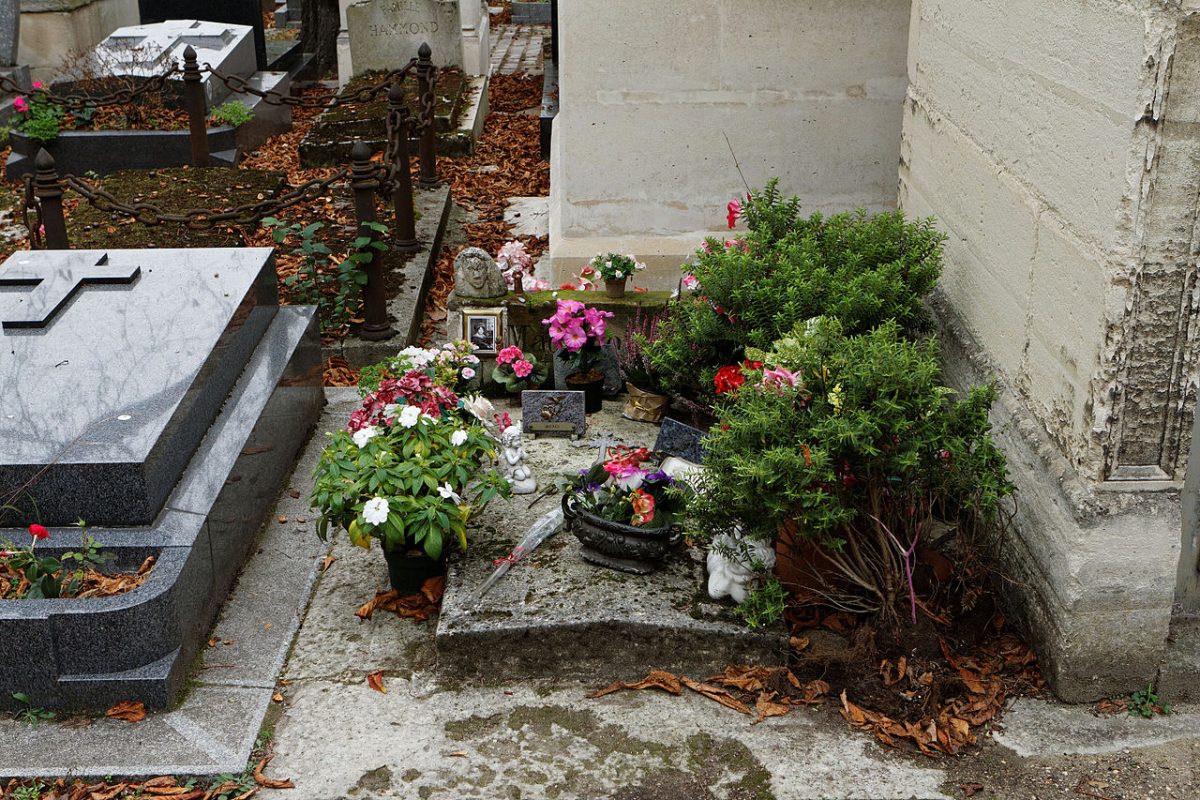
Grave of Lenormand, Père Lachaise Cemetery, Paris, France
Via: Archaeology Art, Mary K Greer
Would you like to support Flashbak?
Please consider making a donation to our site. We don't want to rely on ads to bring you the best of visual culture. You can also support us by signing up to our Mailing List. And you can also follow us on Facebook, Instagram and Twitter. For great art and culture delivered to your door, visit our shop.